Where KAAN Fits Among the World’s Fifth-Generation Fighters

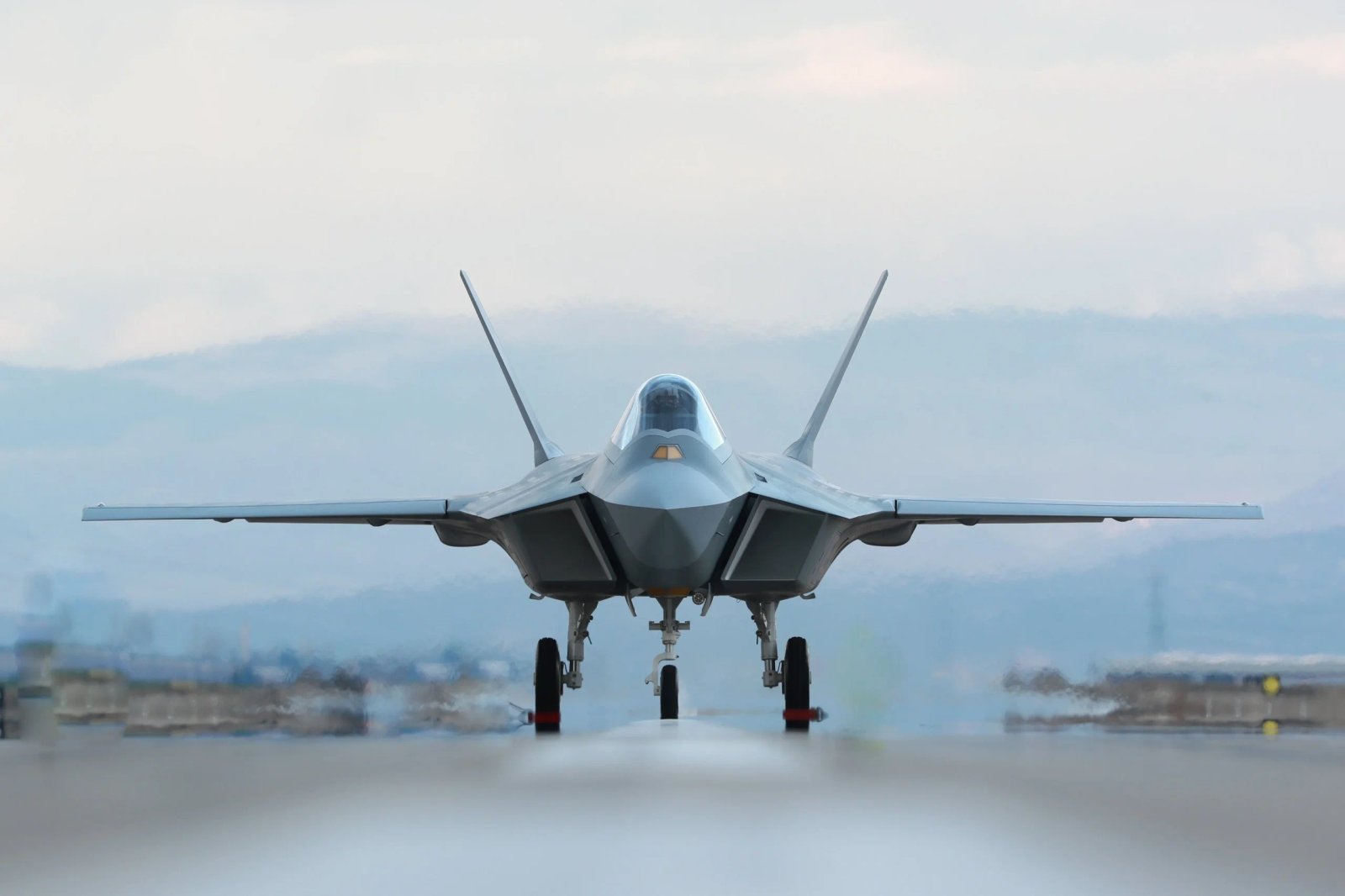
KAAN sits in a very small group. As of October 2026 it is the only fifth-generation fighter programme outside the United States, China and Russia that has flown and has a signed export contract with a named customer and a stated quantity. It is also one of the least mature aircraft in that group: no production-standard prototype has flown yet, no aircraft has been delivered to any air force, and every airframe contracted so far is planned to fly on an American engine. Its real market position is defined less by its design than by a shortage of alternatives — there are very few fifth-generation fighters anyone outside a short list of Washington’s allies can actually buy.
DEFENCETÜRKIYE DATA BOX
| Manufacturer | Turkish Aerospace (TUSAŞ), under SSB contract |
| System | KAAN — twin-engine low-observable multirole fighter |
| Category | Fifth-generation fighter programme, in flight test |
| Programme status | P0 demonstrator flown; P1 production-shape prototype in ground test |
| First flight | 21 February 2024 (P0 demonstrator) |
| Known customers | Türkiye (20, Block 10); Indonesia (48) |
| Export status | One signed export contract; US engine licence required |
| Current milestone | P1 first flight, targeted before end-2026 |
The field, as a buyer sees it in late 2026
English-language coverage of fifth-generation fighters tends to arrive as a ranking — ten aircraft in order of merit, usually built on radar cross-section estimates nobody has published. Envanter Medya runs that format well in Turkish, and its Turkish-language ranking of the world’s ten best fifth-generation fighters is a fair example of the genre. It is not how a procurement office works. An air staff deciding what to replace its F-16s or MiG-29s with in the 2030s does not ask which aircraft is best. It asks which ones exist, which ones will be delivered inside the planning horizon, and which ones it is allowed to buy.
On those three questions the field thins out quickly.
| Programme | Origin | Flown | Delivered to an air force | Named export customer | Open to export buyers |
|---|---|---|---|---|---|
| F-35 | United States | 2006 | Yes — 1,375+ aircraft | 19 allied nations | Only to US-approved partners |
| J-20 | China | 2011 | Yes — PLAAF only | None | Not offered for export |
| Su-57 / Su-57E | Russia | 2010 | Yes — Russian VKS | None named officially | Offered; sanctions exposure |
| J-35 / J-35AE | China | 2021 | Yes — Chinese service | None confirmed | Export variant shown 2026 |
| KAAN | Türkiye | 2024 (demonstrator) | No — first deliveries 2028 | Indonesia — 48 aircraft | Yes, subject to US engine licence |
| KF-21 Boramae | South Korea (Indonesia partner) | 2022 | Yes — first aircraft Sept 2026 | None signed | Yes; not yet a fifth-gen configuration |
| GCAP | UK, Italy, Japan | No | No — in service target 2035 | None | Partner accession discussed |
| FCAS / NGF | France, Germany, Spain | No | No | None | Fighter element cancelled June 2026 |
| AMCA | India | No | No | None | Domestic requirement first |
Read that table as a buyer and the picture is awkward for almost everyone. Nine programmes are routinely described as fifth or sixth generation. Four have delivered aircraft to an operational squadron. One — the F-35 — accounts for essentially the entire installed export base, and access to it is a political decision taken in Washington rather than a commercial one. Türkiye knows that better than most: it was a Joint Strike Fighter partner, built parts for the aircraft, and was removed from the programme in 2019. Its six built airframes are still in storage.
What “fifth generation” does and does not settle
The label is a marketing term before it is an engineering one. There is no certification body that grants it. In practice the industry uses it to mean a combination of low observability, internal weapons carriage, sensor fusion and networked operation — and programmes claim it at very different stages of actually having those things.
The KF-21 is the clearest illustration. South Korea handed its air force the first production aircraft, tail number 25-001, at Yecheon on 22 September 2026, which makes it the newest fighter in operational hands anywhere. But the Block I aircraft carries its weapons externally on recessed hardpoints. Low-observable coatings, internal weapons bays and sensor fusion are deferred to Block III, which is also where the indigenous engine arrives — and the first Block III flight with that engine is targeted around 2040. Korea has a flying, delivered, in-production fighter that is not yet configured as a fifth-generation aircraft. Türkiye has a fifth-generation design that has not yet flown in production shape. Those are opposite risks, and a buyer has to choose which one it would rather carry.
That contrast is the sharpest single comparison in this field, and it runs through the broader competition between Türkiye and South Korea as rising defence exporters, where the same pattern — Korean industrial throughput against Turkish programme ambition — shows up in armour, artillery and shipbuilding too.
Where KAAN actually stands
Three airframes define the programme, and they are not the same aircraft. P0, the demonstrator, flew on 21 February 2024 and again that May. P1 is the first prototype built close to production shape; it began moving under its own power on 31 July 2026. Turkish Aerospace general manager Mehmet Demiroğlu said at TEKNOFEST at the start of October 2026 that P1’s system checks and slow-speed taxi tests were complete and that the aircraft could fly in October or November if nothing slipped, with P2 following before year-end. As this article is published, it has not flown.
That matters for the market position more than any specification. A first flight of a production-representative prototype is the gate that converts a programme from a national ambition into something a foreign air staff can put in a planning document. KAAN has not passed it. The fuller picture of contract dates, block structure and engine milestones sits in our KAAN programme page covering status, orders and the engine timeline.
The order book is the unusual part
Sixty-eight KAAN aircraft are under contract. Twenty are Turkish — the Block 10 batch signed with SSB on 6 May 2026, for delivery between 2028 and 2030. Forty-eight are Indonesian, under a government-to-government agreement of 11 June 2025 and a commercial contract signed at IDEF 2025 in Istanbul on 26 July 2025.
Run the arithmetic and something unusual falls out. Seventy per cent of KAAN’s contracted volume is export, and the export customer signed roughly ten months before the home air force did. Fighter programmes almost never work that way. The normal sequence is a large domestic order that amortises development, followed years later by exports at a lower unit cost. Here, Indonesia committed to more than twice the Turkish launch batch while KAAN was still a demonstrator and a set of drawings.
Two readings of that are defensible, and both are worth holding at once. The optimistic one is that Türkiye has found a buyer willing to co-invest in a programme rather than wait for a finished product, which is how Turkish Aerospace has described the Indonesian arrangement — industrial participation with PT RAD and PTDI rather than a straight airframe sale. The cautious one is that programme volume risk has been pushed onto a customer who has, at various points, publicly attached conditions to it. The scale of the Turkish industrial relationship with Jakarta across drones, armour and shipbuilding is covered in our page on Indonesia’s role in the Turkish defence push across Southeast Asia, and the single Turkish order total is broken down in how many KAAN jets Türkiye has actually signed for.
WHY IT MATTERS
For most of the world’s air forces the fifth-generation market is not competitive — it is closed. Twenty countries fly the F-35 because Washington decided they could. Russia has not publicly named an Su-57E customer. China has shown an export J-35 but no confirmed contract. KAAN is the only programme outside that set offering a fifth-generation aircraft to a named foreign customer at a stated quantity. That is a commercial position created by scarcity rather than by performance, and it is worth exactly as much as Türkiye’s ability to deliver aircraft on time.
The engine decides the market position
Every KAAN contracted so far is planned to fly on the General Electric F110-GE-129, the same engine family that powers Türkiye’s F-16s. That is not a footnote. It means each export sale needs a United States re-export decision, and it means the aircraft Türkiye is selling as an alternative to Western dependence currently runs on a Western engine.
The licence position improved in 2026. A congressional review window on the F110 export expired on 9 July 2026 without a blocking resolution advancing, clearing the path for the engines to power KAAN. Breaking Defense subsequently reported Turkish Aerospace’s chief executive saying the company held the export licence. A licence granted is not a licence that cannot be revisited, and buyers price that distinction.
The Turkish replacement, TEI’s TF35000, entered Critical Design Review in February 2026, and Demiroğlu has said testing will not begin until around 2032 — four years later than the target the company was citing in 2023. We cover what the 2032 engine date actually changed and the wider question of who builds Türkiye’s aircraft engines separately. The short version for a foreign buyer: an aircraft ordered today will arrive with an American engine, and the date at which that stops being true is a target, not a contract.
Korea carries the same problem in a different shape. The KF-21 flies on the F414, and its indigenous KTF16000 is tied to a Block III aircraft whose first flight is targeted around 2040. Neither Ankara nor Seoul has solved fighter propulsion. Both are selling aircraft on the promise that they will.

What KAAN is really competing against
It is tempting to frame KAAN against the F-35. For most of its realistic customers, that comparison never happens, because the F-35 is not on their menu. The genuine competition falls into three groups.
Upgraded fourth-generation aircraft. This is the real competitor and it is rarely named. A country that cannot buy an F-35 and does not want to wait until the 2030s buys more Rafales, more Typhoons, more F-16 Block 70s or more Gripens — aircraft that exist, that are delivered in three to five years, and whose support chains are mature. Türkiye itself is doing exactly this: it is pursuing Eurofighter Typhoons and pressing Washington over stalled F-16 Block 70 deliveries while KAAN matures, and it is upgrading its existing F-16s with domestic mission computers and radars. If the programme’s own sponsor is bridging with fourth-generation aircraft, a foreign buyer will ask why it should not do the same.
Chinese and Russian offers. Both are available in principle and both carry political cost. The Su-57E’s sanctions exposure is the obvious one. Türkiye’s own S-400 purchase is the most-cited precedent for what buying Russian can trigger, and a reader wanting the Russian aircraft’s own story will find a Turkish-language profile of the Su-57 programme in Envanter Medya’s platform database. The Chinese J-35 export variant was shown publicly in 2026 and the South China Morning Post has reported signals of export readiness, but no contract has been confirmed by any government.
Waiting. The most underrated competitor. GCAP targets 2035 and is open to partner accession discussions; the French-led successor to the collapsed FCAS fighter is talking about a demonstrator around 2031. For a European or Gulf state with money and patience, doing nothing for five years is a real option, and it costs nothing today.
BUYER VIEW
- Delivery: no aircraft has been delivered to any customer. Turkish Block 10 deliveries are contracted for 2028–2030; Indonesian deliveries have been discussed for the 2030s.
- Price: neither government has disclosed a contract value. The roughly $10 billion figure attached to the Indonesian deal is reported, not official, and does not yield a flyaway price.
- Export control: the aircraft on offer today needs a US engine licence. Plan for that, not for the 2032 engine.
- Industrial participation: this is where Türkiye competes hardest. The Indonesian agreement names local industrial participants rather than offering a finished airframe, which is a materially different proposition from an F-35 purchase.
- Weapons: the munitions set is Turkish and is the least licence-exposed part of the package.
- Maturity risk: highest in the group. The production-shape prototype has not flown.
Open-source editorial analysis by DefenceTürkiye. Not procurement advice.
What would move KAAN up or down
Three things would change the assessment quickly, and none of them is a specification.
A P1 first flight would convert KAAN from a programme into an aircraft in the eyes of most foreign air staffs — the single highest-value event on the schedule, and one that TUSAŞ has said is weeks away more than once. A second export customer would show that Indonesia was a market signal rather than a bilateral arrangement; Saudi Arabia has been reported as interested at a scale of up to 100 aircraft, but nothing has been signed and reported interest is not a contract. And a visible slip in the 2028–2030 Turkish delivery window would damage the programme more than any engine date, because delivery credibility is what the whole offer rests on.
Pulling in the other direction: the F110 licence could be revisited, the TF35000 could slip again, and Indonesia’s stated preference for a configuration free of American components remains unresolved. We treat the licensing mechanics in detail in our explainer on whether Turkish weapons are ITAR-free.
For readers coming to this from the trainer side of the same manufacturer, the comparable market analysis is where HÜRJET fits in the advanced jet trainer market — a programme in a far more crowded field, with the opposite problem.
FAQ
Is KAAN a real fifth-generation fighter?
It is designed as one — low observability, internal weapons carriage, sensor fusion and provision for controlling uncrewed aircraft are all stated design intent. Whether it performs as one cannot be assessed from open sources, because no production-standard aircraft has flown and no government has published radar cross-section or sensor performance data. Anyone quoting those numbers is estimating. The honest answer is that KAAN is a fifth-generation programme whose fifth-generation performance is unverified.
Which fifth-generation fighters can a country actually buy in 2026?
Very few. The F-35 is available only to nations the United States approves, currently 19 besides the US itself. Russia offers the Su-57E but has never publicly named a customer. China has shown an export J-35 without a confirmed contract. KAAN has one signed export contract, with Indonesia, for 48 aircraft. For most air forces the practical answer in 2026 is still an upgraded fourth-generation aircraft.
How does KAAN compare with South Korea’s KF-21?
They are at opposite stages. The KF-21 has been delivered to its air force and is in production, but its current Block I configuration carries weapons externally and lacks the low-observable features that define the fifth generation; those arrive with Block III, whose indigenous engine is targeted around 2040. KAAN is designed from the start as a low-observable aircraft with internal carriage but has not yet flown in production shape. Korea leads on delivery; Türkiye leads on configuration.
Has KAAN flown?
The P0 demonstrator flew on 21 February 2024 and again in May 2024. The P1 prototype, which is close to production shape, had completed system checks and slow-speed taxi tests by early October 2026, with Turkish Aerospace targeting a first flight before the end of the year. P1 had not flown when this article was published.
Who has ordered the KAAN?
Two customers, 68 aircraft in total. Türkiye signed for 20 Block 10 aircraft on 6 May 2026, for delivery between 2028 and 2030. Indonesia signed a government-to-government agreement for 48 aircraft on 11 June 2025 and the commercial contract on 26 July 2025. Saudi Arabia, Azerbaijan, Pakistan and others have been reported as interested; none has an announced contract.
Does KAAN need American permission to be exported?
For now, yes in practical terms. Every contracted aircraft is planned to fly on the GE F110 engine, so sales depend on a US export licence. A congressional review window closed without objection in July 2026 and Turkish Aerospace says it holds the licence. The dependency ends only when the Turkish TF35000 enters service, and that engine is not expected to begin testing until around 2032.
Why did Indonesia order more KAANs than Türkiye has?
Türkiye’s 20-aircraft contract is a first low-rate production batch rather than its full requirement — Turkish Aerospace has said it expects the number to grow, and has spoken publicly of an eventual requirement in the 250 to 300 range. Indonesia’s 48 aircraft therefore represent a larger single commitment than Türkiye’s launch order, but not a larger eventual fleet.
Sources
Primary and official: Lockheed Martin’s F-35 global enterprise page for participating nations and delivered aircraft; Edgewing on the GCAP joint venture’s ownership and role; Presidency of Defence Industries (SSB) statements on the Indonesian agreement and the Block 10 contract; Turkish Aerospace executive statements by Mehmet Demiroğlu at TEKNOFEST and the Farnborough International Airshow; TEI programme statements on the TF35000.
Secondary: Hürriyet Daily News on Demiroğlu’s October 2026 remarks on the P1 first flight; The Aviationist on the first production KF-21 delivery and the Block I to Block III roadmap; The Aviationist on the unconfirmed status of the Su-57E’s first export customer; Aerospace Testing International on the £4.6 billion GCAP detailed-design contract; Aerospace Global News on Germany ending its participation in the FCAS fighter; Quwa on the F110 congressional review. Breaking Defense reported Turkish Aerospace’s statement that it holds the F110 export licence, and the South China Morning Post reported signals of Chinese readiness to export the J-35A; neither is linked here because both block automated access.
Related DefenceTürkiye coverage: for the wider question behind the engine problem, see how independent Turkish defence production really is.