Türkiye–Pakistan Defence Cooperation: What Was Transferred


Türkiye and Pakistan run the deepest technology-transfer relationship in the Turkish defence industry’s export record. Since a 2018 warship contract, the two countries have built four corvettes together — two in Istanbul, two in Karachi — with design rights and construction know-how handed to the Pakistani yard. They have since jointly designed a larger frigate that Pakistan will build itself. Pakistan sells complete aircraft back to Türkiye. And the same relationship produced Türkiye’s most public export failure, when Washington withheld an engine licence and a 30-helicopter deal collapsed. For any government weighing a Turkish offer, Pakistan is the longest evidence base available.
DEFENCETÜRKIYE DATA BOX
Relationship: Türkiye–Pakistan defence-industrial cooperation, two-way
Lead Turkish contractors: ASFAT (naval prime), STM (submarines), Baykar (UAVs), HAVELSAN, ASELSAN, Meteksan (subsystems)
Flagship programme: Babur-class corvette, four ships, contracted July 2018
Programme status: two ships commissioned (PNS Babur 2023, PNS Khaibar April 2026); two building at Karachi Shipyard
Next step: Jinnah-class frigate (AS3400), jointly designed, first ship contracted November 2025
Reverse flow: 52 PAC Super Mushshak trainers delivered to the Turkish Air Force, completed end-2025
Framework: Mecca Joint Defence Agreement with Saudi Arabia, signed 7 August 2026
Known failure: T129 ATAK helicopter order, cancelled January 2022 over a US engine export licence
Why Pakistan is the case international buyers should actually read
Most of Türkiye’s export customers are two to five years into their first contract. That is long enough to know whether a vehicle arrives on time, and not long enough to know whether anything was really transferred. Pakistan is different. The relationship has been running long enough to complete a full cycle, and the cycle has three rungs that can be checked against dated events rather than brochures.
Rung one: buy the ship. Rung two: build the ship at home. Rung three: design the next one together. Pakistan has now been through all three, and the record includes a failure as well as the successes — which is the part a procurement office should read first.
Rung one: the Babur class, bought and part-built
Pakistan’s Ministry of Defence Production signed with ASFAT, the Turkish state-owned military factory and shipyard corporation, in July 2018. Four corvettes, derived from the Turkish Navy’s Ada class. Two would be built at Istanbul Naval Shipyard, two at Karachi Shipyard & Engineering Works (KSEW). Critically, the contract carried transfer of design rights and construction know-how, not merely a licence to assemble.
The Turkish Secretariat of Defence Industries has never published the contract value. Figures around US$1.5 billion circulate widely in trade reporting; treat them as unofficial estimates, because neither government has confirmed a number.
What Pakistan received is not a copy of the Turkish ship. ASFAT’s programme account, as reported by EDR Magazine, gives the Babur class 108.2 m in length and roughly 2,985 tonnes full load, against about 99 m and 2,300 tonnes for the Turkish Navy’s Ada class — a stretched hull with vertical launch cells the Turkish original does not carry. That is a customised design, which is the substantive claim Türkiye makes about its naval export model and one that can be verified from the dimensions alone.
Who actually supplies a Babur-class corvette
This is the table that explains why Pakistan bought, and it is more revealing than any specification sheet. Türkiye sold the design, the hull and the electronic nervous system. It did not sell the weapons.
| Element | Supplier | Origin |
|---|---|---|
| Design authority and prime contract | ASFAT | Türkiye |
| Build, F-280 and F-282 | Istanbul Naval Shipyard | Türkiye |
| Build, F-281 and F-283 | Karachi Shipyard & Engineering Works | Pakistan |
| Combat management system | HAVELSAN ADVENT | Türkiye |
| 3D surveillance radar | ASELSAN SMART-S Mk2 | Türkiye (Thales-origin design) |
| Hull-mounted sonar | Meteksan YAKAMOS | Türkiye |
| 35 mm close-in weapon system | ASELSAN GÖKDENİZ | Türkiye |
| 76 mm main gun | Leonardo Super Rapido | Italy |
| Surface-to-air missile | MBDA Albatros NG (CAMM-ER family) | Europe |
| Anti-ship missile | Pakistani selection — reported as Harbah and/or P-282; no official fit published | Pakistan / China |
| Gas turbine | General Electric LM2500 | United States |
| Diesel engines | MTU 16V 595 TE90 | Germany |
Compiled by DefenceTürkiye from ASFAT programme reporting, manufacturer product data and Pakistan Navy commissioning material. The anti-ship fit is the one line no official source has settled.
Read down the Origin column and the export proposition becomes legible. Pakistan kept its own strike weapon and its own weapons-industrial autonomy; Türkiye supplied everything that makes a hull into a warship. That is a narrower sale than “buy our system”, and it is precisely why it was politically possible for Islamabad to sign it.
It also shows the limit. The propulsion line is American and German. A Turkish warship export is not an ITAR-free object, and the same logic that governs US export rules over Turkish defence sales applies to hulls as much as to aircraft.
WHY IT MATTERS
Emerging exporters are usually judged on whether their equipment works. The harder question is whether their technology-transfer promises are real, because that is what a buyer is actually paying a premium for. Pakistan is the only Turkish customer where enough time has passed to answer it with dated events: a yard that had never built a modern corvette has launched two, and the same yard now holds a contract for a ship it helped design. That is the strongest single data point in Türkiye’s export pitch — and the Karachi schedule is the strongest argument against taking it uncritically.
Rung two: what building it at home actually cost in time
PNS Babur (F-280) was laid down in Istanbul in June 2020, launched in August 2021 and commissioned in September 2023 — roughly two years from launch to service. PNS Khaibar (F-282), also Istanbul-built, was launched in November 2022 and inducted at Karachi on 4 April 2026.
The Karachi-built ships tell a different story. PNS Badr (F-281) was launched in May 2022 — six months before its Istanbul-built sister Khaibar — and has completed sea acceptance trials, with delivery expected during 2026. On current dates that is close to four years from launch to delivery, against roughly two for the lead ship built in Türkiye. PNS Tariq (F-283), launched at Karachi in August 2023, follows.
This is the transfer premium, and no brochure states it. Building the ship yourself costs time on the first hulls — here, on the order of double the lead ship’s fitting-out period. Whether that is a bad trade depends entirely on whether the yard keeps the capability afterwards. In Pakistan’s case, the Jinnah contract suggests it did.
Rung three: designing the next ship together
In November 2025 the Pakistan Navy contracted KSEW for the first Jinnah-class frigate, designated AS3400. Reported figures put it at about 3,300 tonnes and 119.45 m with CODAG propulsion — a genuine step up from the Babur class.
The significant detail is not the tonnage. It is the design authority: the ship was jointly designed by the Pakistan Navy’s Platform Design Wing and ASFAT’s design office, with intellectual property shared between them. Industry reporting indicates the Navy intends five ships with construction split roughly evenly between Pakistani and Turkish yards, and the lead ship joining the fleet in the 2027–2028 window; neither the number nor the split has been confirmed officially, so both should be read as reporting rather than contract terms.
For context on the Turkish side of that design capability, see our guide to who builds Türkiye’s warships and the MILGEM İ-class frigate programme that the export designs descend from.
The traffic runs both ways
Pakistan is the only Turkish defence partner that also sells Türkiye complete aircraft. Under a deal negotiated from late 2016 and contracted at IDEF 2017, Pakistan Aeronautical Complex supplied 52 MFI-395 Super Mushshak basic trainers to the Turkish Air Force, replacing the Cessna T-41D and SIAI-Marchetti SF.260D. The programme ran late — the first three aircraft reached Yalova only in October 2022, delayed by the pandemic — but deliveries were completed by the end of 2025.

It is a small contract by value and a large one by meaning. Every other Turkish export relationship is a one-way flow of hardware. This one is not, which changes the political character of the partnership and gives Ankara a reason to keep transferring.
Submarines: Türkiye’s first modernisation export
In June 2016, Pakistan’s Ministry of Defence Production contracted STM to modernise the Pakistan Navy’s three Agosta 90B (Khalid-class) submarines, in a programme reported at around US$350 million. The scope was not cosmetic: fire control, sonar suite, electronic warfare, radar, navigation and attack periscopes, underwater command and control, steering station and rescue buoy. STM delivered PNS/M Hamza in April 2021 and PNS/M Khalid subsequently.
This was Türkiye’s first submarine modernisation export, and it matters to the question of what Türkiye can actually do underwater — a question we examine in detail in whether Türkiye builds its own submarines. Modernising a French-designed boat is not the same as designing one, and the Pakistani work sits firmly on the integration side of that line.
The deal that failed — and why buyers should study it hardest
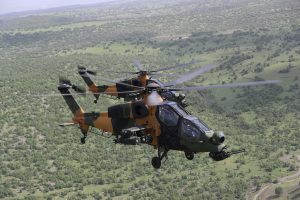
In 2018 Pakistan agreed to buy 30 T129 ATAK attack helicopters from Turkish Aerospace in a deal reported at about US$1.5 billion. It was, at the time, the largest single Turkish defence export ever signed.
It never happened. The T129 is a licensed derivative of the AgustaWestland A129 and flies on the LHTEC CTS800-4A engine, built by a joint venture of the American firm Honeywell and Britain’s Rolls-Royce. A US export licence was required and was not granted. Pakistan extended the delivery deadline in January 2020 and again in March 2021. In May 2021 Washington approved an export licence covering Turkish T129 sales to the Philippines — six aircraft — while the Pakistani order stayed blocked. On 5 January 2022 a Pakistan Army spokesman announced the requirement would be met with the Chinese Z-10ME instead.
Three lessons sit in that sequence, and all three are transferable to any prospective customer:
- The blocking component is rarely the headline system. It was a 1,300-shp turboshaft, not the airframe, the mission system or the weapons.
- The veto is political, not technical. The same engine, in the same helicopter, from the same manufacturer, was licensed for a different buyer within months.
- Turkish localisation since 2018 has been aimed squarely at this problem. The indigenous TEI TS1400 engine programme exists because of episodes like this one — but a buyer signing today should ask which subsystems remain under foreign licence, and get the answer in writing.
That question — who can stop a Turkish sale, and at which component — is the single most useful thing a procurement office can take from the Pakistan file. Our broader treatment is in how countries buy Turkish weapons.
Air: what is confirmed, and what is not
Pakistan is an operator of the Bayraktar AKINCI, alongside Türkiye and Kyrgyzstan, and Turkish UAVs have appeared in Pakistan Air Force public displays. Beyond the fact of operation, published detail is thin: neither Baykar nor the Pakistan Air Force has released fleet numbers, contract values or delivery schedules, and figures circulating in secondary reporting are estimates.
A caution is warranted here. During the India–Pakistan exchanges of May 2025, both governments made competing claims about drone losses, including claims involving Turkish-built types. None has been substantiated by an official Turkish or Pakistani account, and independent verification is absent. DefenceTürkiye does not treat those claims as established fact in either direction, and readers assessing Turkish UAV combat performance should not either. For the manufacturer background, see our Baykar company profile.
The Mecca pact: framework, not contracts
On 7 August 2026, President Recep Tayyip Erdoğan, Saudi Crown Prince Mohammed bin Salman and Pakistani Prime Minister Shehbaz Sharif signed the Mecca Joint Defence Agreement. Its core clause treats an armed attack on one signatory as an attack on all; Foreign Minister Hakan Fidan described the commitment as technically equivalent to NATO’s Article 5. The agreement explicitly covers defence-industrial cooperation and joint projects, and the three states have since stood up a secretariat in Istanbul.
The industrial reading should be sober. A framework agreement does not place orders. As of late September 2026, no production contract has been announced under the pact. What it does create is a standing structure in which three complementary positions can be combined — Turkish design authority and systems integration, Pakistani build capacity and labour cost, Saudi finance — without each project needing its own political scaffolding. Whether anything is built inside that structure is the thing to watch over the next two years, not the signing photographs.
Timeline: Türkiye–Pakistan defence industry, 2016–2028
BUYER VIEW
Delivery: Turkish-built hulls ran roughly two years from launch to service. The first locally built hull is running close to four. Budget for the difference on your own first ships.
Cost data: poor. Neither government publishes contract values for the corvettes, the drones or the trainers. Plan to benchmark independently.
Technology transfer: the strongest evidence in the Turkish export portfolio. Design rights, construction know-how, and then shared IP on a follow-on design — verified by a signed contract for a ship the customer helped draw.
Weapons integration: Türkiye integrated Pakistani, Chinese and European weapons onto a Turkish design. If keeping your own missile stock matters, that precedent exists.
Export limitations: real. Propulsion is American and German; the T129 failure was caused by an Anglo-American engine. Ask for a subsystem-by-subsystem foreign-licence disclosure before signing.
Support: untested at scale outside the naval programmes. Pakistan’s in-country build gives it a maintenance base most customers will not have.
Open-source editorial analysis by DefenceTürkiye. It is not procurement advice and DefenceTürkiye does not advise governments.
What to watch next
Three dates will tell you more than any announcement. First, the delivery of PNS Badr and then PNS Tariq — whether the Karachi yard closes the gap on the second locally built hull is the real test of whether the transfer stuck. Second, the Jinnah-class lead ship against its 2027–2028 target, which is the first time a Pakistani-co-designed warship meets a schedule. Third, Pakistan’s next submarine decision: no Turkish submarine sale has been announced, and Türkiye’s own MİLDEN design remains unlaunched, so any Turkish bid would be offering a paper boat against Chinese hulls already delivering.
Elsewhere in the portfolio, the same transfer model is now being sold to other customers — see where Türkiye builds defence factories abroad and what a buyer actually gets from Turkish offsets. Pakistan is where the model was proved, and where its cost was paid.
Readers working in Turkish will find a full chronological account in Envanter Medya’s Turkish-language chronology of Türkiye–Pakistan joint defence projects, and a system-by-system status list in its inventory of the Turkish weapons currently in Pakistani service.
FAQ
How many warships has Türkiye built for Pakistan?
Four Babur-class corvettes were contracted in July 2018. Two were built at Istanbul Naval Shipyard — PNS Babur, commissioned September 2023, and PNS Khaibar, inducted 4 April 2026. Two are being built at Karachi Shipyard & Engineering Works: PNS Badr, which has completed sea acceptance trials, and PNS Tariq.
Did Türkiye really transfer warship technology to Pakistan, or just assemble kits locally?
The 2018 contract included transfer of design rights and construction know-how. The strongest evidence that it was real is the follow-on: the Jinnah-class frigate was jointly designed by the Pakistan Navy’s Platform Design Wing and ASFAT with shared intellectual property, and contracted to a Pakistani yard in November 2025. A kit-assembly arrangement would not produce a joint design authority.
Why did Pakistan cancel the T129 ATAK helicopter order?
The T129 uses the LHTEC CTS800-4A engine, a Honeywell–Rolls-Royce joint venture product requiring a US export licence. That licence was not granted for the Pakistani order, despite one being approved for Turkish T129 sales to the Philippines. After two deadline extensions, Pakistan announced in January 2022 that it would buy the Chinese Z-10ME instead.
Does Pakistan sell anything to Türkiye?
Yes. Pakistan Aeronautical Complex delivered 52 MFI-395 Super Mushshak basic trainers to the Turkish Air Force under a 2017 contract, completing deliveries at the end of 2025. They replaced the Turkish Air Force’s Cessna T-41D and SF.260D fleets. Pakistan is the only Turkish defence partner supplying complete aircraft in the opposite direction.
Are Pakistan’s Turkish-built corvettes armed with Turkish missiles?
No. The surface-to-air missile is the European MBDA Albatros NG, from the CAMM-ER family; the 76 mm gun is Italian; the anti-ship missile was selected by Pakistan and has been reported variously as the indigenous Harbah and the P-282, with no official fit published. Turkish content is concentrated in the design, the combat management system, the radar, the sonar and the 35 mm close-in weapon system.
What does the Mecca Joint Defence Agreement mean for Turkish defence exports?
So far, a framework rather than orders. Signed on 7 August 2026 by Türkiye, Saudi Arabia and Pakistan, it includes a mutual-defence clause and commits the three to defence-industrial cooperation, with a secretariat in Istanbul. No production contract has been announced under it as of late September 2026.
Sources
- ASFAT — Turkish state-owned prime contractor for the Babur and Jinnah programmes
- Karachi Shipyard & Engineering Works — Pakistani builder of F-281 and F-283 and of the Jinnah-class lead ship
- Presidency of Defence Industries (SSB) — Turkish export approval authority
- Naval News — PNS Khaibar induction, 4 April 2026, and 2018 contract terms
- EDR Magazine — Babur-class programme detail, dimensions, systems fit
- Quwa — Jinnah-class AS3400 contract and design arrangement
- Janes — Pakistan’s cancellation of the T129 order
- Defense News — US licence approved for the Philippines while the Pakistani order stayed blocked
- Shephard Media — Super Mushshak deliveries to the Turkish Air Force
- Defence Turkey — STM’s Agosta 90B modernisation deliveries
- Al Jazeera — terms of the Mecca Joint Defence Agreement, 7 August 2026