
KAAN’s Indigenous Engine Delayed to 2032, TAI Confirms

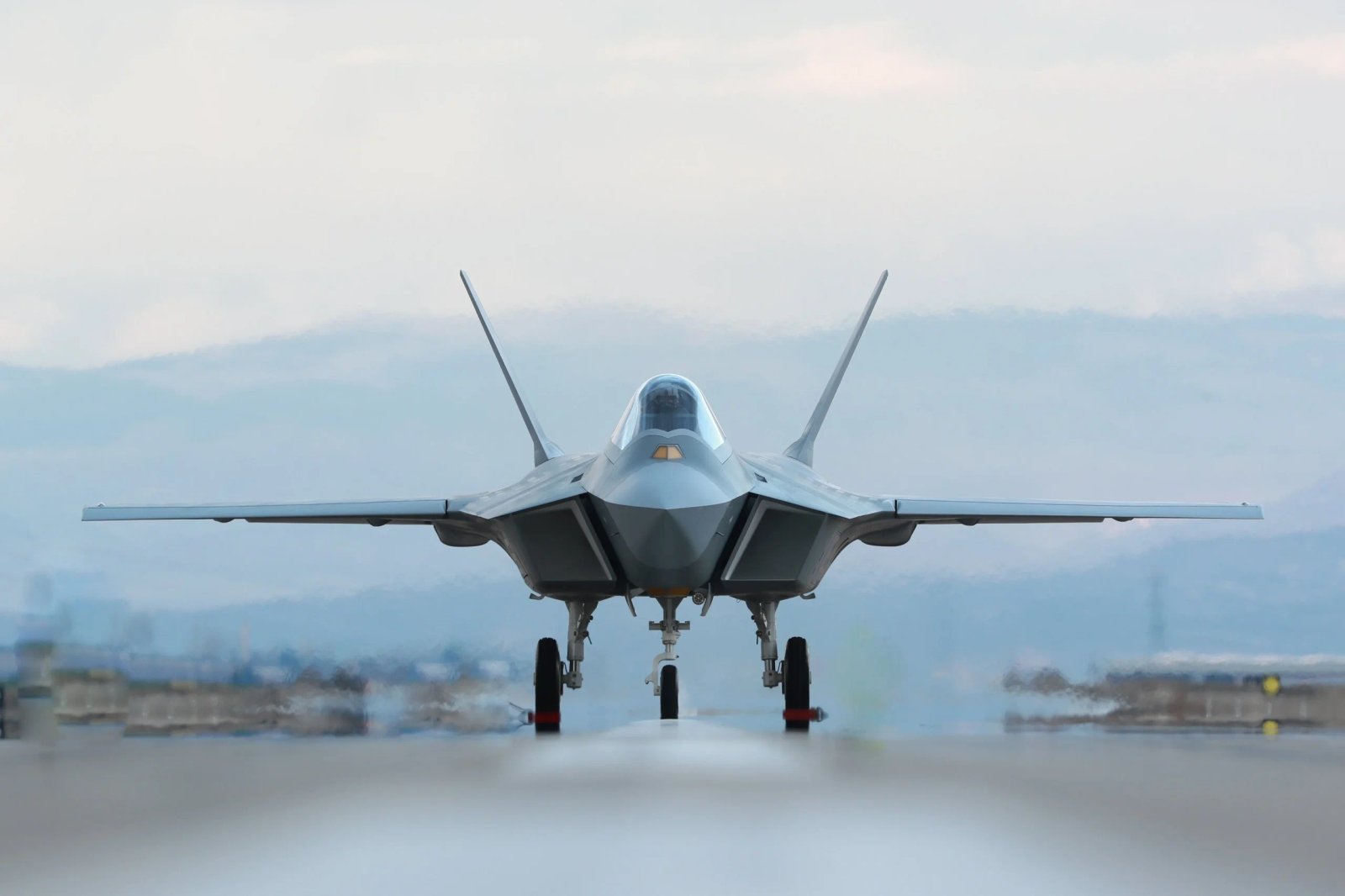
Turkish Aerospace Industries (TUSAS/TAI) General Manager Mehmet Demiroglu confirmed late last month that testing of KAAN’s indigenously developed engine will not begin until “around 2032” — four years later than the 2028 target the company had been citing as recently as 2023. Speaking to Anadolu Agency during the TEKNOFEST Mavi Vatan event, Demiroglu said the engine, once it enters service, will end the aircraft’s last major dependency on foreign suppliers. Until then, KAAN will fly on American power.
It is not the only major Turkish program leaning on an imported engine or powerpack for its early production run. The Altay main battle tank, which entered serial production in October 2025 after years of delay, is shipping its first roughly 85 units with a South Korean-made engine and transmission rather than the Turkish system originally planned for the tank. Together, the two cases say something useful about where Turkiye’s indigenization drive actually stands: further along in airframes, radars, munitions and hulls than in the high-temperature, high-precision business of engines and powertrains.
KAAN’s TF35000: what’s actually delayed
The engine in question is the TF35000, a roughly 35,000-pound-force-class (about 156 kN with afterburner) turbofan under development by TUSAS Engine Industries (TEI) — a meaningful step up from the General Electric F110-GE-129 currently powering KAAN prototypes, rated in the 129-131 kN range. TEI confirmed in February 2026 that the TF35000 program had only just entered Critical Design Review, the stage that precedes manufacture and full validation of test engines. Demiroglu’s “around 2032” timeline for the start of testing lines up with that CDR entry; a target for the engine to be qualified and available for production aircraft, if reporting on the program is accurate, would follow roughly a year after that, in 2033.
In the meantime, KAAN’s first production batch — the Block 10 aircraft due for delivery between 2028 and 2030 — will fly exclusively on the F110-GE-129. The U.S. State Department approved the sale of roughly 80 of those engines in June 2026, which covers Turkiye’s own Block 10/Block 20 aircraft as well as the 48-jet order placed by Indonesia, KAAN’s first export customer. Demiroglu has said nearly every other system on the KAAN prototypes — apart from the engine and the ejection seat — is already domestically sourced, which is why the company frames the TF35000 as the last item on the localization list rather than a surprise gap.
Altay’s engine story: a German embargo forced a Korean stopgap
The Altay tank’s engine saga started earlier and for a different reason. Ankara originally selected a German-sourced engine and transmission package for the tank, but German export licensing restrictions blocked delivery, forcing manufacturer BMC to find an alternative to avoid stalling serial production altogether. The fix was a South Korean powerpack — a Doosan DV27K V12 diesel rated at 1,500 hp paired with an SNT Dynamics EST15K automatic transmission — fitted to the first production tanks that began reaching Turkish army units after October 2025.
BMC Power’s indigenous alternative, the Batu powerpack, is a separate V12 diesel of similar output that has been in development for years alongside the tank itself. It completed factory acceptance testing in early 2026 and is expected to be integrated starting with the tank’s T2 production variant, with a transition targeted from 2028 — meaning the Altay, like KAAN, will run on foreign propulsion for its first several years in service before switching to a fully domestic powertrain.
Why this is worth taking seriously, not spinning away
None of this undercuts what Turkiye’s defense industry has actually delivered: a fifth-generation-class fighter that has flown, an indigenous tank in troop hands, and export contracts for both. But engines are the hardest, slowest-maturing part of any aerospace or armor program anywhere in the world — the United States, China and Russia have all had multi-year, sometimes multi-decade, struggles bringing new jet and tank engines from design to qualified production, and Turkiye’s timeline slippage here is consistent with that broader pattern rather than an outlier specific to Ankara. TEI’s own experience developing turboshaft and now turbofan engines is comparatively young next to firms like General Electric, Pratt & Whitney or Safran.
The practical consequence for now is a continued reliance on U.S. and South Korean suppliers for KAAN and Altay’s early production runs, which is a genuine dependency Turkish officials themselves acknowledge rather than deny — Demiroglu’s own framing was that the domestic engine would end that dependency, implying it has not ended yet. For KAAN’s export customers, including Indonesia, that means aircraft delivered this decade will fly on GE engines regardless of what happens with the TF35000 afterward. For Altay, it means the tanks reaching Turkish units today are not yet the fully indigenous vehicle the program was designed to produce, even though the tank itself, its armor, its fire-control systems and its Turkish-made ammunition are.
Sources: Anadolu Agency (Demiroglu remarks at TEKNOFEST Mavi Vatan), TUSAS Engine Industries program statements, Meta-Defense, Defense News, Janes.
Related reading on DefenseTurkiye:
- KAAN Fighter Programme: status, orders and the full engine timeline
- KAAN National Combat Aircraft Enters the Procurement Phase
- Altay Production to Triple as Order Expectations Rise
- New Digital Capabilities Enter Service at the KAAN Technology Facility
- Who Builds Türkiye’s Aircraft Engines? TEI, Kale and the TF35000 schedule in context


[…] of Türkiye rejoining, no agreement has been finalized. Meanwhile, Turkish Aerospace’s own KAAN fifth-generation fighter remains years from serial deliveries, and the programme’s indigenous TF35000 engine is not […]
[…] types. Air forces buying trainers today are buying for F-35, GCAP and, in Türkiye’s case, the KAAN fighter programme. Second, the incumbent Western supplier base is either committed elsewhere or behind […]
[…] The officially sanctioned KAAN engine is the TEI-TF35000, developed by TEI with TRMOTOR under SSB oversight and targeting about 35,000 lbf with afterburner. TEI confirmed in February 2026 that the programme had entered Critical Design Review — the gate before test-engine manufacture and validation. Turkish Aerospace general manager Mehmet Demiroğlu subsequently said testing would not begin until around 2032, four years later than the 2028 date the company had used as recently as 2023. We covered that admission when it was made, in our report on KAAN’s indigenous engine slipping to 2032. […]
[…] Aerospace general manager Mehmet Demiroğlu told Anadolu Agency at TEKNOFEST Mavi Vatan that testing of the indigenous engine will not begin until “around 2032” — four years later than the 2028 target the company cited as recently as 2023. TEI confirmed in […]