
ROKETSAN: Türkiye’s Missile Maker and Its Export Limits

ROKETSAN is Türkiye’s missile house — a state-controlled company founded in 1988 that builds almost everything Turkish forces fire, from 8 km laser-guided rockets to ballistic missiles, and that earned $2.37 billion in defence revenue in 2025, enough for 64th place on the Defense News Top 100. But the company that international buyers meet is narrower than the company Turkish forces buy from. ROKETSAN’s public export catalogue stops at 280 km. Its longest-ranged weapons — TAYFUN and GEZGİN — are not in it at all. That gap is not an accident of marketing; it is where the Missile Technology Control Regime draws its line, and Türkiye has been inside that regime since 1997.
DEFENCETÜRKIYE DATA BOX
| Company | ROKETSAN Roket Sanayii ve Ticaret A.Ş. |
| Founded | 14 June 1988, by decision of the Defence Industry Executive Committee |
| Ownership | An establishment of the Turkish Armed Forces Foundation (TSKGV); unlisted, all shareholders state-linked |
| Chief executive | Murat İkinci, General Manager |
| Business areas | Land systems, air defence, naval systems, precision-guided systems, space systems, ballistic protection, subsystems |
| 2025 defence revenue | $2.37bn (Defense News Top 100, 2026 edition) — 64th worldwide, up seven places |
| 2025 exports | Approximately $570m, roughly a quarter of revenue |
| Export footprint | Around 50 countries, per General Manager Murat İkinci (April 2026) |
| Current milestone | $3bn capacity programme; Kırıkkale fuel and warhead plants and Lalahan missile integration facility opened April 2026 |
| Public financials | None. ROKETSAN is not listed and publishes no audited annual accounts |
Who owns ROKETSAN, and why that matters to a buyer
ROKETSAN describes itself, in its own words, as “an establishment of Turkish Armed Forces Foundation” — the TSKGV, the holding structure that also stands behind ASELSAN, HAVELSAN and, historically, Turkish Aerospace. The company does not publish a shareholder table in English. The split reported consistently by Turkish trade and company-register sources puts TSKGV at roughly 55 per cent, with ASELSAN and MKE at about 15 per cent each, VakıfBank near 10 per cent and HAVELSAN around 4.5 per cent. Treat those percentages as reported rather than filed.
The percentages matter less than the pattern: every shareholder is a state body, a state-linked foundation company or a state bank. There is no private equity in ROKETSAN, no listed float and no quarterly disclosure. That is a genuine difference from the two Turkish companies foreign buyers most often compare it with. ASELSAN is listed on Borsa İstanbul and publishes audited financial statements; Baykar is a private family firm that publishes export and revenue figures when it chooses. ROKETSAN does neither.
For a procurement analyst the practical consequences are specific. Every figure in this article that is not a published specification comes from an executive statement, a state news agency or the Defense News ranking — there is no audited source to check it against. And because the controlling shareholder is the Turkish state’s own defence foundation, a ROKETSAN export is closer to a government-to-government transaction than a commercial one. That cuts both ways: political backing when Ankara wants a deal, political exposure when it does not.
What ROKETSAN actually builds
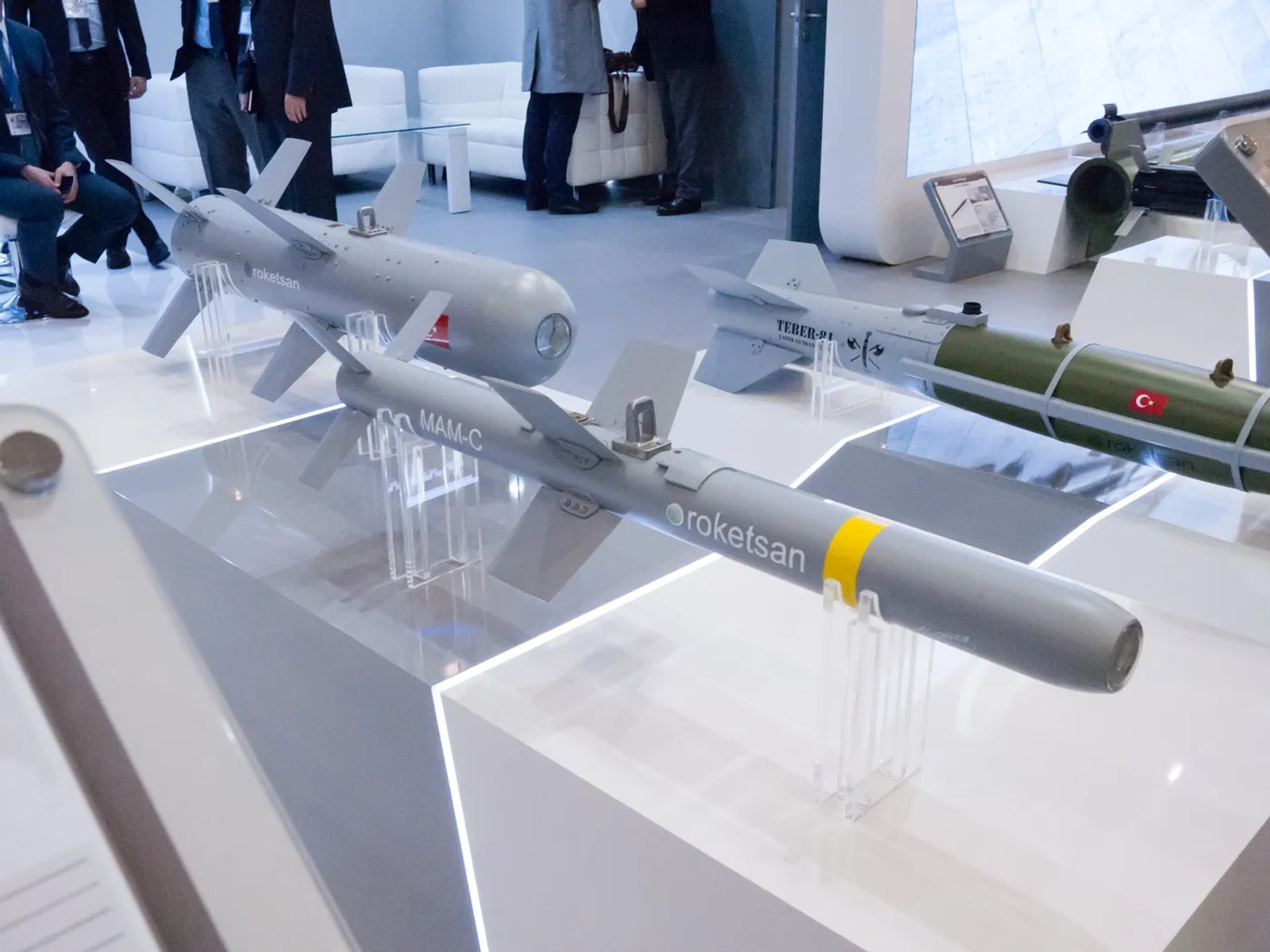
ROKETSAN organises its public catalogue into six areas, and the breadth is the point. In land systems it builds the 122 mm and 230 mm guided artillery rocket families — TRG-122, TRLG-122, TRG-230, TRLG-230 — plus the TRG-300, which its own datasheet puts at 20–90 km with a 180 kg warhead in Block-II and 30–120 km with a 105 kg warhead in Block-III. In precision-guided systems it builds the CİRİT laser-guided missile at up to 8 km, the UMTAS, L-UMTAS, OMTAS and KARAOK anti-tank families, the MAM-C, MAM-L and MAM-T micro-munitions that arm Turkish drones, and the TEBER, LAÇİN and ELÇİN guidance kits that convert general-purpose bombs.
In naval systems it builds the ATMACA anti-ship missile — 250 km range, 220 kg warhead on ROKETSAN’s own figures — the AKYA heavyweight torpedo and the ORKA lightweight torpedo. In air defence it builds the SUNGUR very-short-range missile and the HİSAR family, and it is the missile partner in SİPER, the long-range interceptor developed with ASELSAN and TÜBİTAK SAGE that forms the top layer of Çelik Kubbe, Türkiye’s Steel Dome. ASELSAN supplies the sensors and much of the electronics; ROKETSAN supplies the round.
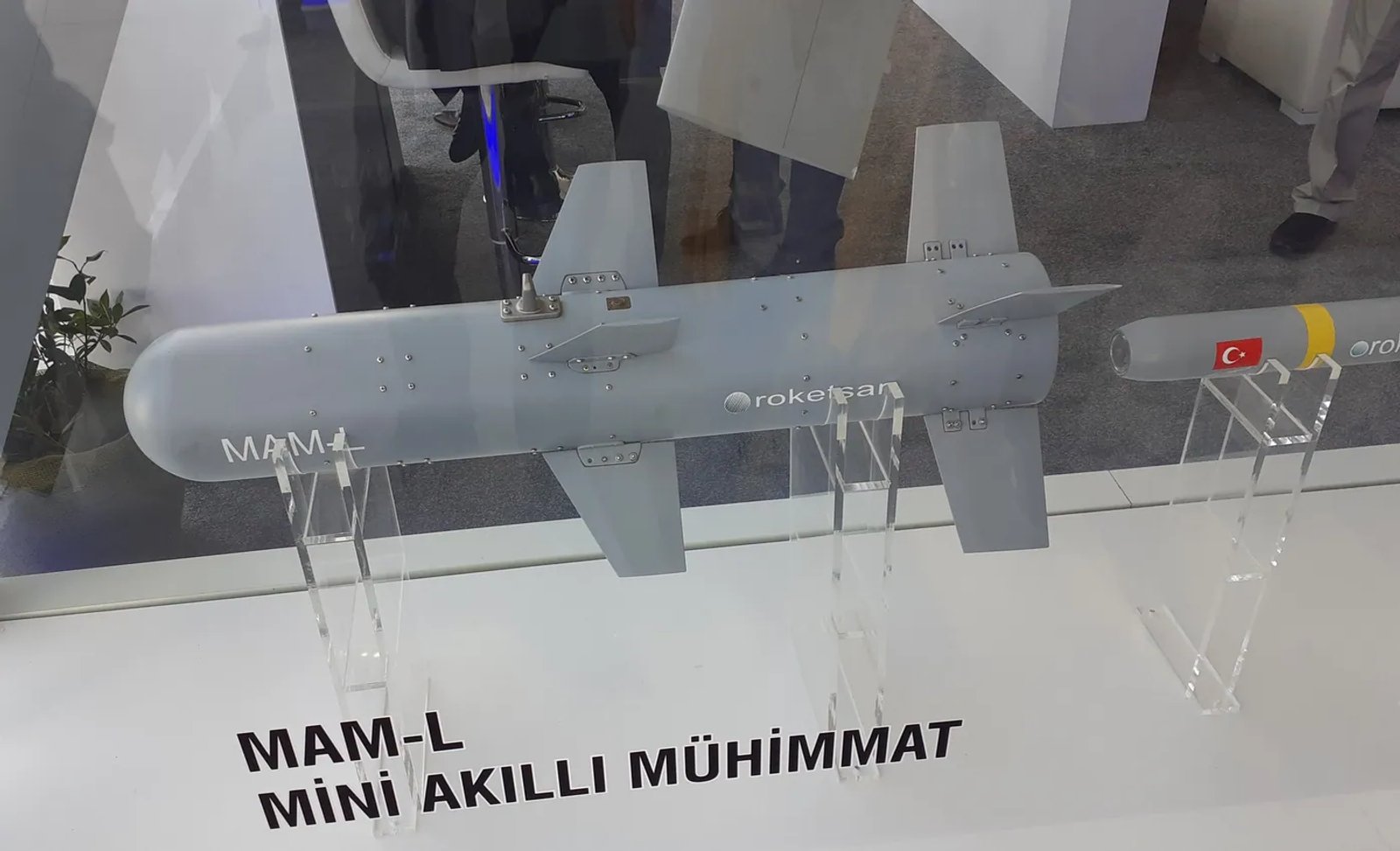
Two things are worth noticing about that list. First, ROKETSAN is not only a missile company — it makes the rocket motors, warheads, fuzes and composite structures that other Turkish primes design around, which is why it sits underneath programmes it does not own. Second, the catalogue is not the whole company. Readers who want a full Turkish-language institutional profile of the firm — founding, facilities, product-by-product detail — will find one in Envanter Medya’s reference page on ROKETSAN; this article is about what that portfolio means in an export market.
The 300 km line runs straight through ROKETSAN’s catalogue
The Missile Technology Control Regime sorts missiles into two categories. Category I covers complete systems able to deliver a 500 kg payload to 300 km, and transfers of Category I items carry what the regime calls a strong presumption of denial. Category II covers complete systems reaching 300 km with any payload, plus components and technology, and is licensed case by case. Türkiye has been an MTCR partner since 1997. The regime restricts nothing a member builds for itself — only what it sells.
Read ROKETSAN’s export catalogue with those numbers in hand and it stops looking like a product list. The longest-ranged weapon ROKETSAN markets publicly is the KHAN ballistic missile, and its own datasheet gives it a range of 80–280 km with a 470 kg high-explosive warhead. Both figures sit immediately below an MTCR Category I parameter. ATMACA is listed at 250 km. ÇAKIR, the cruise missile ROKETSAN has pushed hardest at trade shows, is listed at “150 + km” with a 70 kg warhead. Nothing in the public catalogue crosses 300 km.
Now look at what is missing from it. TAYFUN, the ballistic missile family already in Turkish service, does not appear. Neither does GEZGİN, the long-range cruise missile Envanter Medya profiles in Turkish. Both are real, both have been displayed publicly, and both are absent from the products ROKETSAN presents to foreign buyers.

The company’s own language points the same way. Asked in April 2026 about TAYFUN’s range, İkinci told Al Jazeera: “We avoid mentioning its range; we just say its range is sufficient.” He repeated the formula in September 2026 when discussing TAYFUN Blok-4 and GEZGİN on Turkish television, saying only that Türkiye would strike “from sufficiently long range”. A 2022 TAYFUN test was widely reported at about 561 km; ROKETSAN has never confirmed the figure, and has never published one for GEZGİN or TAYFUN Blok-4 either.
There is a straightforward reading of all this. A published range above 300 km turns a weapon into a controlled item with an export problem attached. A company whose growth plan depends on exports has every reason not to publish one — and every reason to specify the missile it does market at 280 km and 470 kg. None of this makes ROKETSAN unusual; it makes it an MTCR member’s missile manufacturer behaving exactly as the regime intends.
WHY IT MATTERS
Türkiye is routinely described as a supplier that sells what others will not. On missiles, that is only half true. Above 300 km ROKETSAN is bound by the same regime as its Western competitors, which is why the strategic systems that dominate Turkish coverage are not on offer. Below 300 km it is genuinely permissive — no ITAR, no congressional notification, and an increasing willingness to move production into the customer’s country. A buyer reading Turkish missile headlines needs to know which side of the line the weapon in the headline sits on.
The numbers, and where they disagree
ROKETSAN placed 64th in the 2026 Defense News Top 100 with $2.37 billion in 2025 defence revenue, up about 18 per cent and up seven places — the sharpest climb of the five Turkish companies on that list. İkinci, in the same period, described turnover passing $2 billion and growing more than 50 per cent. Both can be true: the ranking converts audited defence-segment revenue into US dollars, while the company quotes total turnover in a high-inflation currency. The gap between an 18 per cent rise and a 50 per cent rise is a currency and methodology artefact, not a contradiction, and it is worth remembering whenever Turkish growth figures are compared with European ones.
Exports are the number that matters for this analysis, and it is smaller than the headlines suggest. ROKETSAN’s 2025 exports came to roughly $570 million, up more than 50 per cent on 2024. Against $2.37 billion of defence revenue, that is about a quarter of the business. The frequently quoted “$1 billion in exports” is a forward target, not an achieved figure.
That ratio is the single most useful fact about ROKETSAN as a supplier. Baykar sells the overwhelming majority of its output abroad. ROKETSAN does not: it is a national missile house first and an exporter second, and roughly three-quarters of its production is spoken for by the Turkish Armed Forces — including the interceptors for Çelik Kubbe, which is being fielded now. For a foreign buyer, that is a delivery-slot question long before it is a price question.
| System | Published range | Warhead | In public export catalogue? | Export position |
|---|---|---|---|---|
| CİRİT | up to 8 km | Multi-purpose / HE | Yes | Exported; long-standing volume product |
| TRG-300 Blok-III | 30–120 km | 105 kg | Yes | Marketed openly |
| ÇAKIR | 150+ km | 70 kg | Yes | Technology transfer reported to Indonesia |
| ATMACA | 250 km | 220 kg | Yes | Marketed openly; in Turkish naval service |
| KHAN | 80–280 km | 470 kg | Yes | Offered; no export contract publicly confirmed |
| TAYFUN family | Not published | Not published | No | Turkish service only |
| GEZGİN | Not published | Not published | No | Pre-serial; Turkish programme |
Capacity: the $3 billion answer to a delivery problem
ROKETSAN’s constraint through 2024 was not demand. It was how many rounds it could physically finish. The response has been the largest industrial build-out in the company’s history: a $3 billion investment programme, of which İkinci said roughly $1 billion was complete by April 2026, when President Erdoğan opened the Kırıkkale solid-propellant and warhead facilities and the Lalahan missile integration facility. The company put the Kırıkkale fuel investment alone at about $450 million. Officials said the new plants would raise Türkiye’s missile production capacity fivefold — a company and government claim that no independent output figures yet confirm, and one worth treating as a target until deliveries validate it.
Breaking Defense reported that the April opening was paired with deliveries to Turkish forces spanning TAYFUN, SİPER, ATMACA, HİSAR-A, HİSAR-O, SUNGUR, ÇAKIR, SOM and the MAM family — a useful snapshot of how wide the production base has become. İkinci has separately described around 3,200 engineers, a new R&D centre intended to add about 1,000 more, a supplier base of roughly 4,000 small and medium-sized firms, and local content above 90 per cent. ROKETSAN does not publish a total headcount.
How ROKETSAN actually sells abroad: build it there
The company’s export model has shifted from shipping rounds to standing up production lines in the customer’s country. At the World Defense Show in Riyadh in February 2026, ROKETSAN signed two agreements with Saudi Arabian Military Industries — one for joint production of cruise missiles, a second with SAMI Land Systems covering sales and joint production of anti-tank guided missiles. Neither side named the specific missiles. In Indonesia, ROKETSAN agreed a joint venture with PT Republikorp to build a missile plant, reported alongside a transfer of ÇAKIR production technology. İkinci has also pointed to investments tied to Azerbaijan and Indonesia, and to Qatar as the template for how ROKETSAN prefers to structure a relationship.
Two observations follow. First, the products being localised are the sub-300 km ones — ÇAKIR and anti-tank missiles — which is precisely what the control regime permits and what a buyer should expect. Second, this is the same industrial-participation playbook Turkish industry now runs everywhere: not a cheaper missile, but a share of the factory. It is also how Turkish drone exports moved from sales to co-production, and it competes directly against European and South Korean offers on the same ground.
Europe is the newer front. ROKETSAN spent 2026 working the European circuit — Eurosatory in June, MSPO in Poland in September — pitching NATO-standard precision munitions into a continent short of exactly that. Nothing at scale has been signed publicly. Turkish systems already reach several NATO members, but in European ammunition and missile procurement ROKETSAN remains a challenger rather than an incumbent.
BUYER VIEW
- Price. ROKETSAN publishes no unit prices, and because the company is unlisted there are no audited accounts to infer them from. Comparative cost claims about Turkish missiles are almost always estimates.
- Delivery. Roughly three-quarters of output goes to Turkish forces, and Çelik Kubbe is being fielded now. Ask where an export order sits in the queue, not only what the line can produce.
- Export ceiling. Anything at or above 300 km falls under MTCR review by Türkiye’s own authorities. Assume the strategic-strike systems are not available, and get any range expectation written down.
- Industrial participation. This is where ROKETSAN is most flexible — joint production and technology transfer have been agreed with Saudi Arabia and Indonesia. Scope and depth are negotiated case by case and have not been published.
- Foreign content. İkinci cites local content above 90 per cent. That is high, but seekers, propellant chemistry and electronic components remain the areas to probe on any re-export question — as the US export-control exposure of Turkish systems shows, one imported component can carry a third-country veto.
- Integration. ROKETSAN munitions are already qualified on Turkish drones, helicopters, ships and launchers. Integration onto a non-Turkish platform is an engineering programme, not a catalogue purchase.
This is open-source editorial analysis by DefenceTürkiye. It is not procurement advice and DefenceTürkiye advises no government or company.
What ROKETSAN does not do well, stated plainly
Transparency is the first gap. There are no audited public accounts, no headcount, no unit prices and no published ranges for the systems that attract the most attention. Analysts comparing ROKETSAN with MBDA, Raytheon or LIG Nex1 are comparing a company that discloses almost nothing with companies that must disclose a great deal.
Export concentration is the second. The $570 million export figure is real, but ROKETSAN has not published a customer list, and outside a handful of confirmed relationships the “around 50 countries” figure cannot be checked against contracts. The KHAN missile — the flagship of the exportable catalogue — has no publicly confirmed export customer.
Third, capacity claims run ahead of demonstrated output. A fivefold increase in national missile production is an ambition backed by new buildings; it is not yet a delivery record. Fourth, the supply chain still has foreign layers — the sort of dependency examined in our assessment of how independent Turkish defence production actually is. Above 90 per cent local content is not 100 per cent, and the missing percentage is rarely the cheap part.
What comes next
The announced programme for 2026 and 2027 is dense: TAYFUN Blok-4 entering Turkish service, GEZGİN moving from qualification into serial production, the GÖKBORA beyond-visual-range air-to-air missile, an extended-range TRG-300 variant, and continued SİPER development for the upper layer of Çelik Kubbe. Space remains a declared line of business through the Micro Satellite Launching System, which is also the clearest long-term technology bridge from ballistic missiles to launch vehicles.
The commercial question is narrower. ROKETSAN’s growth so far has come from capacity, not from opening the catalogue — and the catalogue cannot open past 300 km while Türkiye remains an MTCR partner in good standing, which it has every reason to do. So the export story over the next three years will be decided in two places: how much of the new capacity is released to foreign customers rather than absorbed by Turkish air defence, and how far ROKETSAN is willing to go on joint production to win orders it cannot win on delivery time alone.
FAQ
Who owns ROKETSAN?
ROKETSAN describes itself as an establishment of the Turkish Armed Forces Foundation (TSKGV). It is not listed on any exchange. Reported shareholdings put TSKGV at about 55 per cent, with ASELSAN and MKE near 15 per cent each, VakıfBank about 10 per cent and HAVELSAN about 4.5 per cent. All shareholders are state or state-linked bodies.
What does ROKETSAN make?
Guided artillery rockets, anti-tank missiles, air-defence missiles including SUNGUR, HİSAR and the SİPER interceptor, the ATMACA anti-ship missile, ÇAKIR and other cruise missiles, drone munitions such as the MAM family, guidance kits, torpedoes, ballistic protection, rocket motors and warheads, plus a satellite launch programme.
How much does ROKETSAN export?
Approximately $570 million in 2025, up more than 50 per cent year on year, against $2.37 billion of defence revenue. The company targets about $1 billion in annual exports; that figure has not been reached.
Can Türkiye export TAYFUN or GEZGİN?
Neither appears in ROKETSAN’s public export catalogue, and no export offer for either has been announced. Türkiye has been an MTCR partner since 1997, and complete systems reaching 300 km fall under the regime’s controls, with a strong presumption of denial for Category I transfers. ROKETSAN has not published a range figure for either weapon.
Is ROKETSAN bigger than ASELSAN?
No. In the 2026 Defense News Top 100, ASELSAN ranked 40th with $4.46 billion in 2025 defence revenue against ROKETSAN’s $2.37 billion at 64th. They are also complementary rather than competing: ASELSAN typically supplies the sensors and electronics of a system and ROKETSAN the missile, as in SİPER.
Does ROKETSAN transfer missile technology to buyers?
It has agreed to. ROKETSAN signed joint-production agreements with Saudi Arabia’s SAMI for cruise missiles and anti-tank missiles in February 2026, and a joint venture with Indonesia’s PT Republikorp for a missile plant, reported alongside transfer of ÇAKIR production technology. The scope of each transfer has not been published.
How many people work at ROKETSAN?
ROKETSAN does not publish a total headcount. General Manager Murat İkinci has cited about 3,200 engineers and a new R&D centre intended to add roughly 1,000 more. Third-party workforce estimates circulate but are not company figures.
Sources
- ROKETSAN, “About Us” — founding date, founding decision, ownership statement, milestones.
- ROKETSAN product datasheets: KHAN (80–280 km, 470 kg), ATMACA (250 km, 220 kg), ÇAKIR (150+ km, 70 kg), TRG-300, full product catalogue.
- Arms Control Association, “The Missile Technology Control Regime at a Glance” — Category I and II thresholds, presumption of denial, partner list and Türkiye’s 1997 accession.
- Breaking Defense, “Turkey’s Roketsan opens new production facilities, delivers missiles to armed forces”, April 2026 — facility openings, $1bn and $3bn investment figures, delivered systems.
- Al Jazeera, “Türkiye’s Roketsan eyes top 10 exporter rank”, 16 April 2026 — İkinci interview: ranking ambition, roughly 50 export countries, 3,200 engineers, ~4,000 suppliers, local content, and the TAYFUN range quotation.
- Anadolu Agency, “Roketsan eyes production surge in 2026” — 2025 turnover above $2bn, exports near $570m, 2026 programme list.
- Defense News, Top 100 2026 edition — ROKETSAN 64th, $2.37bn 2025 defence revenue; ASELSAN 40th, $4.46bn.
- Türkiye Today, “Roketsan signs joint missile production deals with Saudi Arabia’s SAMI at WDS2026” — the two Riyadh agreements.
- Envanter Medya, “ROKETSAN Nedir?” — Turkish-language institutional reference on the company.



[…] Roketsan General Manager Murat İkinci gave the clearest public timeline yet for two of the company’s most closely watched strategic-strike programmes on September 12, telling state broadcaster TRT Haber at a TEKNOFEST technology event in Aksaray that the TAYFUN Blok-4 hypersonic ballistic missile is close to entering Turkish Armed Forces service, and that serial-production preparations for the long-range GEZGİN cruise missile are complete pending final test and qualification work. […]
[…] DefenceTürkiye coverage: Who builds Türkiye’s radars? · ASELSAN company profile · ROKETSAN company profile · Which NATO members operate Turkish defence systems? · Azerbaijan co-produces Dearsan naval […]
[…] lawyers would ask. Our survey of who builds Türkiye’s radars and the profiles of ASELSAN and ROKETSAN set out what is publicly known about the supply chain behind the Çelik Kubbe (Steel Dome) […]