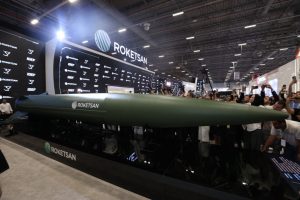
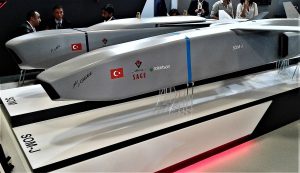
Roketsan’s TRLG-230 Gives Rocket Artillery a Laser Seeker

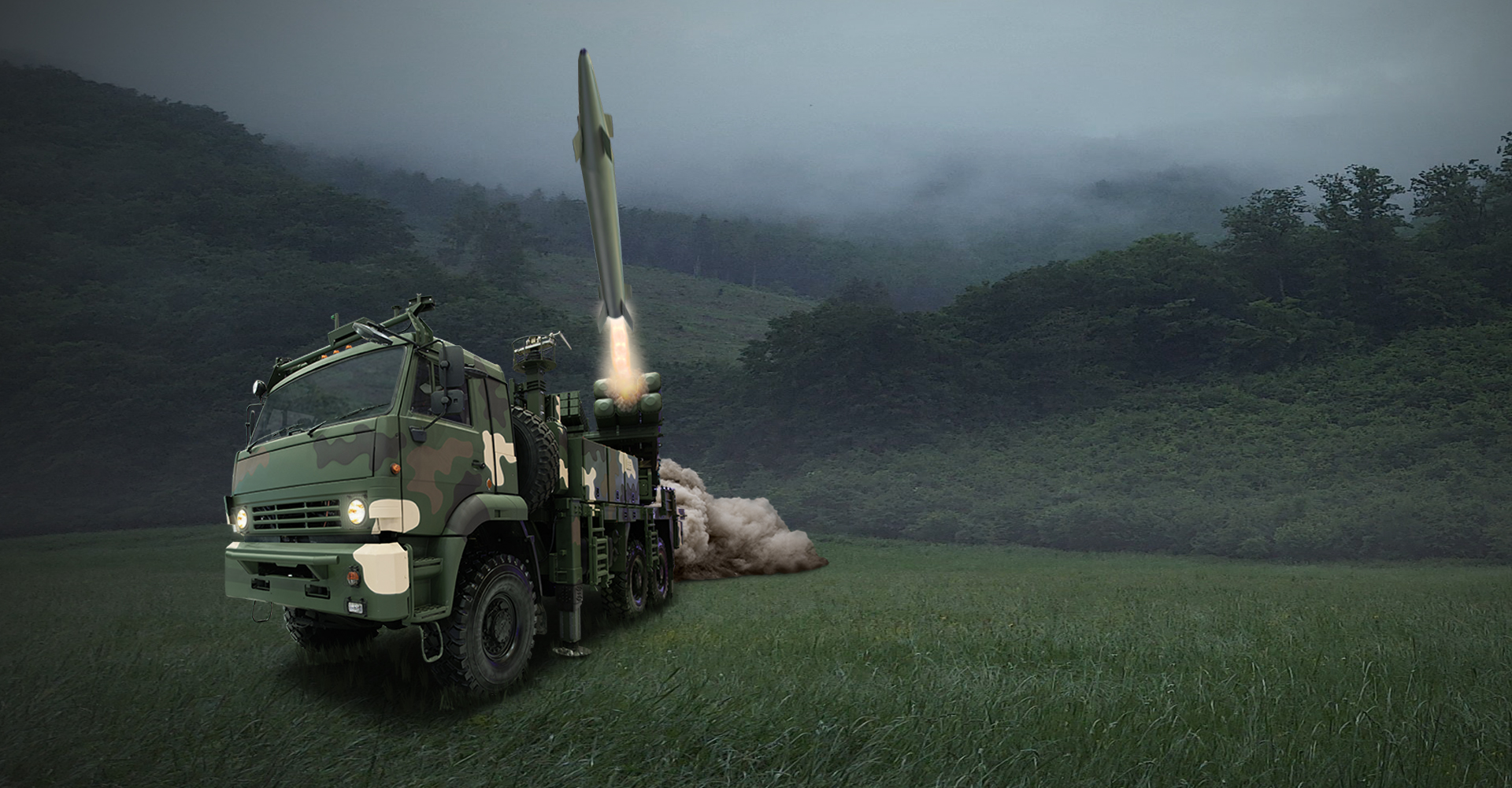
Most 230 mm rockets are area weapons. They are cheap, they fly far, and they land somewhere near the aim point. Roketsan’s TRLG-230 is built to break that habit. It keeps the 230 mm airframe but adds a laser seeker, so a spotter with a designator can steer the rocket onto a single target, including one that is moving.
The idea is simple to state and harder to execute: take the long reach of rocket artillery and give it the terminal accuracy that used to belong to aircraft-launched missiles.
| Item | Detail |
|---|---|
| Manufacturer | Roketsan (Türkiye) |
| Type | Laser-guided surface-to-surface rocket, 230 mm |
| Range (Roketsan) | 20 to 70 km |
| Weight | 210 kg |
| Warhead | 42 kg high explosive with steel balls; effective radius of at least 55 m |
| Guidance | GPS and GLONASS aided INS plus laser seeker; aerodynamic control |
| Accuracy (Roketsan) | 2 m CEP or better |
| Fuzing | Point detonating and proximity options |
| Launcher | Roketsan MCL multi-caliber launcher and compatible platforms |
| Reported users | Azerbaijan and Ukraine (reported); the standard TRG-230 is reported with Bangladesh |
What does the laser seeker change?
The base TRG-230 steers by inertial navigation aided by satellite signals. That works against fixed coordinates. It does not work well against a vehicle that moves after the coordinates were entered. Open references put the TRG-230 at roughly 10 m CEP; the TRLG-230 brings that to 2 m or better, according to the company.
The laser seeker is the reason. Someone, or something, paints the target with a laser designator, and the rocket homes on the reflected energy in the last seconds of flight. Roketsan says the seeker is compatible with the STANAG 3733 laser code standard, which matters because it lets the rocket work with designators built to that standard.
Satellite-aided navigation still carries the rocket most of the way. The laser takes over only for the final correction. That split keeps the seeker simple.
How was the TRLG-230 developed?
Roketsan started work on the missile in spring 2020, and Defense News reported that September that officials described it as a locally developed system with no foreign involvement. An industry source quoted in that report said Türkiye had no surface-launched laser-guided missile in that class in its inventory.
The speed was notable. The company timeline, as repeated in open sources, has prototype production beginning within weeks of design completion and a first test launch from the Sinop test center in July 2020. Those dates come from secondary summaries and should be read as reported.
The same report tied the weapon to the drone fleet from day one. The concept was a drone that finds and designates a target while a ground-based launcher fires the rocket, a division of labor that spares the drone from carrying its own munition.
Why does the drone connection matter?
A laser-guided rocket is only as good as its designation. Three sources are discussed in open reporting: a UAV with a laser designator, such as the TB2, a portable ground designator in the hands of a forward observer, and counter-battery radar for locating the target in the first place. The War Zone laid out those options when the rocket first surfaced in Ukraine.
The strength of this arrangement is that the shooter can sit 20 to 70 km back while the eye sits much closer. The weakness is the same link. If the designating drone is shot down or jammed, or weather and smoke defeat the laser, the rocket falls back on satellite-aided navigation and loses most of its precision edge. That is a limit of the whole class, not a flaw peculiar to this rocket.
Roketsan has also pushed the family into the air. In December 2022 the company released footage of a Bayraktar AKINCI launching a 230 mm rocket variant, referred to as TRG-230-İHA, and reported a strike from about 100 km. Open sources list a range of up to 150 km for that air-launched version. It is a different weapon from the ground-launched TRLG-230, though it shares the airframe lineage. For the drone itself, see our profile of the Bayraktar AKINCI; for a later and longer-reaching AKINCI-launched Roketsan missile, see the report on the İHA-300 test.
Who fires it, and from what?
Roketsan markets the rocket for its MCL, a modular launcher designed to take 122 mm, 230 mm and 300 mm rockets, and for other platforms with a compatible interface. Launchers in this family ride on 6×6 or 8×8 trucks.
Ukraine is the best-documented foreign user. Reports from late 2022 said Ukraine had received a small number of TRLG-230 rockets earlier that year. In April 2023 the Ukrainian 49th Artillery Brigade posted a photograph of an MCL launcher with a caption saying its crews were ready for the counteroffensive, which Militarnyi described as the first visual confirmation. The launcher in the image had two blocks of two tubes each, not the six-tube layout, and sat on a KAMAZ-65224 chassis.
Numbers floated in the press for the transfer, such as at least 50 rockets and eight launchers, were never confirmed and are best treated as unverified. Azerbaijan is also listed as an operator of the TRLG-230 in open references.
Where does it sit in Roketsan’s rocket and missile lineup?
The TRLG-230 occupies a middle slot. Below it are 122 mm rockets and the helicopter-fired CİRİT, a 70 mm guided rocket that uses a laser seeker at a very different scale. Above it are heavier systems such as the BORA ballistic missile, which reach into a different range class. The TRLG-230 is the weapon for a target worth a precise hit but not worth a ballistic missile.
Roketsan describes the intended targets as artillery positions, radar sites, assembly areas, logistics facilities and command and control nodes, and stresses low collateral damage. A 42 kg warhead with a 55 m effective radius is a modest charge by missile standards, which fits that brief: precision substitutes for tonnage.
For the company behind the weapon and its export record, the ROKETSAN profile covers the wider picture.
What remains unclear?
Several things are not public. Roketsan has not released a production count or unit price. The accuracy and range figures are manufacturer claims, and no independent test data has been published. Combat results in Ukraine have not been documented in detail by either side, so anyone quoting a kill record for the TRLG-230 is working from rumor.
What can be said with confidence is narrower. Türkiye now has a domestically designed, laser-guided 230 mm rocket that is in the hands of at least one foreign customer, and it was designed from the outset to be paired with unmanned aircraft.