
Is Türkiye Fully Independent in Defence Production?


No — and the Turkish procurement agency’s own project list is the clearest proof. Türkiye designs, integrates and manufactures the large majority of what its armed forces buy, and the Presidency of Defence Industries (SSB) puts domestic content above 80 per cent against roughly 20 per cent in 2002. But that figure measures the share of procurement money spent inside Türkiye, not technological self-sufficiency. Four flagship platforms — KAAN, ALTAY, the İstif-class frigate and the Reis-class submarine — all run on foreign propulsion in 2026. And SSB’s public industrialisation portfolio currently funds work on DC-DC converters, thermal batteries, transmission housings and metallic nickel, which is a precise map of what Türkiye still buys abroad.
That is a very different answer from either of the two positions usually on offer. Türkiye is not a licensed assembler of other people’s designs, and it is not self-sufficient. It is a country that has closed the design, integration and weapons layers of its industry almost completely, and is still working on the propulsion and deep-component layers underneath.
DEFENCETÜRKIYE DATA BOX
| Procurement authority | Presidency of Defence Industries (SSB), reporting to the Presidency |
| Stated domestic content | Above 80% (SSB); about 20% in 2002 |
| Defence & aviation exports 2025 | $10.05bn ($9.87bn goods, $184m services), up 48% year on year |
| Layers effectively closed | Design, systems integration, radar and EO sensors, electronic warfare, guided munitions, naval shipbuilding, UAVs |
| Layers still open | Aero engines, tank powerpacks, marine propulsion, submarine design, power electronics, some raw materials |
| Main constraint | Third-country export licences on imported subsystems, not manufacturing capacity |
What the “80 per cent” figure actually measures
The number quoted in almost every English-language article about Turkish defence is a procurement statistic. It expresses how much of Türkiye’s defence spending goes to firms registered in Türkiye rather than to foreign vendors. It is a real and meaningful measure of industrial policy success — in 2002 four fifths of the money left the country, and now four fifths stays. It is not a measure of whether a Turkish system could be built if every foreign supplier stopped shipping tomorrow.
The distinction becomes obvious at hull and airframe level. When SSB president Haluk Görgün described the Ç-159 landing craft, commissioned in December 2025, as built to an 80 per cent localisation rate, that ship still carries two 2,400 kW main engines and two 300 kW diesel generators alongside its Turkish ASELSAN stabilised weapon stations. Envanter Medya’s Turkish-language breakdown of which indigenous systems are actually fitted to the Ç-159 landing craft makes the composition visible: the weapons, the sensors and the hull are Turkish; the number does not claim that every kilowatt of the propulsion train is.
A localisation percentage is therefore best read as a contracting statistic with a manufacturing story behind it — useful, but not the answer to the independence question. The answer to that question is found one level down, in specific components and specific export licences.
Where the dependency actually sits in 2026
Take the four programmes Türkiye is proudest of and look at the same layer in each.
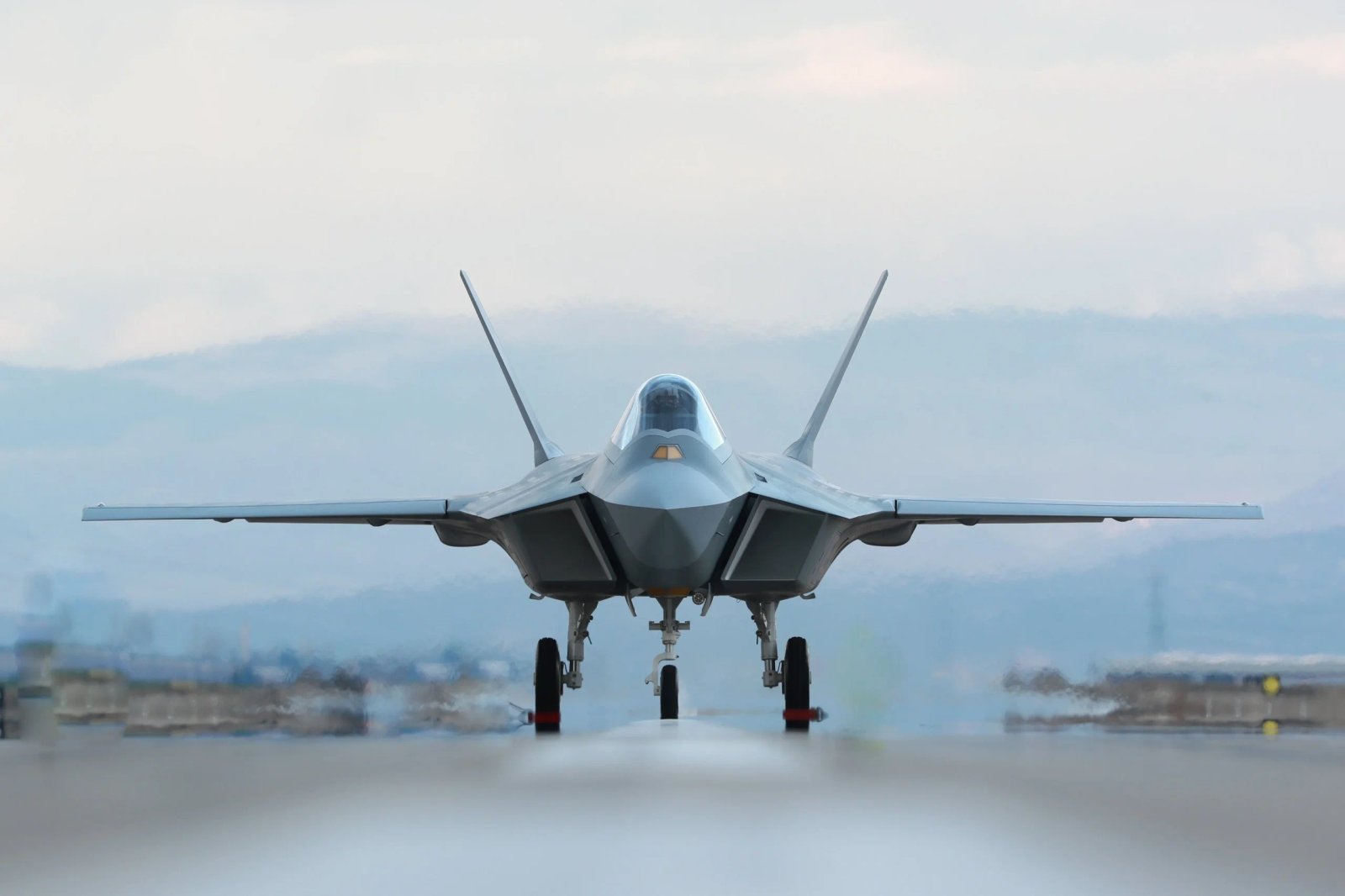
KAAN. The airframe, the mission systems and the MURAD AESA radar are Turkish. The engine is not. The prototypes fly on General Electric F110 turbofans, and in July 2026 Turkish Aerospace chief executive Mehmet Demiroğlu confirmed at Farnborough that the company had received the US export licence covering 80 further F110s for serial production, on top of ten already held. Turkish Aerospace has separately said the indigenous replacement now sits in 2032. The dependency is therefore not a rounding error at the end of the programme — it is the propulsion of the first production blocks, and it is documented in detail in our assessment of the KAAN programme’s orders, blocks and engine timeline and in the reporting on the slip of the indigenous engine to 2032.
ALTAY. The tank most often cited as evidence of Turkish self-sufficiency has the longest engine story of the four. The five prototypes used the German MTU MT883 and RENK HSWL 295 EuroPowerPack; German export approval did not follow, and Defense News reported in March 2021 that Türkiye had turned to South Korea after talks with German suppliers failed under Berlin’s restrictions. Serial ALTAY T1 tanks — the first two delivered on 28 October 2025 — run an HD Hyundai Infracore DV27K 1,500 hp V12 with an S&T Dynamics EST15K transmission. Part of that workaround involved substituting German-origin content inside the Korean powerpack itself. BMC Power’s indigenous BATU pack completed factory acceptance testing at the end of December 2025 and is planned to enter serial production tanks from 2028. Envanter Medya’s Turkish-language comparison of the ALTAY and the K2 Black Panther, which share the same Korean powerpack, is a useful companion for readers who want the platform-level detail.
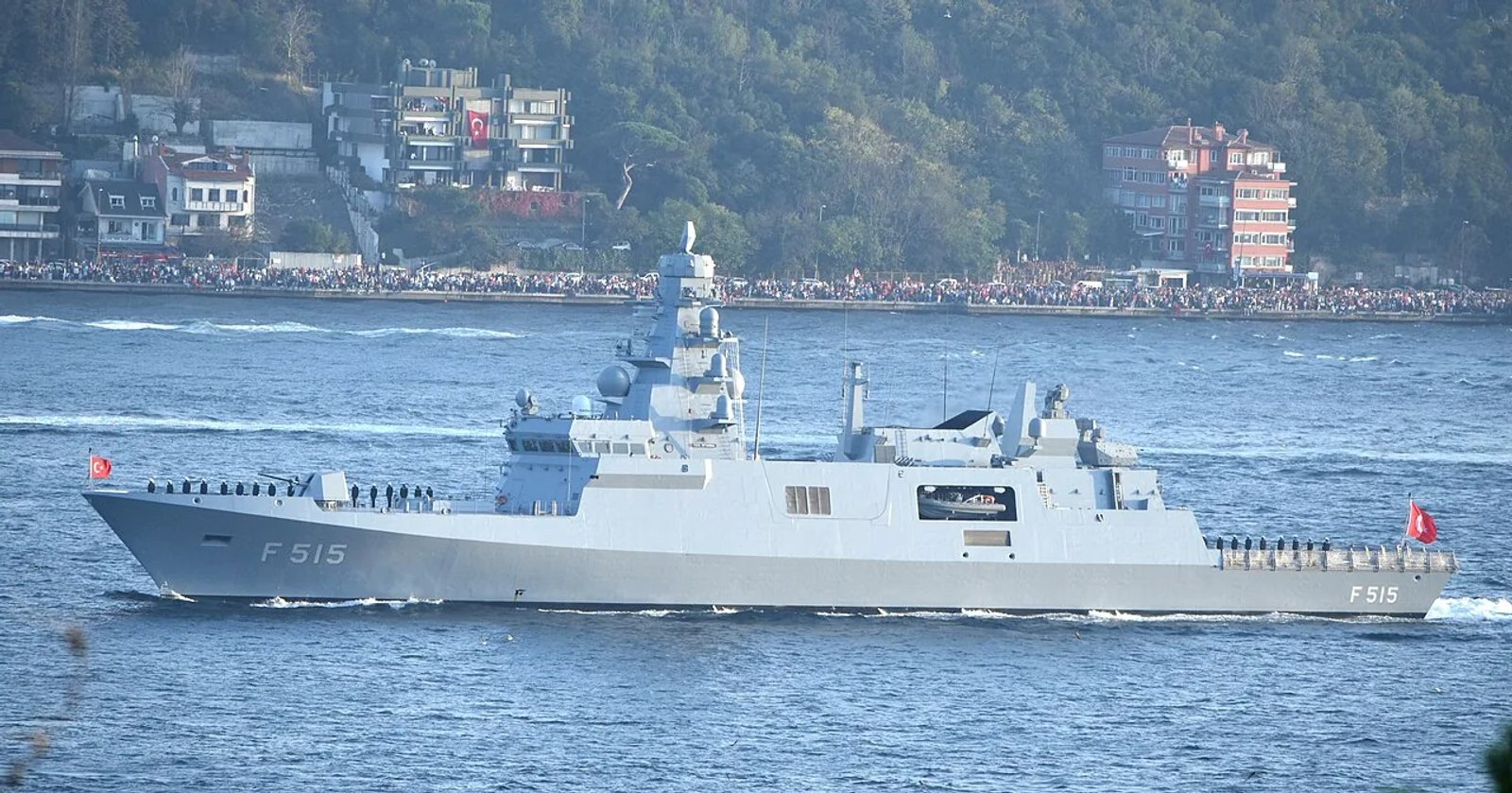
İstif-class frigate. Hull, design, combat management system and weapons are Turkish. The combined diesel and gas arrangement is a General Electric LM2500 gas turbine with MTU diesels — American and German. Our page on the MİLGEM İstif-class frigate programme covers the ship itself; the point here is narrower, and SSB states it openly. The agency’s own Marine Engine Family project page says the programme exists to meet the engine requirements of national naval platforms “while resolving export license issues arising from the engines”. That is the procurement authority naming export-licence exposure as the reason for the programme.
Reis-class submarine. This one is foreign at the top of the stack, not the bottom. The six boats are a thyssenkrupp Marine Systems Type 214TN design built at Gölcük Naval Shipyard under a €2.06bn contract signed in June 2011, with German fuel-cell air-independent propulsion. TKMS handed over the second boat on 27 November 2025. The indigenous answer is MİLDEN, whose first hull is in construction at Gölcük and whose principal dimensions ASFAT released for the first time in late August 2026 — over 80 m long, roughly 2,700 tonnes surfaced, eight 533 mm tubes, fuel-cell AIP and lithium-ion batteries.
SSB’s own shopping list of what Türkiye still imports
The most useful open-source document on this question is not an analyst report. It is the “Industrialisation” section of SSB’s public project catalogue, which lists the components the agency is currently paying to bring inside the country. Read as a list, it is a map of the remaining gaps — and it goes considerably deeper than engines.
| SSB industrialisation project | What it localises | What that tells a buyer |
|---|---|---|
| DC-DC Converter | Power-conversion modules used across defence programmes | SSB states these are “currently procured about 80% from abroad”, with a 70% local-content target. Basic power electronics remain an import |
| Next-Generation Thermal Battery | Thermal batteries for guidance kits and missiles | Munitions production volume depends on a single small subsystem class; SSB frames the work as capacity and sustainability |
| Transmission Housing Indigenisation | Casting and machining of special-alloy aluminium cross-drive transmission housings | The BATU powerpack story is not only about the engine — the casting base has to be built too |
| Ore Enrichment Pilot Facility | Metallic nickel and cobalt for aircraft engine manufacture | Türkiye is localising the raw-material layer beneath its engine programmes. SSB says the pilot plant is in service and has produced high-purity nickel and cobalt |
| Electroform Infrastructure | Rotor blade erosion shields for GÖKBEY and the heavy-class attack helicopter | Helicopter serial production can be gated by a single specialised process, not by the airframe |
| Marine Engine Family | Engines and auxiliary machinery for national naval platforms | SSB’s stated purpose includes “resolving export license issues arising from the engines” — an explicit acknowledgement of the constraint |
None of this is hidden. It is published, in English, on the procurement agency’s own website. The reason it rarely appears in coverage of Turkish defence is that it is unglamorous — nobody writes headlines about aluminium castings and DC-DC converters — but it is exactly the layer that determines whether a production line can keep running under pressure.
The real constraint is the licence, not the part
Foreign content only matters if someone can switch it off. Türkiye has two well-documented cases where someone did.
The first is the T129 ATAK. Türkiye signed a roughly $1.5bn contract with Pakistan in 2018 for 30 helicopters. The T129 uses the LHTEC T800-4A, a joint Honeywell and Rolls-Royce product, and the required US export licence did not come. Defense News reported in May 2021 that Turkish Aerospace had obtained a US licence for a six-aircraft Philippine order while the Pakistani licence remained unresolved; Pakistan subsequently cancelled. A Turkish-built, Turkish-designed helicopter lost a $1.5bn export order because of a third-country component licence.
The second is Canada. Ottawa suspended and then, in April 2021, cancelled 29 military export permits for Türkiye after concluding that L3Harris Wescam MX-15D imaging and targeting turrets supplied for Bayraktar TB2s had been used in Nagorno-Karabakh. ASELSAN’s CATS was presented as the replacement. That episode is now routinely cited inside Türkiye as the moment domestic electro-optics became a priority rather than a preference.
Status language matters here. A component being foreign is not a vulnerability. A component being foreign and licence-controlled by a government with a track record of restricting Türkiye is a vulnerability. The F110, the LM2500, the MTU diesels and the T800 all fall in the second category; the South Korean DV27K, so far, has not.
What Türkiye has actually closed
The honest version of the independence story includes the wins, and they are substantial.
- Cruise-missile propulsion. SSB states plainly that indigenous turbojets “are already being employed in multiple cruise missiles, and serial production of these engines is ongoing”. This is the one propulsion class where the dependency is finished, not scheduled.
- Electro-optics and infrared detectors. On 4 August 2026 ASELSAN presented a domestically developed infrared detector family in both cooled and uncooled configurations, saying its microelectronics competence had placed Türkiye “among the few countries producing infrared detectors”. The company named ALTAY, Çelik Kubbe, KIZILELMA and KAAN as destinations. Production volumes were not disclosed, so this should be read as a capability announcement rather than a supply-chain closure.
- Radar and electronic warfare. AESA radar, standoff jamming and self-protection suites are designed and produced in Türkiye; our profile of ASELSAN sets out the breadth of that portfolio, and the layered architecture behind Çelik Kubbe, Türkiye’s Steel Dome, is built on it.
- Guided munitions and naval weapons. ATMACA, the ROKETSAN and TÜBİTAK SAGE families and MKE ordnance mean Turkish platforms do not depend on foreign magazines — a point that matters more to export customers than engine origin, because weapons are what get embargoed first in a conflict.
- UAV propulsion. SSB’s diesel-engine projects note that indigenous diesels are already in service across many UAV platforms, which is why the small-engine import question that dominated coverage in 2020 has largely faded.
Our separate examination of who builds Türkiye’s aircraft engines covers the propulsion ecosystem — TEI, Kale, TRMotor — in the depth this article does not.
The counter-example nobody expected: Türkiye is also buying
Any assessment written in 2026 has to account for a fact that sits awkwardly beside the self-sufficiency narrative. On 27 October 2025 Türkiye signed for 20 new-build Eurofighter Typhoons in a UK-led package the British government valued at up to £8bn, with first deliveries expected in 2030, followed by second-hand Tranche 3 aircraft from Qatar and Oman and a separate support and training agreement. A country running its own fifth-generation fighter programme placed the largest UK fighter export order in a generation. Turkish pilots began Typhoon conversion training in the UK in September 2026.
This is not a contradiction if independence is understood correctly. No European state builds a complete air force alone; the United Kingdom does not build its own AESA-equipped fighter without partners, and France’s nominal autonomy rests on a supply chain that reaches well past its borders. What Türkiye is buying with Typhoon is time — capability in the 2030-2032 window while KAAN matures. What it is buying with the F110 licence is the same thing.
WHY IT MATTERS
For a foreign buyer, “is it independent?” is really two questions: can this supplier deliver on schedule, and can a third government stop the delivery? Türkiye now answers the first question well across sensors, weapons, armour and shipbuilding, where the answer is entirely in Turkish hands. On propulsion the answer still runs through Washington, Berlin and Seoul until the indigenous replacements arrive between 2028 and 2032. That is a narrower exposure than most sellers in Türkiye’s price bracket carry, and a wider one than the 80 per cent headline implies.
Buyer view
Framed as open-source editorial analysis rather than procurement advice, the practical checklist for a foreign evaluator looks like this.
- Ask which subsystem carries a third-country licence, by name. On an armoured vehicle or a missile system the answer is often none. On a fixed-wing aircraft, a helicopter or a surface combatant it is usually the engine.
- Ask what the re-export position is. A US-licensed engine inside a Turkish airframe means the buyer inherits the US decision, as Pakistan discovered with the T129 and as Indonesia’s reported ITAR-free condition on its KAAN order attempts to pre-empt.
- Treat the indigenous replacement dates as targets, not commitments. BATU is stated for 2028 and the KAAN engine for 2032. The KAAN engine date has already moved once.
- Weight the weapons ecosystem heavily. Turkish platforms come with Turkish munitions, which is the layer most likely to be restricted during an actual conflict and the one where Türkiye’s position is strongest.
- Do not assume localisation percentages transfer. An 80 per cent domestic content figure for a Turkish ship in Turkish service says nothing about what an export configuration will contain or what its licence conditions will be.
What comes next
Three dates decide whether this article reads differently in 2030. BATU entering serial ALTAY production in 2028 would close the land powerpack question. A flying, qualified TF35000 in 2032 would close the fighter question, and until then every KAAN sale carries a US licence inside it. MİLDEN reaching sea trials would close the submarine design question, which is the one place Türkiye currently depends on a foreign design rather than a foreign part. Türkiye’s position inside NATO’s own procurement market gives it a strong incentive to close all three, because alliance customers scrutinise licence chains more carefully than most.
Meanwhile the least visible line items — converters, thermal batteries, castings, nickel — are the ones to watch. They will not generate headlines. They will determine whether Türkiye’s production lines can absorb a shock.
FAQ
Is Türkiye self-sufficient in defence production?
No. SSB puts domestic content above 80 per cent, meaning most defence procurement spending stays inside Türkiye, but flagship platforms including KAAN, ALTAY, the İstif-class frigate and the Reis-class submarine all use foreign propulsion in 2026, and SSB funds active projects to localise power converters, thermal batteries, transmission housings and engine-grade nickel.
Does Türkiye build its own fighter jet engines?
Not yet for combat aircraft. KAAN flies on the General Electric F110, and Turkish Aerospace has said the indigenous TF35000 is now expected in 2032. Türkiye does build its own turbojets for cruise missiles, and SSB says those are in serial production.
What is Türkiye’s defence localisation rate?
Above 80 per cent according to SSB, against roughly 20 per cent in 2002. It is a measure of the share of procurement spending going to firms in Türkiye, not a measure of technological self-sufficiency.
Has an embargo ever actually stopped a Turkish defence export?
Yes. Pakistan cancelled a roughly $1.5bn order for 30 T129 ATAK helicopters after the required US export licence for the LHTEC T800 engine did not materialise. Canada also cancelled 29 export permits in April 2021 covering imaging turrets used on Bayraktar TB2s.
Is the ALTAY tank entirely Turkish?
The design, armour, fire control and 120 mm gun are Turkish. Serial T1 tanks use a South Korean HD Hyundai Infracore DV27K engine and S&T Dynamics transmission after German export approval for the original MTU and RENK powerpack did not follow. The indigenous BATU powerpack is planned for serial production tanks from 2028.
How much did Türkiye export in defence and aviation in 2025?
$10.05bn, comprising $9.87bn in goods and $184m in services, up 48 per cent year on year, announced by SSB president Haluk Görgün on 5 January 2026.
Which foreign supplier is Türkiye most exposed to?
The United States, through aero engines. The F110 for KAAN, the F404 class for advanced trainers and the T800 for the T129 all sit under US licensing authority. German exposure is concentrated in naval propulsion and the Reis-class submarine design.
Sources
- Presidency of Defence Industries (SSB) project catalogue: DC-DC Converter, Marine Engine Family, Turbojet Engine Projects, National Fighter Jet Power Systems, New Type Submarine
- Anadolu Agency, Türkiye’s defence and aviation exports exceed $10bn in 2025 (SSB figures, 5 January 2026)
- Breaking Defense, Turkish Aerospace CEO: US cleared KAAN fighter engines for export, and FlightGlobal’s Farnborough 2026 interview with Mehmet Demiroğlu
- Defense News, At long last, Turkey’s Altay tank finds an engine from South Korea and Turkey to export T129 helos to Philippines despite block on Pakistani order
- European Security & Defence, Türkiye begins serial production of the ALTAY main battle tank
- The Globe and Mail, Ottawa cancels 29 military export permits for Turkey
- Naval News, TKMS hands over second Reis-class submarine to the Turkish Navy; Shephard Media, Turkey begins steel-cutting on MUGEM and MİLDEN
- UK Government, Türkiye buys 20 Typhoon jets in biggest fighter jet deal in a generation (27 October 2025)
- ASELSAN statement on indigenous infrared detectors, reported by Sabah, 4 August 2026


[…] None of this contradicts the headline. It qualifies it: Türkiye now builds the radars it designs new programmes around, and is still working through a fleet that was equipped before it could. That pattern — indigenous at the front, imported at the back — recurs across the industry, and is examined in detail in our assessment of how independent Turkish defence production really is. […]
[…] Four, stated without softening. The workforce figure is two and a half years old because the company has not published a newer one. The T-70 outcome — 39 helicopters against an original 109 — is a programme failure by any normal measure, whatever its cause. The T925, intended to replace the Black Hawk in Turkish service, had still not flown as of September 2026; the CEO said in January 2026 that it would fly that year, and later reporting points to the first quarter of 2027. And KAAN’s export proposition rests on an engine that the United States currently licenses, which is precisely the arrangement the programme exists to escape. Our assessment of how far that escape has actually progressed across the whole industry is in is Türkiye fully independent in defence production? […]
[…] embargoes and export restrictions on systems bound for sensitive missions. That effort, detailed in an earlier look at how far Türkiye’s defence-production independence actually extends, produced radar-processing chains, composite manufacturing lines, secure communications stacks and […]