Why Turkish Defence Contracts Say “Customer Undisclosed”

Turkish defence companies routinely announce export contracts worth hundreds of millions of dollars without naming the buyer. That is not evasion. It is exactly what Turkish law asks of them, and nothing more. A company listed on Borsa İstanbul — ASELSAN, Otokar — must tell the Public Disclosure Platform (KAP) anything capable of moving its share price: the value, the scope, the delivery profile, the conditions attached. No rule obliges it to name the counterparty, and most governments buying weapons insist that it does not. The result is a disclosure record that is unusually precise about money and almost silent about geography.
For a foreign analyst, that asymmetry is workable once you know where it comes from. This page sets out what a Turkish defence contract disclosure legally has to contain, what it leaves out and why, which companies file at all, and what you can reliably reconstruct from the filings that do exist.
DEFENCETÜRKIYE DATA BOX
Subject: Turkish defence contract disclosure
Disclosure body: Public Disclosure Platform (KAP), operated under the Capital Markets Board (SPK)
Legal basis: CMB Communiqué II-15.1 on Material Events Disclosures
Export licensing: Ministry of National Defence, under Law no. 5201 (29 June 2004); registration by the Ministry of Trade
Who files: listed companies only — ASELSAN, Otokar, Katmerciler, SDT, Altınay Savunma, Papilon Savunma, Karel, Forte
Who does not: Baykar, ROKETSAN, Turkish Aerospace, HAVELSAN, STM, MKE, FNSS, Nurol Makina, BMC, ASFAT, TEI, Dearsan, Meteksan
Always disclosed: contract value, broad product category, revenue effect, conditions precedent
Usually withheld: customer identity, country, designation, unit count
National arms export report to parliament: none published
The two filings that make the point
Within 24 hours at the start of October 2026, the two largest listed Turkish defence manufacturers filed export contracts that together exceed $2 billion, and neither named a customer.
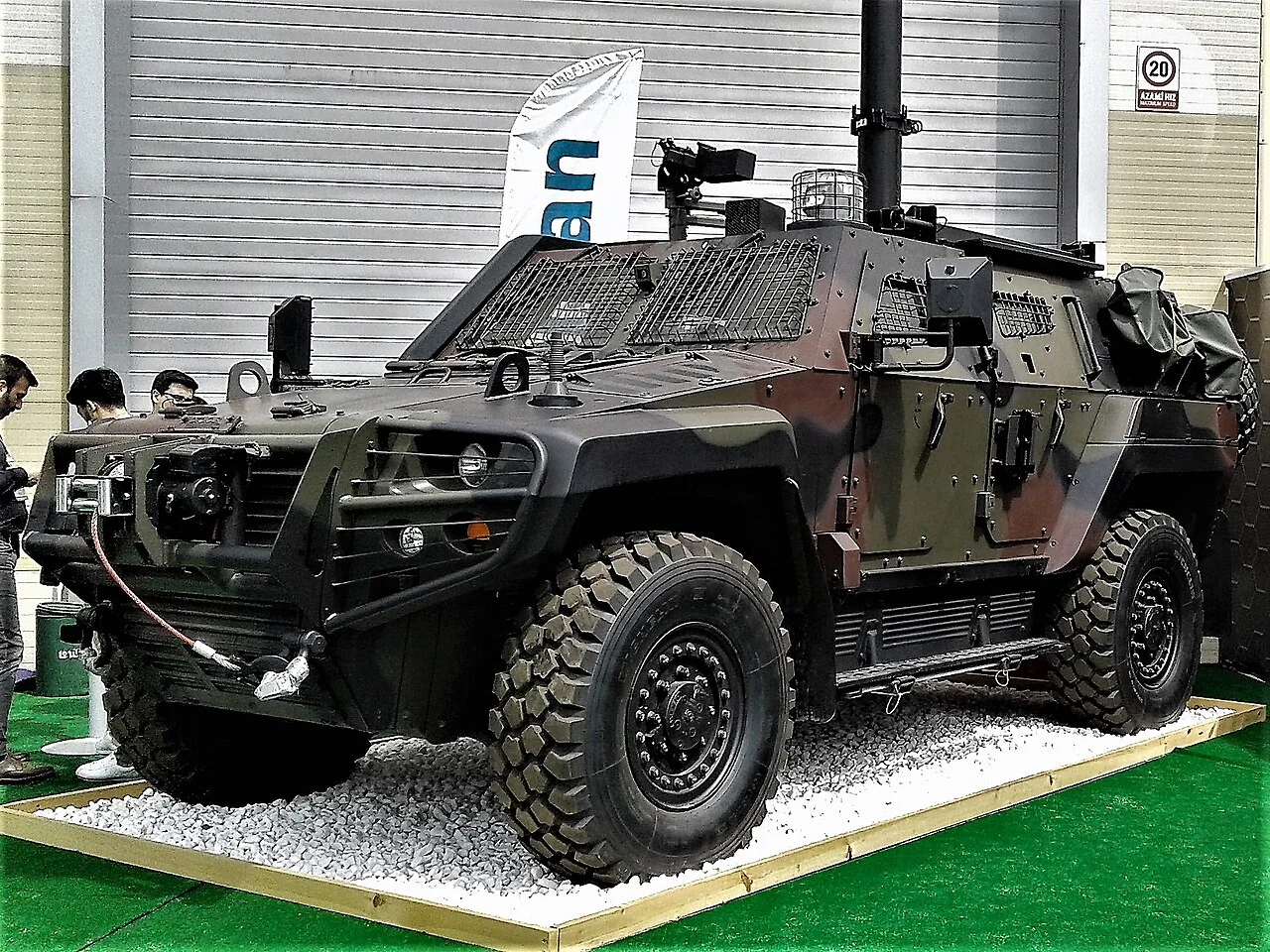
On 1 October, Otokar disclosed an export contract worth $1,472,080,360 for wheeled armoured vehicles and integrated logistics support — among the largest single export contracts in its history. The filing stated that deliveries begin in 2027 in batches across three years, that the contract remains in force for seven years, and that Otokar will issue the buyer letters of guarantee totalling $441,624,108. It also stated that the contract enters force only once official approvals are obtained, the guarantees are in place and an advance payment is received. It did not state the country, the vehicle family or the number of vehicles. Our news desk covered the filing in Otokar’s $1.47 billion armoured vehicle export contract.
The next day, ASELSAN filed a €488.5 million contract covering the direct export of integrated air defence systems, radar architectures and fire-control nodes, describing the buyer only as a foreign end user and noting an expected positive effect on the year’s revenue. Again: no country, no designation, no quantity. That filing is covered in ASELSAN’s €488.5 million air defence export deal.
Read side by side, the two filings show the pattern clearly — and show how much is actually there once you stop looking for the name.
| Field | Otokar, 1 Oct 2026 | ASELSAN, 2 Oct 2026 | Why |
|---|---|---|---|
| Contract value | $1,472,080,360 | €488.5 million | Price-sensitive, so it must be disclosed |
| Customer identity | Not stated | “A foreign end user” | Not required; usually barred by the contract |
| Country | Not stated | Not stated | Buyer’s confidentiality clause |
| Product designation | “Wheeled armoured vehicles” | “Air defence systems” | Category is enough for materiality |
| Quantity | Not stated | Not stated | Would identify the buyer by inference |
| Delivery profile | From 2027, batches over 3 years | Not stated | Affects revenue recognition |
| Contract term | 7 years | Not stated | Signals a support tail, not a one-off batch |
| Financial security | $441,624,108 in guarantees | Not stated | A balance-sheet commitment |
| Conditions precedent | Approvals, guarantees, advance | Not stated | The deal is signed, not yet in force |
Compiled by DefenceTürkiye from the two companies’ KAP filings as reported on 1–2 October 2026.
The Otokar filing is the more instructive of the two. A seven-year term with a logistics tail and nearly $442 million of guarantees describes the shape of the business even without a flag on it: this is a government customer large enough to demand performance security on that scale, buying a fleet rather than a batch, with a support contract attached. Compare that with the smaller single-batch export contracts in the $40–140 million range that Otokar has periodically disclosed for African and Asian buyers. On structure alone, this is a different class of deal.
What the law actually requires
Two separate regimes govern what reaches the public, and conflating them is the commonest mistake foreign readers make.
The first is capital markets law. Under the Capital Markets Board’s Communiqué II-15.1 on Material Events Disclosures, a listed issuer must publish, immediately, any information that could affect the value or price of its securities or an investor’s decision. The test is materiality — not completeness, and not identity. A €488.5 million order is plainly material; which ministry signed it is not necessarily so. The same communiqué lets an issuer postpone disclosure of inside information to protect its legitimate interests, provided it does not mislead investors and keeps the information confidential until the reason for postponement falls away. That provision is the legal hook for the gaps you see.
The second is export control. Under Law no. 5201 of 29 June 2004, every export of weapons and ammunition requires a licence from the Ministry of National Defence, with registration handled by the Ministry of Trade through the exporters’ unions. Türkiye set out the mechanics itself in a 2020 submission to the OSCE Forum for Security Co-operation. A licence application must carry the recipient country, the name and address of the recipient company or person, type, quantity and prices, the export contract itself and an end-user certificate issued by the importing state’s authorities. Permissions are granted case by case, and the controlled-items list is published annually in the Official Gazette.
Read those two paragraphs together and the shape of the problem becomes clear. The Turkish state knows the customer, the quantity and the price of every exported weapon. It simply does not publish any of it. In the same OSCE submission, asked whether there were additional laws, reports to parliament or special procedures covering arms exports, Türkiye’s answer was a single word: none. Türkiye publishes its legislation and its control lists; it does not publish an annual arms export report of the kind most EU member states produce. Türkiye does report to the UN Register of Conventional Arms, but that register is annual, aggregated by category, and lags the contract by years.
So the only per-transaction window into Turkish arms exports is a stock-market disclosure rule that was never designed to serve defence analysts — and it covers only the minority of the industry that happens to be listed.
Who has to disclose anything at all
This is the structural fact that determines how much you can see, and it has nothing to do with how important a company is.
Checked against KAP’s own directory of listed companies on 4 October 2026, the defence-sector names present are ASELSAN, Otokar, Katmerciler, SDT Uzay ve Savunma Teknolojileri, Altınay Savunma Teknolojileri, Papilon Savunma, Karel and Forte. Absent from that directory — and therefore under no continuous disclosure obligation whatever — are Baykar, ROKETSAN, Turkish Aerospace, HAVELSAN, STM, MKE, FNSS, Nurol Makina, BMC, ASFAT, TEI, Dearsan, Sefine, Meteksan, CANiK and Repkon.
The consequence is a visibility gradient that runs almost perpendicular to importance. ASELSAN’s order intake can be tracked filing by filing, in near real time, with values given to the last dollar or euro. Baykar — the exporter that did more than any other company to build Türkiye’s reputation abroad — is privately held by the Bayraktar family and publishes nothing it does not choose to; what is known about its finances comes from interviews and occasional official statements, as we set out in who owns Baykar. ROKETSAN and Turkish Aerospace sit between the two, majority-owned through the Turkish Armed Forces Foundation and reporting to the state rather than to a market.
If you are modelling the Turkish defence sector from filings, you are modelling the listed slice of it and should say so. There is no public filing trail for a KIZILELMA order, a ROKETSAN missile export or an ASFAT shipbuilding contract comparable to the one ASELSAN leaves behind.
What ASELSAN’s own reporting gives you that the filings do not
Here is where the work pays off. Individual KAP filings withhold geography, but ASELSAN’s quarterly investor material does not withhold it entirely — it publishes a backlog breakdown by customer, including a three-way regional split of the export portion. That is the single most useful published number in Turkish defence, and almost nobody outside the Istanbul equity desks reads it.
As of the first quarter of 2026, ASELSAN reported a backlog of $20.7 billion, divided as follows.
ASELSAN backlog by customer, Q1 2026
Total backlog $20.7 billion. Percentages as published by ASELSAN; dollar values are DefenceTürkiye’s arithmetic from that total.
Source: ASELSAN investor presentation, April 2026. Backlog composition 97% defence, 3% non-defence; currency split 51% USD, 43% EUR, 6% TL.
Four things follow from that chart that no individual filing will tell you.
First, ASELSAN remains a domestic supplier with a growing export business, not an export house: the export line is 16.2% of the Q1 2026 backlog and everything else is domestic or unallocated, with the SSB alone accounting for 42.5%. Second, the export book, at roughly $3.35 billion, is heavily weighted towards the Middle East, Africa and Asia, which hold more than twice as much work as Europe and the Americas combined. Third, the Caspian region — ASELSAN’s own label, and in practice centred on Azerbaijan — is small in backlog terms despite how visible those deliveries are in Turkish coverage. Fourth, the currency split is the clearest proxy available for export geography: 43% of the backlog denominated in euros is more European exposure than the 4.7% regional line suggests, because euro-denominated work also arrives through Turkish prime contractors.
The half-year figures, published in August 2026, carried the backlog to $23.2 billion, up 45%, on new contracts of $4.9 billion, up 72%. In that report ASELSAN listed its major contracts signed — and described each export deal as signed with “international customers” or “international end-users”, without exception. The company’s domestic counterparties, by contrast, are named outright. That contrast is the rule in miniature.
When the customer is named — and who decides
The exception matters more than the rule, because it shows where the confidentiality actually originates.
On 19 December 2025, ASELSAN announced a $410 million export contract for electronic warfare systems with the Poland State Treasury – Armament Agency. Named counterparty, named country, named agency. Poland publishes its own procurement decisions, has a parliamentary scrutiny process and treats the purchase as a political asset rather than a secret; there is nothing for a confidentiality clause to protect. We covered the Polish electronic warfare line in Türkiye builds its own jammers, and a NATO army is buying.
Set that against a Gulf or North African order, where the purchasing ministry routinely requires that the supplier say nothing, and the pattern resolves: the buyer decides whether it is named, not the Turkish company and not the Turkish state. Turkish exporters withhold customer identities because their customers require it as a condition of contract. For a procurement official reading this, that is a practical point rather than an abstract one — if your government wants the order publicised, Turkish suppliers will publicise it, and if it does not, they will not.
The national export figure, and what it actually counts
Above the company filings sits a single headline number that circulates widely and is used carelessly. On 4 January 2026, SSB head Haluk Görgün announced that Türkiye closed 2025 at $10.05 billion in defence and aviation exports — $9.87 billion in goods and $184 million in services — up roughly 48% on $7.1 billion in 2024.
Three caveats belong with that figure every time it is quoted.
It is defence and aviation. The series bundles civil aerospace work — Turkish Aerospace’s structural components for Airbus and Boeing, TEI’s engine parts — with weapons exports. It is not a measure of arms sales, and treating it as one overstates the arms figure by an amount nobody outside the compilers can isolate.
It is lumpy in a way that defeats trend-reading. Turkish Minute, citing the official data, reported $6.7 billion for the first ten months of 2025. Against a $10.05 billion full year, that leaves roughly $3.35 billion for November and December alone — a third of the year in a sixth of it. That is our arithmetic from two published figures, not a published breakdown, and the likely explanation is ordinary: deliveries and licence clearances cluster at year end. But it means any comparison of part-years is close to meaningless.
Published totals do not always agree. SSB’s own announcement gives $10.05 billion; other compilations of the same year run higher, generally because they mix the goods-only and goods-plus-services series, or draw on the Turkish Exporters Assembly’s monthly releases rather than the year-end official statement. When precision matters, cite which series you are using.
None of this is unique to Türkiye — national arms export statistics are awkward everywhere. But it does mean the headline number cannot be decomposed by country, by company or by product from any public source. For how much of this output the industrial base can actually sustain, see our analysis of how much Türkiye’s defence industry can actually build.
WHY IT MATTERS
Türkiye is now a major arms exporter whose per-transaction public record is thinner than those of the established Western suppliers it competes against. The United States publishes congressional notifications naming the recipient and the value; EU member states publish annual licence reports by destination. Türkiye publishes neither, and the only transaction-level window — the stock exchange — covers a minority of the industry and withholds the customer by default.
For journalists and analysts that is a sourcing constraint to be stated openly rather than papered over with inference. For buyers it is closer to a feature: a Turkish supplier will keep an order quiet if you ask it to, and will publicise it if you prefer.
What you can and cannot reconstruct
Working only from public sources, the following is reliably obtainable for the listed companies: contract values to the currency unit, broad product category, delivery start and contract duration where the company chooses to give them, guarantees and conditions precedent, quarterly backlog, new order intake, book-to-bill ratio, R&D and capital expenditure, and — for ASELSAN specifically — a three-region split of the export backlog.
The following is not obtainable from Turkish public sources at all: the customer country for most export contracts, unit quantities, unit prices, delivery performance against schedule, the identity of subcontractors, and anything whatever about the unlisted majority of the industry beyond what those companies volunteer.
The practical workarounds are all foreign or multilateral. Customer-country budget documents and parliamentary records frequently name a Turkish supplier that the Turkish filing would not — Poland, Romania and Indonesia have all disclosed Turkish purchases through their own processes before or instead of Ankara. SIPRI’s Arms Transfers Database reconstructs deliveries independently, in trend-indicator values rather than money, with a lag. The UN Register of Conventional Arms carries Türkiye’s own annual export declarations by weapons category and recipient, again lagged. And company annual reports, read in full rather than in summary, routinely carry segment and geographic detail that the market filings compress away.
Envanter Medya has set out, in Turkish, the related question of how to handle technical figures that no official source has published — its guide to what “not publicly disclosed” means in Turkish defence reporting builds a six-tier source hierarchy for exactly that problem. The same discipline applies to contract data: an unsourced country attribution circulating in defence media is not evidence, however often it is repeated.
BUYER VIEW
- Confidentiality is yours to set. Turkish suppliers withhold customer identity because customers require it. Decide your disclosure posture during negotiation, not after signature.
- Check whether your counterparty files at all. Contracting with ASELSAN or Otokar means your order value will appear on a public platform, without your name. Contracting with Baykar, ROKETSAN or ASFAT means it will not appear anywhere.
- Guarantees are large and they are priced in. Otokar’s October 2026 filing put the letters of guarantee it will issue to the customer at $441,624,108 — 30% of contract value. Security on that scale sits in the supplier’s cost of capital and therefore in your unit price.
- Signature is not entry into force. Turkish filings routinely state that a contract becomes effective only on government approvals, guarantees and an advance payment. A disclosed contract is not yet a running programme.
- Licences can be revoked. Under Law no. 5201 an export licence may be revoked by presidential decision, with the Treasury indemnifying the Turkish exporter. The exporter is compensated; the buyer’s schedule is not.
- Due diligence has to go wider. Because no Turkish source reports delivery performance, reference checks with existing operators do more work here than in markets with published schedule data.
Open-source editorial analysis by DefenceTürkiye. Not procurement advice to any government.
What this does not tell you, and where it could change
Three honest limits on everything above.
The chart is ASELSAN’s alone. No other Turkish defence company publishes a comparable backlog breakdown, so the 16.2% export share and its regional split describe one company’s order book and cannot be generalised to the sector. Otokar, which is also listed, discloses contract values but no equivalent customer distribution.
The regional categories are the company’s own and are not defined. “Middle East, Africa and Asia” is a single bucket spanning three continents; “Europe and the Americas” could be one NATO contract or a dozen small ones. ASELSAN states it exports to 95 destinations, which tells you the buckets are coarse.
Indirect exports blur the totals. ASELSAN’s own material notes that its systems are both exported directly and integrated as payloads inside platforms exported by other Turkish companies. A radar sold into a MİLGEM-derived corvette appears in one company’s accounts and the hull in another’s. Summing Turkish companies’ export claims therefore double-counts by an unpublished amount — a caution that applies to any attempt to build a sector total from company statements. Envanter Medya’s Turkish-language summary of ASELSAN’s 2025 annual report is a useful companion for anyone tracking the company’s own published figures year on year.
Would any of this change? Two things would. Türkiye adopting an annual arms export report, on the EU model, would transform the picture overnight; there is no public proposal to do so. More plausibly, the shift in the customer base towards European and NATO buyers — who publish their own procurement — will keep raising the share of Turkish contracts whose counterparty becomes public through the buyer’s process rather than the seller’s. The Polish electronic warfare contract is what that looks like. On present trends, more of the Turkish export record will be written in Warsaw, Bucharest and Jakarta than in Istanbul.
FAQ
Why do Turkish defence companies not name their export customers?
Because the customers require it. Turkish capital markets law obliges a listed company to disclose price-sensitive information, not the identity of a counterparty, and most foreign defence ministries write confidentiality into the contract. Where the buyer permits disclosure — Poland’s Armament Agency in December 2025, for example — Turkish companies name it.
What is KAP?
The Public Disclosure Platform, the electronic filing system through which companies listed on Borsa İstanbul make their mandatory disclosures, operated under the supervision of the Capital Markets Board. It is the only public, transaction-level record of Turkish defence contracts, and it covers only listed companies.
Does Baykar publish its contracts?
No. Baykar is privately held and has no listing, so it carries no continuous disclosure obligation. What is known about its orders and revenue comes from company statements, interviews and customer-country announcements.
Does Türkiye publish an annual arms export report?
No. In its 2020 submission to the OSCE Forum for Security Co-operation, Türkiye answered “none” when asked about additional laws, reports to parliament or special procedures covering conventional arms exports. Legislation and the annual controlled-items list are published in the Official Gazette; individual transactions are not. Türkiye does file annual declarations with the UN Register of Conventional Arms.
How much did Türkiye export in 2025?
$10.05 billion in defence and aviation exports, comprising $9.87 billion of goods and $184 million of services, announced by SSB head Haluk Görgün on 4 January 2026 — about 48% above the 2024 figure of $7.1 billion. The series combines defence and civil aerospace and is not broken down by country or company.
Can you work out which country bought the Otokar vehicles?
Not from Turkish sources. The 1 October 2026 filing gives the value, the delivery profile, the contract term and the guarantees, and no geographic detail at all. If the identity becomes public it will most likely come from the buyer’s own budget documents or parliament, as has happened with other Turkish export customers.
Where should an analyst look first?
KAP filings and the quarterly investor material of the listed companies for money and timing; the buying country’s budget and parliamentary record for identity; SIPRI’s Arms Transfers Database and the UN Register for independent and lagged reconstruction of what was actually delivered. Our guides to how countries buy Turkish weapons and who supports Turkish weapons after the sale cover the contracting and sustainment structures those documents describe, and Otokar’s armoured vehicle export record gives the background to the October 2026 contract.
Sources
- Capital Markets Board of Türkiye — legislation, including Communiqué II-15.1 on Material Events Disclosures
- Public Disclosure Platform (KAP) — ASELSAN company record and Otokar company record; directory of listed companies, checked 4 October 2026
- Republic of Türkiye, Law no. 5201 of 29 June 2004 — official text
- OSCE Forum for Security Co-operation, FSC.EMI/311/20, 7 July 2020 — Turkey’s policy, practices and procedures for the export of conventional arms
- ASELSAN — investor presentation, April 2026 (backlog customer distribution, shareholder structure)
- ASELSAN — H1 2026 earnings release (backlog $23.2bn, new contracts $4.9bn, major contracts list)
- Hürriyet Daily News — Otokar’s $1.47 billion export contract, 1 October 2026
- Türkiye Today — ASELSAN’s €488.5 million export contract and related air defence deals
- Times of Defence — scope of the €488.5 million layered air defence contract
- EDR Magazine — ASELSAN’s $410 million electronic warfare contract with Poland’s Armament Agency, 19 December 2025
- Daily Sabah — Haluk Görgün on 2025 defence and aviation exports, 4 January 2026
- Turkish Minute — first ten months of 2025 at $6.7 billion
- Janes — ASELSAN cites IAMD sales in a 45% backlog increase
- SIPRI — Arms Transfers Database