Roketsan’s ALKA Pairs a Jammer With a Laser to Counter Cheap Drones

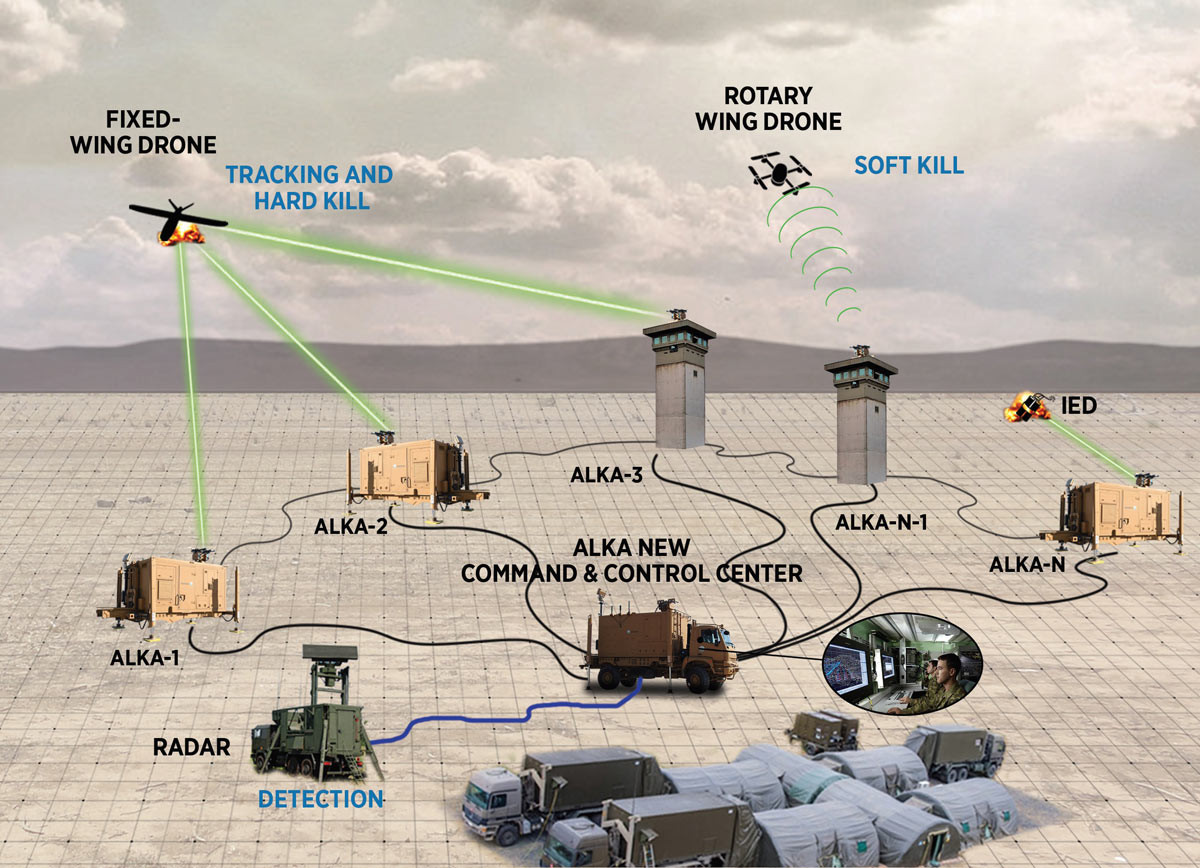
A quadcopter that costs a few hundred dollars can force an air defence battery to fire a missile worth many times more. That arithmetic is the reason Roketsan’s ALKA exists. It is a short-range directed energy weapon that pairs a radio-frequency jammer with a laser, and it is aimed at the cheapest end of the drone threat.
ALKA is also unusual in Turkish service. Turkish press reports in 2026 describe it as the only directed energy weapon in the Turkish Armed Forces inventory, which makes it the closest thing Türkiye has to a fielded laser air defence layer.
What Is the ALKA Directed Energy Weapon System?
ALKA (Yönlendirilmiş Enerji Silah Sistemi, or DEWS) is developed by Roketsan. The company describes it as a very short-range hybrid air defence system that uses electromagnetic and laser technology against asymmetric threats. Roketsan first showed it at the IDEF exhibition in May 2019. According to published accounts, development had run for roughly five years by then.
| Item | Detail |
|---|---|
| Developer | Roketsan |
| Type | Hybrid directed energy weapon (jammer plus laser) |
| Layers | Electromagnetic Jamming System (EJS) and Laser Destruction System (LDS) |
| Laser effective range (manufacturer) | 750 m |
| Detection | Radar plus electro-optical tracking, AI-assisted image processing |
| Configurations | Vehicle-mounted, portable, stationary (tower or cabin) |
| Crew (manufacturer) | Two in mobile form, one in stationary form |
| Serial production | Reported to have begun in 2023 |
How Does ALKA Stop a Drone?
The system works in two steps. A radar picks up the target, and an electro-optical sensor locks on and tracks it. If the drone relies on a radio link or satellite navigation, the jammer can cut that link first. If that fails, or the target is autonomous, the laser takes over.
The laser does not blow a drone apart in the cinematic sense. It dwells on one spot and heats it until a component fails: a wing, a motor mount, a battery, a payload. Time on target depends on material, aim point and power. A Roketsan director quoted in Turkish press in June 2026 put the kill time at roughly one to five seconds for typical drones.
Roketsan also says the system can handle multiple targets at once. Third-party descriptions mention up to 100 simultaneous tracks. The company’s literature lists a threat evaluation and weapon assignment function and multi-sensor data fusion to cut false alarms, and says the system can work autonomously or as part of a network, with command and control redundancy on each vehicle.
How Much Power Does ALKA Have Now?
Public figures have moved quickly, and they do not all agree. Early test coverage in 2022 described a laser of about 50 watts with a 750 m effective range, plus an electromagnetic effect out to about 1,000 m. Later descriptions mention 2.5 kW and 5 kW configurations, with the 5 kW version cited at up to 1,500 m in one defence outlet.
The most recent claim comes from Koray Dayanç, Roketsan’s Weapons Systems and Integration Director. According to Turkish press in June 2026, he said the laser has gone from 2.5 kW through 5 kW and now exceeds 10 kW, and that the 10 kW version is already in the inventory. Treat these as manufacturer statements. Sources use different configurations and years, and some online summaries list other output and range figures, so the safest reading is that ALKA has been upgraded repeatedly rather than that one spec sheet applies.
Roketsan’s own product page still gives the laser destruction range as 750 m. That is the number to hold onto for now.
What Is ALKA Meant to Protect?
Roketsan’s product literature lists military units, government buildings, airports, residential areas, production and energy facilities, and VIP protection. The mobile version is integrated into a vehicle and operated from inside, with its own power source and a modular design. The stationary version sits on a tower or in a cabin, runs from facility power and is controlled from a command centre.
That split matters in practice. A fixed site such as a base or an energy plant can afford the power draw and a single operator. A convoy or forward position needs the vehicle version, where battery and generator capacity limit how many engagements are possible before the system must recharge.
Has ALKA Been Used in Combat?
Several outlets report that ALKA was used in August 2019 near Misrata, Libya, against a Chinese-made Wing Loong II drone operated by forces opposed to the Tripoli government. The claim circulates widely, but it comes from secondary reporting and online accounts rather than a detailed official after-action statement, and independent confirmation is thin. It is best treated as reported, not established.
What is documented is a run of demonstrations. In December 2024, Roketsan released test footage showing ALKA neutralising drones and, according to Army Recognition’s account, detonating a 10 mm explosive reactive armour block. That second result was not part of the system’s original job description. It does point to the use against explosives and improvised devices that Roketsan lists for the system.
Where Does ALKA Fit in Steel Dome?
Turkish coverage places ALKA as the innermost layer of Steel Dome (Çelik Kubbe). The logic is layered defence. Long-range interceptors deal with aircraft and missiles, mid-range systems take the next tier, and something cheap has to handle the swarm of small drones that slip through or arrive too low to engage economically.
Kinetic options already exist at that bottom end. ASELSAN’s KORKUT 35 mm gun system is built for the same problem, and the broader ASELSAN counter-drone and electronic warfare portfolio covers jammers and sensors. A laser’s selling point is the cost per shot, which is mostly electricity, and the absence of ammunition to resupply. Its weaknesses are also well known: weather, dust and smoke reduce effectiveness, a target must be held in the beam for a few seconds, and range stays short.
For the export side of the same problem, see our look at how Türkiye turned the drone threat into a product line.
Who Else in Türkiye Is Building Lasers?
ALKA is not alone. Turkish press commentary names three main laser efforts: TÜBİTAK’s work, ASELSAN’s Gökberk, and Roketsan’s ALKA, with ALKA aimed at unmanned systems and the others pitched at air defence roles. A retired officer quoted by Milliyet cautioned that these systems are not yet powerful enough to bring down aircraft or helicopters, and that smaller targets such as drones, missiles and munitions are the realistic mission.
Separately, METEKSAN’s NAZAR naval system, reported delivered in April 2023, takes a different approach by dazzling the seekers of incoming missiles instead of destroying them.
Is Roketsan Taking Laser Weapons Abroad?
Roketsan has started looking for partners. At World Defense Show 2026 in Riyadh in February, it signed a strategic partnership agreement with Australia’s Electro Optic Systems (EOS) covering laser weapons and integrated counter-drone solutions in jointly identified markets. EOS says it holds the first export contract for a 100 kW-class high-energy laser, with the Netherlands, signed in 2025.
The agreement is a framework for pursuing opportunities, not a delivery contract. No ALKA export customer has been confirmed publicly, and the announcement does not say which system would be offered where. Roketsan General Manager Murat İkinci was quoted saying the company wants to become among the best in laser weapons in the future.
Power scaling is the thing to watch. If ALKA’s output keeps climbing, the target set widens from small quadcopters toward larger fixed-wing drones and loitering munitions, and the case for a laser-first inner layer gets stronger.