
First Production HÜRJET for Turkish Air Force Completes Maiden Flight


The first production-standard HÜRJET destined for the Turkish Air Force took to the air for the first time on August 30, flying an 18-minute sortie from Turkish Aerospace’s facility near Ankara. The aircraft, tail number TUS-A020, flew in bare white primer rather than its eventual service paint scheme, chased by one of the programme’s two development prototypes.
It is a distinction worth being precise about. HÜRJET’s maiden flight as a programme came back in April 2023; what happened on August 30 was the first flight of an airframe built to the configuration Turkish Aerospace intends to actually deliver to squadrons, rather than a development or test aircraft. The flight fell on the 30th anniversary of Turkey’s Victory Day, a detail Turkish Aerospace was unlikely to have left to chance.
From prototype to production line
TUS-A020 is the third HÜRJET airframe built, after the two prototypes that have carried the flight-test campaign since 2023. Turkish Aerospace CEO Mehmet Demiroğlu called the flight “another important milestone for our national aviation,” a fairly restrained description for what amounts to proof that the production line is turning out flightworthy jets, not just engineering demonstrators.
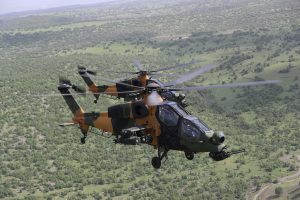
Turkish Aerospace’s rotary-wing sister programme, the T625 GÖKBEY helicopter, has followed a similar arc from certification into fleet deliveries, most recently with its first delivery to the Turkish National Police. The Turkish Air Force has ordered 12 HÜRJET aircraft. An initial batch of six is scheduled for delivery starting in 2027, Turkish Aerospace has said, with deliveries continuing on a rolling basis after that — a schedule that has not publicly slipped, for now. Early production aircraft, including TUS-A020, fly with imported General Electric powerplants (the F404 and F110 families depending on variant); Turkish Aerospace has said later production batches are intended to switch to the domestically developed TEI TF-series engine, though no firm date for that transition has been disclosed.
HÜRJET is built to replace Turkey’s T-38 Talon fleet — roughly 68 of the 1960s-era jets remain in service — and to sit at the top of an Integrated Combat Training System designed to walk pilots up through basic training toward 4.5- and fifth-generation fighters, including KAAN, Turkish Aerospace’s fifth-generation fighter programme. That places HÜRJET in a similar programme role to the T-7A Red Hawk in the United States: a supersonic-capable lead-in trainer meant to close the gap between basic jet training and frontline fighter conversion.
Why it matters beyond Turkey
HÜRJET already has an export customer. Spain’s Ejército del Aire y del Espacio signed on in 2026 to acquire 30 jets under its SAETA-II programme, intended to replace Spain’s ageing fleet of F-5M Freedom Fighters — a contract that made Spain the type’s first international operator and gave Turkish Aerospace a foothold in a NATO air force’s training pipeline. Turkish Aerospace is also pursuing the United Kingdom’s next-generation jet trainer requirement, where HÜRJET would compete against established Western designs, part of a broader Turkish push to grow export targets in rotary-wing and trainer aircraft.
A clean first flight of the production-configuration jet does not resolve either competition on its own, but it removes one of the more common failure points in fighter and trainer programmes: the gap between what flies in test conditions and what actually comes off a production line. Turkish Aerospace still has to hold the 2027 delivery date for the Turkish Air Force’s own aircraft and demonstrate the engine transition it has promised for later batches — both are the kind of commitments that prospective export customers watch closely before committing to their own contracts.
Sources
- The Aviationist, “First Production-Representative Hürjet Jet Trainer Makes Maiden Flight,” August 31, 2026
- Daily Sabah, “1st Hürjet to be delivered to Turkish Air Force completes flight“



[…] The wider point in the original text still holds: evaluation processes in international trainer tenders are multi-stage, running from flight demonstrations to certification and the cost of the sustainment package, and announcements are not contracts. For the competitive picture behind the Spanish award, see our analysis of where HÜRJET fits in the advanced jet trainer market, and for the current programme status, the first production-configuration HÜRJET flew on 30 August 2026. […]
[…] type to help replace its oldest F-4 and early-block F-16 airframes while KAAN matures and while HÜRJET takes over the advanced jet-trainer role. Türkiye Today has reported that Ankara’s broader […]
[…] builds workforce depth and captures value — all genuinely useful — but a buyer evaluating the first production HÜRJET should not read it as […]