Is Türkiye’s TAYFUN BLOK-4 Really a Hypersonic Missile

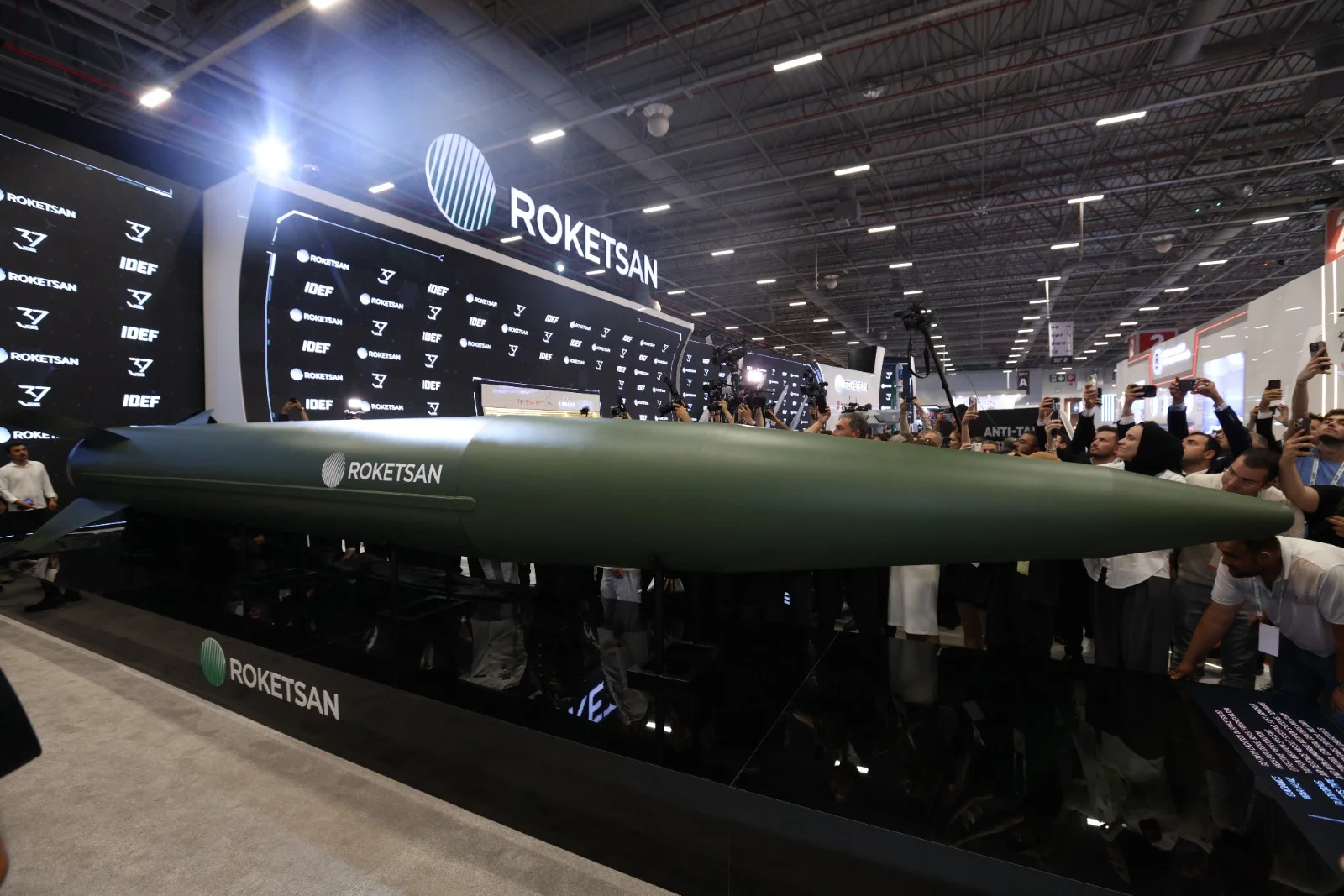
When ROKETSAN rolled a 10-metre green missile onto its IDEF 2025 stand in Istanbul, the company called it the TAYFUN BLOK-4 and described it as a hypersonic ballistic missile. Within hours the phrase “Turkish hypersonic missile” was in headlines worldwide. The label is accurate on one reading and misleading on another, and the gap between the two is worth understanding before the next range or speed figure circulates.
This article sets out what ROKETSAN has actually said, what outside outlets have added, and where Türkiye’s research into a different kind of hypersonic weapon stands.
| Item | Detail |
|---|---|
| Missile | TAYFUN BLOK-4 |
| Developer | ROKETSAN |
| Type | Surface-to-surface ballistic missile, described by the maker as hypersonic |
| Speed | Mach 5 class (reported as exceeding Mach 5) |
| Length and diameter | About 10 m and 938 mm (reported) |
| Launch weight | About 7.2 tonnes (reported) |
| Range | Not officially stated, reported estimates differ widely |
| Warhead | Multi-purpose, penetration-capable (reported) |
| Unveiled | IDEF 2025, Istanbul (July 2025) |
What Did ROKETSAN Actually Say About BLOK-4?
The company’s own IDEF 2025 news release is short. It calls TAYFUN the longest-range ballistic missile produced with national capabilities, says the new variant weighs over seven tons, and says the BLOK-4 carries a multi-purpose warhead meant to neutralise strategic targets such as air defence systems, command and control centres and military hangars. It labels the missile hypersonic.
The rest comes from trade coverage and company officials quoted in the press. Reports put the speed in the Mach 5 class, with ROKETSAN’s general manager quoted as saying the missile sustains speeds above Mach 5, according to Newsweek. Dimensions of roughly 10 metres in length and 938 mm in diameter, against about 610 mm for the original TAYFUN, circulate widely, as does a launch mass near 7.2 tonnes.
What the company has not published is just as telling. No official range, no warhead weight, no accuracy figure and no description of the terminal flight path appeared in the release.
Is Every Fast Ballistic Missile Hypersonic?
Strictly speaking, hypersonic means faster than Mach 5. Many ballistic missiles pass that line in the later stages of flight, particularly medium-range ones, so the word on its own does not make the TAYFUN BLOK-4 unique. A ballistic missile follows a high arc and falls onto its target at great speed, and an air defence radar can often predict where it will end up.
The weapons that arguably deserve the hypersonic tag in current debates are different. Glide vehicles ride the upper atmosphere and change course. Hypersonic cruise missiles fly powered at Mach 5 or above for most of the route. Both are designed to remove the predictability that interceptors rely on.
ROKETSAN’s description points to a third category. Defence outlets such as The War Zone, summarised by Newsweek, read the BLOK-4 as following a modified quasi-ballistic path, which would make it hard to track and engage rather than a true glider. That is an outside interpretation. The company has not described how the missile manoeuvres, if it does.
How Far Can the TAYFUN BLOK-4 Fly?
Here the sources disagree, and no figure should be treated as settled.
- Early coverage of the IDEF reveal cited about 800 km.
- One defence magazine reported the manufacturer’s data as “at least 1,500 km”, according to EDR Magazine.
- Other outlets estimate 1,000 km or more, in line with the target President Erdoğan mentioned in 2023 for the TAYFUN family.
- The War Zone, based only on the missile’s size, placed it in the medium-range ballistic class, which spans roughly 1,000 to 3,000 km.
For comparison, the first TAYFUN test flight in October 2022 covered about 561 km, a demonstrated distance rather than a maximum. Our guide to TAYFUN range and what each Blok does lays out the earlier variants in detail.
Where Does the BLOK-4 Sit in the TAYFUN Family?
The programme began as an offshoot of ROKETSAN’s solid-fuel ballistic work, following the shorter-range BORA. The BLOK-4 is a clearly different airframe. It is much larger than the first variant, and reports say only a single missile fits on its truck-mounted launcher, with a DERMAN 8×8 carrier mentioned in coverage of the SAHA EXPO 2026 display, where the missile appeared on its launcher for the first time.
Other blocks have moved faster toward the troops. The Land Forces have received batches of the BLOK-2, covered in our report on the TAYFUN BLOK-2 delivery. The BLOK-4 is a longer road. ROKETSAN’s management has spoken of mass production in 2026 and entry into the inventory, but the timing has shifted in public statements, and our report on BLOK-4 and GEZGİN production follows the latest wording. The company has also reportedly said the missile is not intended for export.
Who Is the BLOK-4 Meant to Hit?
The target list in the release is specific: air defence systems, command centres, hangars and critical infrastructure. Those are the assets a country wants to remove in the first minutes of a conflict, and they are usually well defended. A faster, heavier missile with a penetrating warhead improves the odds against hardened or protected sites.
Accuracy is another open question. One outlet cites a circular error probable of 5 to 10 metres, using inertial navigation aided by GPS and GLONASS, but ROKETSAN did not publish a figure at IDEF, so that number should be read as reported. The same goes for claims of resistance to electronic warfare. Without live-fire data on the BLOK-4 itself, performance statements rest on the earlier TAYFUN tests.
It also changes the arithmetic for neighbours. Reported ranges beyond 1,000 km would cover the Aegean, the Eastern Mediterranean, the Black Sea and parts of the Middle East from Turkish territory, according to GlobalSecurity.org. Official Turkish statements frame the system as deterrence and a step in domestic strike capability, not as a response to a named adversary.
On the defensive side, Türkiye is building its own layered shield, explained in our piece on the Steel Dome programme. The two efforts run in parallel, one to absorb incoming threats and one to hold distant targets at risk.
Where Does GEZGİN Fit?
GEZGİN is often mentioned in the same breath as the BLOK-4, but the two are different weapons. GEZGİN is a long-range land-attack cruise missile, not a ballistic or hypersonic one. TÜBİTAK SAGE is reported as prime contractor, with ROKETSAN as main subcontractor, and a submarine launch test was reported at the Aksaz Naval Base in May 2025. ROKETSAN has not published an official range, and estimates above 1,000 km are unofficial.
Together they split the work. A ballistic missile arrives fast on a predictable arc, while a cruise missile flies low and can route around defences. ROKETSAN’s shorter-range cruise option is the KARA ATMACA, which sits well below GEZGİN in reach.
Is Türkiye Working on a True Hypersonic Weapon?
There are signs of research, though not of a fielded system. In 2022, TÜBİTAK SAGE director Gürcan Okumuş said hypersonic missiles would be the institute’s main focus once its ramjet and wind tunnel work was complete, and that a scramjet project was at an early conceptual stage.
The ramjet side has moved since. According to reports, the company DeltaV Uzay Teknolojileri, supported by the Presidency of Defence Industries, ignited an indigenous ramjet in flight on 24 November 2025 as part of the GÖKHAN air-to-air missile effort, with SSB President Haluk Görgün placing Türkiye among a small group of countries able to build both solid and liquid-fuel ramjets. A ramjet takes a missile to supersonic speed and sustained powered flight. A scramjet, the engine class usually linked to hypersonic cruise missiles, would be the next step, and no flight test of one has been announced.
That is the useful way to read the phrase “Turkish hypersonic missile”. The BLOK-4 is a large ballistic missile whose maker says it flies above Mach 5. Genuine glide or scramjet-powered weapons are still at the research stage, with no declared timeline. The distinction matters for anyone judging what Türkiye can field today and what it is only studying, and it explains why ROKETSAN’s own wording, more than the headlines around it, is the safest guide. More background on the maker is in the ROKETSAN company profile.