TOLUN Glide Bomb Gives Turkish Jets and Drones Standoff Reach

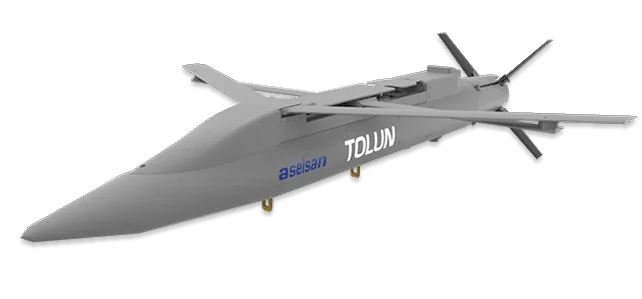
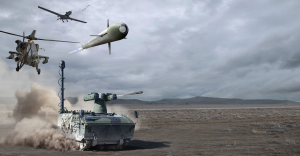
Most of the bombs a Turkish fighter or drone drops are still heavy, and most of the guidance kits that steer them still bolt onto old Mk-80 bodies. TOLUN is a different idea. ASELSAN’s weapon is a small, purpose-built glide bomb with folding wings, a satellite and inertial guidance package, and enough standoff range to let the launch aircraft stay well outside the target area.
It has now been flown from F-16s, from the Bayraktar AKINCI and, most recently, from the internal bay of the Bayraktar KIZILELMA, and a family of variants is taking shape around it. This article lays out what TOLUN is, what is publicly known about its performance, and where it fits among Türkiye’s precision weapons.
What Is the TOLUN Glide Bomb?
TOLUN is an air-launched, GPS/INS-guided glide munition. According to ASELSAN’s product page, the warhead was designed by TÜBİTAK SAGE, while the rest of the system, including guidance and control, comes from ASELSAN. The wings stay folded while the weapon hangs on the aircraft and deploy shortly after release to provide aerodynamic lift, which is what stretches its reach without a rocket motor.
| Manufacturer | ASELSAN (warhead by TÜBİTAK SAGE) |
|---|---|
| Type | Air-launched guided glide munition |
| Guidance | GPS/INS (TOLUN-IIR adds an imaging infrared seeker) |
| Range | 55 NM (about 100 km) per ASELSAN, depending on release conditions |
| Accuracy | CEP under 10 m per ASELSAN |
| Penetration | 1 m of reinforced concrete per ASELSAN |
| Carriage | SADAK-4T smart pneumatic quad rack |
| Platforms tested | F-16, Bayraktar AKINCI, Bayraktar KIZILELMA |
The company describes the weapon as suitable for engaging multiple soft and hardened targets at once. Published weight figures differ between outlets, with the weapon commonly described as a 250-pound-class munition, so this article does not rely on a single number.
How Far Can TOLUN Fly and How Accurate Is It?
ASELSAN’s datasheet lists a range of 55 nautical miles, a maximum release altitude of 40,000 feet, and a circular error probable under 10 metres. The penetration claim is one metre of reinforced concrete when released from 30 NM. Defence press coverage generally repeats a range of roughly 100 km in optimal conditions, which matches the datasheet figure; one outlet cited more than 110 km from a fighter jet.
Range depends heavily on release altitude and speed, so a drone at medium altitude gets less reach than a fighter that lofts the weapon from high up. Treat the headline number as a best case, and note that the datasheet figures are manufacturer claims. Independent range and accuracy data from live firings have not been published.
Navigation is the other selling point. TOLUN combines satellite positioning with an inertial unit, so it can keep flying toward its target if the GPS signal is degraded. Reports from earlier F-16 firings said the weapon performed well under heavy jamming, though those accounts come from press coverage of tests rather than independent evaluation.
Which Aircraft Carry TOLUN?
The first public drop from an AKINCI took place in December 2022, according to defence press reports. In August 2024, tests from the same aircraft reportedly included strikes on floating sea targets. The Bayraktar AKINCI carries the weapon on the SADAK-4T quad rack under the fuselage, and reports put the load at up to four bombs.
The F-16 is the other established carrier. A Defense Mirror report dated 1 January 2025 said ASELSAN had delivered TOLUN bombs to the Turkish Air Force for use on the F-16, with up to eight munitions per sortie. Earlier F-16 trials were reported to have scored four simultaneous hits.
The newest platform is the stealthy drone. On 30 July 2026, according to The Aviationist citing Baykar, the Bayraktar KIZILELMA released a TEBER-82 guided bomb and a TOLUN-P from its internal weapons bays at the Çorlu test centre. The TEBER-82 hit its marked target, while the TOLUN-P reportedly landed farther from its aim point, so the drop is better read as an integration milestone than a full accuracy demonstration. ASELSAN said the integration would let KIZILELMA carry up to eight TOLUN-P munitions in its internal station.
What Are the TOLUN Variants?
ASELSAN’s product catalogue now lists TOLUN-I, TOLUN-F, TOLUN-P, TOLUN-IIR, TOLUN-S, TOLUN-L and TOLUN-EW alongside the base weapon. Only some of these have detailed public descriptions.
- TOLUN-I uses an impact fuze and a fragmentation warhead.
- TOLUN-F adds a proximity sensor with a fragmentation warhead, aimed at targets such as armoured personnel carriers. Reports also mention a selectable impact angle and GPS-spoofing-resistant software.
- TOLUN-P carries a penetrating warhead with a programmable time-delay fuze, designed for reinforced structures.
- TOLUN-IIR adds an imaging infrared seeker and a data link so an operator can steer the weapon in the final phase, which opens the door to moving targets.
On 1 September 2026, ASELSAN fired TOLUN-I, TOLUN-F and TOLUN-P from an AKINCI at the Karapınar range in Konya in front of military delegations from more than 15 countries, according to EDR Magazine. The results of that event are covered in our report on ASELSAN’s guided munition demonstration.
A ground-launched cousin, GÖKTAN, pairs the TOLUN airframe with a hybrid rocket booster from the Turkish company DeltaV. Its first flight test was reported from Sinop in February 2025.
Who Has Ordered It?
TOLUN has an export record already. In August 2023, ASELSAN announced a contract worth roughly 35 million dollars for TOLUN munitions with an undisclosed country, a figure reported as 36 million by some outlets. At ADEX 2024 in Baku, ASELSAN said Azerbaijan had ordered TOLUN together with ASELFLIR-500 electro-optical systems for its AKINCI drones, with deliveries planned for 2025, according to Janes. These sales values come from company statements and press reports, not from published contract documents.
Where Does TOLUN Sit Among Turkish Precision Weapons?
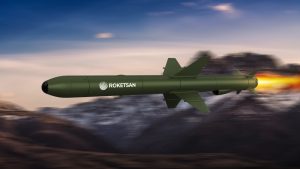
Türkiye’s precision-strike inventory already includes Roketsan’s MAM family and the TEBER guidance kits, which turn conventional bombs into guided ones. Our explainer on Turkish guidance kits covers that older approach. TOLUN differs because it is a complete, small, winged weapon rather than a kit, designed from the start for external racks and internal bays on modern aircraft.
Press commentary compares it with the American GBU-39 Small Diameter Bomb, and one outlet likened it to a Mk-81-class weapon. Those are loose comparisons of size and role rather than equivalences. What matters for the Turkish services is practical: a domestic source for stand-off munitions, built by ASELSAN, that can be integrated on locally developed drones.
The open questions are volume and the quality of the variant line-up. ASELSAN has not published production quantities, and several versions remain in test. The next milestones to watch are the TOLUN-IIR seeker against moving targets, and any additional KIZILELMA drops that show the weapon hitting its aim point from the internal bay.