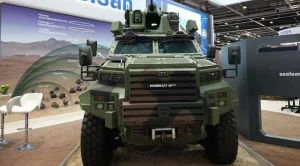
ASELSAN’s PULAT and AKKOR Give Turkish Tanks an Active Shield

A tank crew that sees the missile launch usually has seconds, sometimes less. Thicker armor was the traditional answer. Turkish engineers have spent more than a decade on a different one, which is to destroy or blind the incoming round before it touches the hull. ASELSAN’s two active protection systems, PULAT and AKKOR, are how that idea reached Turkish tanks.
They are related but not the same product, and the two names are often mixed up. This article separates them, based on ASELSAN’s own datasheets and defense press reporting.
What Is the Difference Between PULAT and AKKOR?
PULAT is the faster, narrower system. ASELSAN describes it as a hard-kill active protection system: a radar detects an anti-tank missile or rocket heading for the vehicle, and a countermeasure munition disables it at a safe distance from the platform. According to the company’s datasheet, the munitions were developed by TÜBİTAK SAGE.
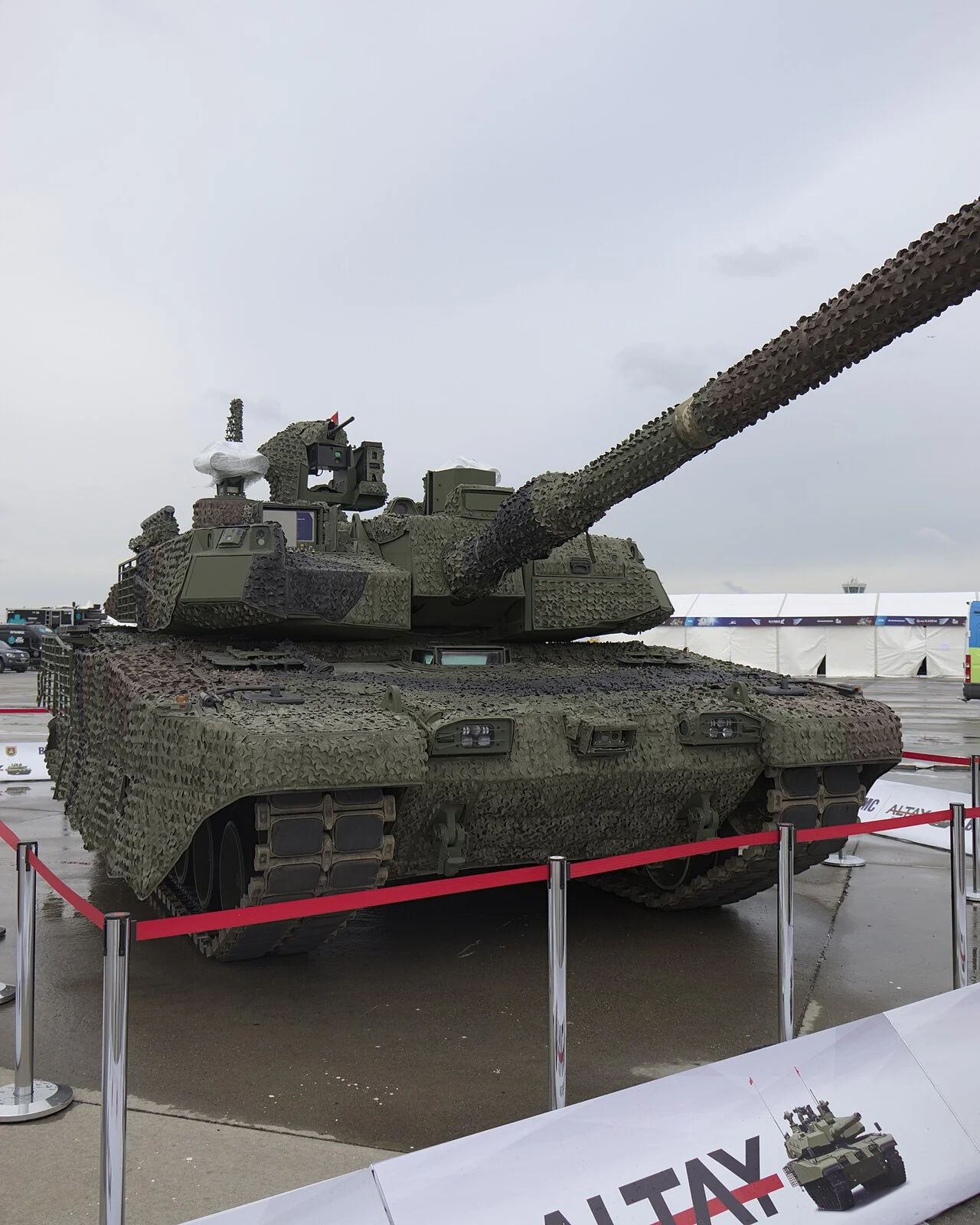
AKKOR is the wider package. It combines the same hard-kill logic with a soft-kill layer, and ASELSAN markets it as an electronic warfare self-protection suite for armored vehicles. It was designed from the start around the ALTAY main battle tank.
| Feature | AKKOR PULAT | AKKOR |
|---|---|---|
| Developer | ASELSAN | ASELSAN |
| Method | Hard-kill | Hard-kill and soft-kill |
| Detection | Triggering radar | Very high resolution hard-kill radar plus laser warning subsystem |
| Coverage | 360 degrees, depending on module placement | 360 degrees |
| Threats | Anti-tank missiles and rockets | Missiles and rockets, including top-attack and fly-over threats, and laser-guided missiles |
| Standards cited by ASELSAN | NATO STANAG 4569 qualification, MIL-STD 461 and 810 | Not stated in datasheet |
| Lead platform | M60T tanks | ALTAY |
How Does the Hard-Kill Layer Work?
Both systems start with radar. In AKKOR PULAT, ASELSAN lists the components as an anti-threat module (an armor-protected ammunition case, the anti-threat ammunition and a triggering radar), a power distribution unit and a control panel. Modules are placed around the vehicle, and coverage depends on how many are fitted and where.
Because the architecture is distributed, the system can in principle handle more than one threat at a time. ASELSAN states that qualification involved hundreds of munitions, from anti-tank rockets to many known ATGMs. The company also stresses that radar detection keeps the system working in dust, mud, rain, snow and fog, where optical sensors struggle.
AKKOR’s hard-kill chain is described in a similar way but with more capable parts: a very high resolution radar, a high-speed launcher, a smart munition and a control panel. ASELSAN says the direct reaction to the threat reduces collateral damage. That matters for tanks operating near infantry and civilians, where a poorly aimed countermeasure can hurt friendly troops.
What Does the Soft-Kill Layer Add?
Hard-kill alone does not help against every threat. A laser-guided missile can be defeated by confusing its seeker rather than shooting it. AKKOR’s soft-kill side includes a laser warning subsystem, multispectral soft-kill munitions, launchers and a control panel. ASELSAN says it generates a multispectral smoke screen that protects against laser-guided missiles and thermal sighting systems.
An EW computer ties both layers together. This is why ASELSAN files the product under electronic warfare, and why it sits alongside the company’s wider work described in our look at how Turkish companies share the electromagnetic spectrum.
Where Did PULAT Come From?
PULAT came out of an urgent operational requirement. Defense reporting, including The War Zone in 2019, said ASELSAN obtained a license from Ukraine’s Microtek to produce a version of the Zaslon-L system under the name Akkor Pulat. That report cited an initial order of 120 systems for M60A3, M60T and Leopard 2A4 tanks. ASELSAN’s own current datasheets describe the system and its TÜBİTAK SAGE munitions without mentioning the Ukrainian origin, so the exact split of design work between the partners is not something the company documents publicly.
The system was publicly shown on an M60 at IDEF 2019, according to Janes. Army Recognition reported that it was fielded on M60T tanks upgraded under the Fırat project, equipping a battalion, and called it a transitional step for Turkish active protection. ASELSAN says PULAT was qualified against hundreds of RPGs and ATGMs and describes it as one of the few operationally used active protection systems in the world. Treat that last phrase as the company’s claim, not an independent ranking.
How Did AKKOR Reach the ALTAY?
AKKOR is the older program in one sense. Reporting in 2015 said ASELSAN had started it with its own funds around 2009 and that the system was in testing. Turkish procurement officials then signed a development contract reported at 54 million euros, covering design, testing, qualification and prototypes. The early plan to fit it to the ALTAY from 2018 slipped, as the tank program itself did.
By IDEF 2023, ASELSAN said the first AKKOR units had been delivered to the Turkish Armed Forces with the ALTAY prototypes and were in field testing, and that the system had reached a level where it could be adapted to other platforms. Army Recognition later reported that an SSB engineer said trials were complete and that fitting to ALTAY by 2025 was expected, with Leopard 2A4 tanks and Korhan light armored vehicles named as further candidates. Those further fits are reported plans, not confirmed deliveries.
The tank itself has now moved into production. Press reports said the first ALTAY tanks were handed to the Land Forces at BMC’s new Ankara plant in late October 2025, and that the APS fitted to the tank is AKKOR. For the full picture of deliveries and schedule, see our ALTAY tank programme guide, and for the maker, the BMC profile. The first batch uses an imported diesel, covered in our piece on the ALTAY engine.
Why Do Tanks Need Active Protection Now?
ASELSAN’s own explanation is simple. RPG and ATGM use against main battle tanks has grown, and passive armor alone has become inadequate. Cheap loitering munitions and top-attack missiles have made that case stronger, and AKKOR’s datasheet specifically lists top-attack and fly-over threats.
There is also a fielding question. A hard-kill system fires a countermeasure munition close to the vehicle, so crews, nearby infantry and the platform’s own sensors have to be considered in doctrine and integration. ASELSAN stresses that the modular, distributed design lets AKKOR PULAT be adapted to different armored vehicles by changing module layout, which is how one system can serve both an ageing M60T and a new-build tank. Integration work on each platform still decides how well the radar sees and where the launchers sit.
No such system is a guarantee. Hard-kill countermeasures work against the threat types they were qualified against, and ASELSAN notes its specifications are subject to change and carry a tolerance of 10 percent. Independent combat data on either system has not been published, and nothing in the sources reviewed here quantifies how many tanks have survived because of them.
What Else Does ASELSAN Put on Armored Vehicles?
Active protection is one piece of a layered kit. Weapon stations, optics and fire control all come from the same house. One example is the SARP turret, which we covered in our report on why ASELSAN’s SARP keeps appearing on Turkish armored vehicles. The wider company is profiled in ASELSAN: The Company Behind Türkiye’s Defence Electronics.
The next questions are practical ones. How many ALTAY tanks will carry AKKOR, whether Leopard 2A4 and Korhan fits go ahead, and whether ASELSAN finds an export customer for either system. None of these has been officially settled in the sources reviewed.