ASELSAN’s KORKUT 35 SPAAG Takes On Drones for 12-Nation Audience

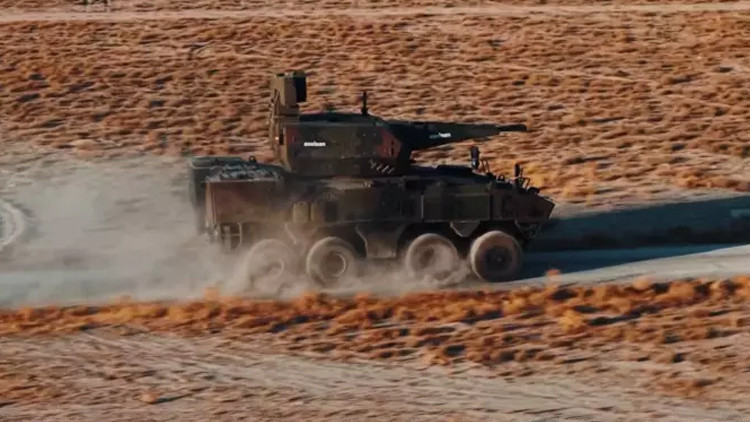
ASELSAN put its KORKUT 140/35 self-propelled air defence gun through a live-fire demonstration on 26 September at the Ministry of National Defence’s Karapınar Fire Test and Evaluation Group Command range in Konya province, engaging a mix of fixed-wing, delta-wing and mini/micro drones as well as a moving ground target while the system itself was on the move. Defence delegations from twelve countries watched the trial, according to Turkish and international trade media that observed the event, underlining how central counter-drone capability has become to ASELSAN’s export pitch.
What the Test Showed
The demonstrated configuration mounts the KORKUT 140/35’s twin 35 mm gun turret on Otokar’s ARMA II 8×8 wheeled armoured vehicle, a wheeled derivative of the system that originally entered Turkish service on a tracked FNSS ACV-30 chassis. ASELSAN has been showing this wheeled variant, sometimes referred to in company material as KORKUT 35 WV, at exhibitions since Eurosatory 2024 and IDEF25, and tested it separately in January 2026 against an FPV-type drone.
At Karapınar, the emphasis was squarely on the low-cost drone threats that have dominated recent conflicts. The system engaged fixed-wing, delta-wing and mini/micro UAVs, including a representative target standing in for Shahed/Geran-type loitering munitions, and separately fired on a ground target while both the KORKUT vehicle and the target were moving. ASELSAN has said the system’s accuracy and shot dispersion held up under these dynamic conditions, a harder test than engaging a static target from a stationary platform.
Inside the System
KORKUT’s core weapon is a twin 2×35 mm Oerlikon KDC-02 cannon, produced under licence by Türkiye’s state ordnance maker MKE, capable of a combined rate of fire of around 1,100 rounds per minute per gun installation out to an engagement range of roughly 4 km. Its signature ammunition is ASELSAN’s own ATOM 35 airburst round, which detonates at a programmed point along its trajectory to spray fragments across a kill volume rather than relying on a direct hit — a useful trait against small, agile drones that are hard to strike precisely with conventional rounds. The original towed and tracked KORKUT installations pair three gun vehicles with one command-and-control vehicle carrying 3D search radar; the wheeled, single-vehicle ARMA II version compresses detection, tracking and engagement onto one platform.
ASELSAN has also flagged upgrade paths for the family, including KORKUT 240/35 and 250/35 variants and a version integrating the company’s KALKAN 050-G AESA radar array alongside KANGAL FPV jammers, adding an electronic soft-kill layer to the gun’s hard-kill role. None of these enhanced variants were confirmed as part of the Karapınar demonstration, and ASELSAN has not disclosed unit pricing or a timeline for any of the international delegations to place orders.
Why It Matters Beyond Türkiye
Counter-drone defence has become one of the most competitive segments of the global air-defence market, driven by the proliferation of Shahed-type loitering munitions and cheap first-person-view attack drones over Ukraine and the Middle East. Gun-based systems like KORKUT compete there on cost per engagement: intercepting a few-thousand-dollar drone with a multi-million-dollar guided missile is an increasingly hard sell for budget-conscious militaries, and a 35 mm airburst round is far cheaper per shot. That logic is also why ASELSAN keeps returning to live international audiences for these tests rather than only publishing footage — a foreign delegation watching a system defeat a moving target in real time is a stronger sales argument than a data sheet.
KORKUT already has at least one export customer: Pakistan has fielded the system, and Türkiye’s own armed forces have used it in service since 2016 as part of the layered ground-based air defence network that also includes ASELSAN’s SUNGUR short-range missile and the wider Çelik Kubbe (Steel Dome) architecture. A wheeled, single-vehicle version aimed squarely at mobile force protection widens the pool of potential customers to militaries that want organic air defence for manoeuvre brigades without fielding a full three-vehicle battery.
The Broader Picture
The Karapınar trial adds to a run of ASELSAN counter-drone announcements this year, from the GÜRZ hybrid air defence system’s first live-fire test and its counter-drone and electronic-warfare showcase at MSPO 2026 in Poland to the SMASH 300 naval remote weapon station’s debut firing tests. Türkiye’s defence and aerospace exports have been rising through 2026, and air defence exports — cheaper and faster to qualify than a fighter jet or a frigate — have been one of the sector’s more reliable growth lines. Whether the twelve delegations at Karapınar translate into contracts will depend on factors ASELSAN does not control, including end-user export approvals and competing offers from European and Israeli counter-drone suppliers. What the demonstration did confirm is that ASELSAN considers the wheeled KORKUT variant mature enough to put in front of foreign militaries under realistic, moving-target conditions rather than a controlled static setup.
Sources
Reporting for this article drew on accounts from Defence Industry Europe, TURDEF and Army Recognition, alongside ASELSAN’s own product materials on the KORKUT 140/35 system.