Turkish Artillery Now Spans Howitzers, Guided Rockets and Shell Supply

Turkish artillery used to mean one thing: a licence-built self-propelled gun and a large stock of imported or old-stock tubes. In 2026 the picture is broader. Türkiye now fields its own 155 mm self-propelled howitzer in a second-generation form, sells a locally designed 105 mm towed gun to NATO members, shows two new wheeled howitzers in factory trials, and fires guided rockets that were not in the inventory a generation ago. This article walks through how those pieces fit into one Turkish artillery programme, what is confirmed and what is still reported.
| Item | Detail |
|---|---|
| Programme scope | Self-propelled 155 mm, towed and light 105 mm, rocket artillery, guided rockets, ammunition supply |
| Main producers | BMC and the Land Forces maintenance factory (Fırtına II), MKE (BORAN, URAN, Attila), Roketsan (rockets and guided rockets) |
| Self-propelled gun | T-155 Fırtına II, 155 mm/52 calibre |
| Light howitzer | BORAN, 105 mm, about 1,700 kg (reported) |
| Rocket artillery | T-122 Sakarya (122 mm), TRG and TRLG guided rockets |
What does Türkiye field in self-propelled artillery today?
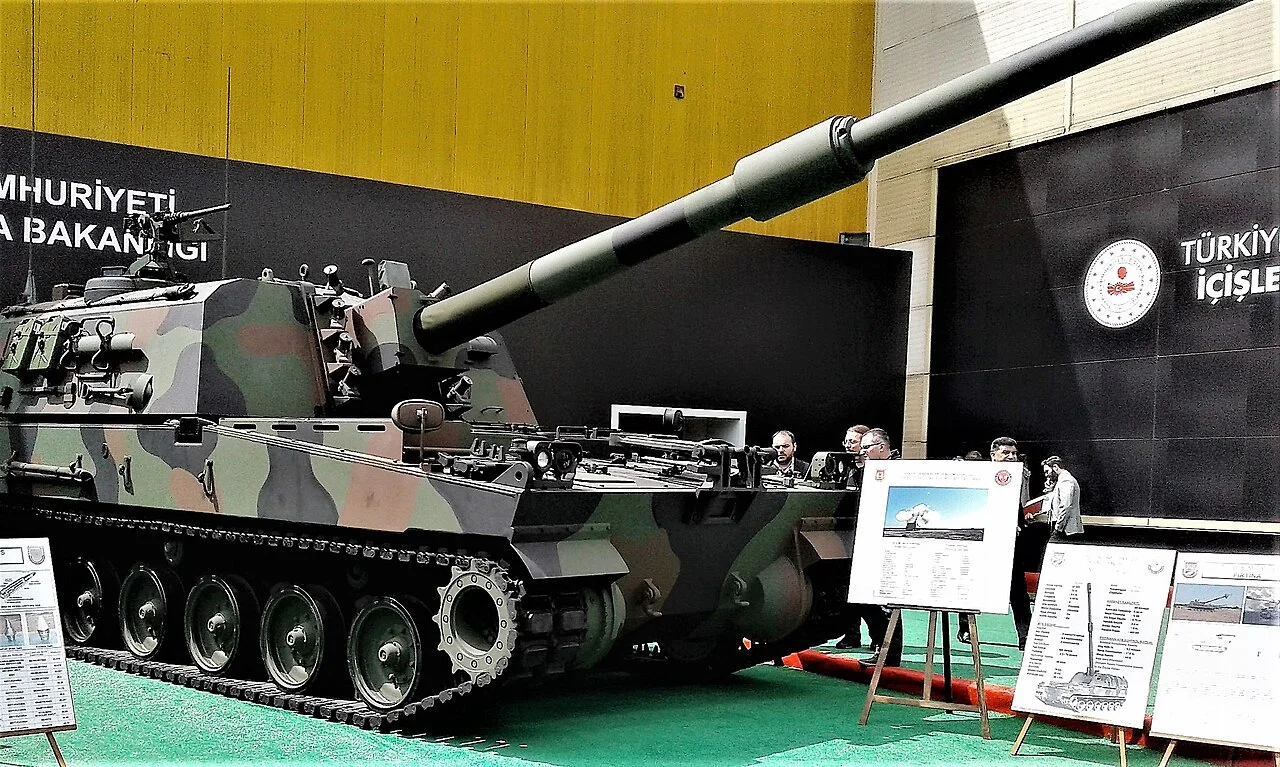
The backbone is the T-155 Fırtına, a 155 mm self-propelled howitzer built under a technology-transfer arrangement based on the South Korean K9 Thunder, with Turkish-made subsystems added over time. It fires standard NATO 155 mm ammunition from a 52-calibre barrel, and published figures put its maximum range at about 40 km depending on the round. Our profile of the Fırtına howitzer covers the platform’s history.
The newer Fırtına II version is the programme’s centre of gravity. Public descriptions mention a fully electric, servo-controlled turret and gun drive, an automated loading system, an ASELSAN fire-control suite and a remote weapon station. BMC Defence is named as the manufacturer, and the Land Forces’ maintenance factory in Sakarya’s Arifiye district is reported to have started series production of a batch of 140 vehicles.
Deliveries have come in small lots. Turkish media reported six more Fırtına II vehicles handed over by BMC in early 2023. Open sources also describe an engine problem: roughly 40 vehicles are said to use the original imported powerpack, while the larger follow-on batch is meant to carry a domestic engine, and Azerbaijan’s export order is reported to be partly on hold until that powerpack is fielded. Treat those numbers as reported rather than confirmed by the Ministry of National Defence.
How did BORAN turn a light howitzer into an export product?
BORAN is a 105 mm air-transportable howitzer from MKE, the state-owned manufacturer. The company’s own site describes it as the lightest howitzer in its class that can be moved by air. Reported figures give a weight of about 1,700 kg, a deployment time under a minute and a normal rate of fire of around six rounds per minute, with short bursts of 12 rounds. Helicopter carriage, including by medium-lift types, is part of the design pitch.
It entered Turkish service in 2021, and the export record is what changed its profile. Bangladesh is reported as the first customer in 2024, described as Türkiye’s first howitzer export. North Macedonia followed in 2025 as a European NATO buyer, and an Albanian order for six guns with ammunition has been reported for 2026. We follow the Balkan angle in our piece on drones, howitzers and ammunition spreading across the Balkans.
The lesson for planners is simple. A light gun that a small army can afford, airlift and integrate with NATO ammunition sells in places where a 50-tonne tracked system never would.
What are the new Attila and URAN howitzers?
At SAHA Expo in May 2026, MKE showed two more self-propelled designs, according to Janes. The Attila is a 155/52 mm gun on a 6×6 Tatra T815 chassis, reported at roughly 29 tonnes combat weight, with 4 to 6 rounds a minute and a load of 36 to 38 rounds. The URAN puts a BORAN-derived 105 mm gun on a 4×4 KIA light tactical vehicle with a two-person crew and elevation from minus 3 to plus 70 degrees. Both were reported to have completed factory trials. Neither has a publicly announced Turkish Armed Forces order.
That last point matters for how to read the programme. These are company-funded offers aimed at buyers who want truck-mounted artillery quickly. Our earlier report on the URAN and BORAN exports tracks where the 105 mm line stands.
Where does rocket artillery fit in?
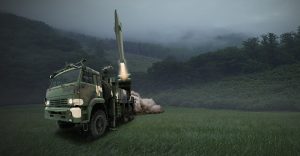
Roketsan’s T-122 Sakarya, a 40-barrel 122 mm multiple rocket launcher, has been associated with the Land Forces since the late 1990s. Reported ranges run to about 36 to 40 km. The more interesting development is guidance. Roketsan’s TRG-122, TRG-230 and TRG-300 families use the calibre in millimetres as part of the name, and laser-seeker variants carry an L in the middle.
The TRLG-230 is described as a 230 mm rocket with a laser seeker, with a reported range band of about 20 to 70 km, launched from the multi-calibre launcher family. The TRG-300 Tiger sits above it, with a reported 20 to 120 km range, and Bangladesh is reported to have received a second batch in October 2021. For the seeker detail see our explainer on the TRLG-230, and for the ballistic-missile tier above it, the TAYFUN range guide.
Together these rockets cover the gap between a 155 mm shell and a ballistic missile. Cannon artillery gives volume and low cost per round; guided rockets give reach and precision when a target is worth the price.
How do the tiers divide the work?
Read as a system rather than a list of products, the programme splits by weight and reach. The light 105 mm guns, BORAN and URAN, serve mobile or airlifted units that need support without a heavy logistics tail. The 155 mm tier, Fırtına II and Attila, carries the standard NATO calibre and the longest tube-artillery reach, which is why it is the one that depends most on ammunition supply. Rocket artillery then adds saturation fire with the Sakarya and precision strikes with guided rockets, while TAYFUN-class missiles sit above both.
The split also shapes exports. Azerbaijan is reported to have ordered 36 Fırtına vehicles, and Ukraine was reported in 2023 to be seeking the system, but neither case is a closed chapter in public sources. The 105 mm gun has been the easier sale because it fits small defence budgets and existing NATO-standard rounds, a pattern visible in the Balkan orders above.
Fire control ties it together. ASELSAN’s role in the Fırtına II fire-control suite means the Land Forces can keep software and sensors under national control. The same logic explains the push for a domestic powerpack: an engine built abroad can slow deliveries even when the rest of the vehicle is Turkish.
Can Türkiye make the shells to feed all of this?
Barrels are only half the answer. NATO-standard 155 mm production has been a bottleneck across Europe since 2022, and Turkish firms moved into that gap. Repkon, a metal-forming machinery maker, has supplied shell production equipment abroad, and reports link it to lines in the United States, an explosive-filling facility planned in Germany for early 2027, and a Pakistan plant sized at about 120,000 shells a year. Those figures come from trade and press reporting and have not been checked against company filings. The US project has also drawn criticism over output, so planned capacity should not be confused with delivered shells. More on the machinery side is in our Repkon report.
For the Turkish Army the practical question is whether domestic ammunition plants can match the fire rate of Fırtına II and Attila-type guns in a long conflict. Public data does not settle that.
What is still unclear?
- The exact delivered number of Fırtına II vehicles and the date the domestic engine enters service.
- Whether the Land Forces will order Attila or URAN, or whether they stay export-oriented.
- Production quantities and unit costs for guided rockets, which Roketsan has not published in full.
- Real shell output from Turkish-equipped plants abroad, as opposed to announced capacity.
Until official figures appear, the safest reading is of a programme with three clear parts: a tracked 155 mm core, an export-proven light howitzer line, and a rocket tier that is getting steadily more precise.