Turkish Firms Build GPS Receivers That Shrug Off Jammers

Satellite navigation signals reach the ground at extremely low power. That is why a modest jammer can blind a receiver, and why a guided shell or drone that depends on GPS can end up far from its aim point. Turkish engineers have spent the past several years on the receiver side of that problem, and a handful of domestic firms now sell anti-jam GNSS products aimed at missiles, drones and ships.
Why Does GPS Jamming Hurt Guided Munitions So Much?
Satellite navigation, whether GPS, Galileo, GLONASS or BeiDou, relies on weak signals. Anything that floods the same frequencies drowns them. A spoofer is subtler: it transmits counterfeit signals so the receiver computes a wrong position or time without knowing it.
The war in Ukraine made the cost visible. According to Defense One, the Pentagon’s acquisition chief Bill LaPlante said in 2024 that a new ground-launched glide bomb “just doesn’t work” against Russian electronic warfare. Reporting on the Excalibur 155 mm round describes a similar arc: strong early accuracy, then degraded results once jamming spread. Exact hit rates vary by source and are contested, so treat any single percentage with caution.
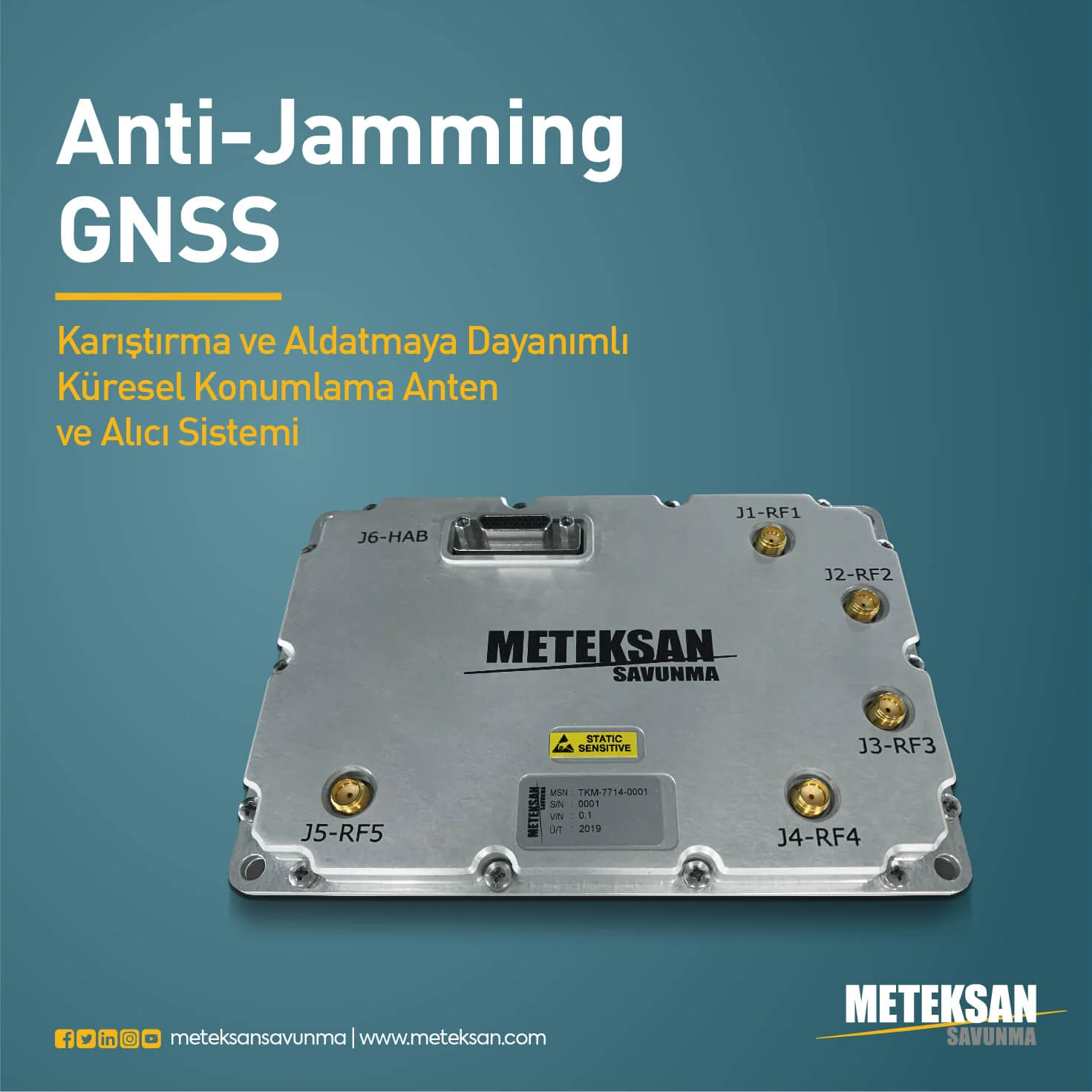
Türkiye did not need to wait for that lesson. Meteksan Defence said in June 2020 that it developed its anti-jamming GNSS product in response to jamming and spoofing experienced during operations in Northern Syria and Libya, according to the company’s announcement.
How Does an Anti-Jam GNSS Antenna Actually Work?
Most of the Turkish products are built around a controlled reception pattern antenna, or CRPA. Instead of one antenna element, a CRPA uses an array. Software compares what each element hears and works out the direction each signal comes from. Satellites are spread across the sky; a jammer usually sits at one point. The processor then steers “nulls” toward the jammer, in effect turning the antenna deaf in that direction while it keeps listening to the satellites.
Because direction of arrival also says something about authenticity, an array can help flag spoofing too.
More elements mean more simultaneous jammers can be nulled. The trade-off is size, weight and power, which matters a great deal on a loitering munition or a mini-UAV.
Which Turkish Companies Build Anti-Jam GNSS Hardware?
| Product | Developer | Reported details |
|---|---|---|
| Anti-Jamming GNSS | Meteksan Defence | 4-element array with built-in receiver; GPS, GLONASS, Galileo and BeiDou support; announced June 2020; MIL-STD-810G and MIL-STD-461F compliant |
| CRPA GPS antenna | TÜBİTAK SAGE | 4-element antenna with internal receiver; about 100 g and 7 x 7 x 2 cm; fitted to the Barbaros Hayreddin Paşa seismic vessel in 2020 |
| KARETTA | ASELSAN | 8-element antenna plus controller; GPS, Galileo, GLONASS and BeiDou; listed for land, air, naval and UAV platforms |
| HEDGE-8008 | EDGE Microwave | 8-element design; about 275 g; more than 50 dB nominal jammer suppression and seven independent suppression channels, per a December 2025 report |
The table is not exhaustive, and all performance numbers are manufacturer claims reported by trade outlets, not independent test results.
Meteksan Defence
Meteksan’s unit pairs the antenna array with a receiver and reconstructs a clean signal before handing it on to a standard GNSS receiver. The company says it is designed for missile systems and unmanned aircraft of the Turkish Armed Forces and can handle several jammers at once at high speed and altitude. The broader picture of the firm is in the Meteksan Defence profile.
TÜBİTAK SAGE
The state research institute’s CRPA module is small enough for drones and small weapons. Turkish press reporting in November 2020 said it was protecting the Barbaros Hayreddin Paşa during seismic surveys in the Eastern Mediterranean. For where SAGE and its sister institutes fit, see how TÜBİTAK powers Türkiye’s defence research.
ASELSAN and EDGE Microwave
ASELSAN lists the eight-element KARETTA among its anti-jam solutions, aimed at military land, air, naval and UAV users. EDGE Microwave, a much younger firm, announced the HEDGE-8008 in late 2025 for small UAVs, loitering munitions and marine platforms. Its claimed suppression figure is high for a unit of this weight, which is exactly the sort of number that field trials will test.
What If the Satellites Cannot Be Trusted at All?
A better antenna is one layer. The other is not depending on satellites alone.
Inertial navigation keeps a weapon on course for a while when the signal drops, though its error grows with time. TUALCOM, which is reported to work with TÜBİTAK SAGE on anti-jam GPS technology, also describes TRNAV, a ground-based positioning and timing network. Stations form a mesh and a receiver calculates its 3D position from signal arrival times. The company says its signal is roughly 50 dB stronger than GPS at the receiver, uses frequency hopping and spread spectrum, and reached timing accuracy of 5 ns RMS during tests. Those are company claims.
The US has the same problem. M-code on newer GPS satellites carries stronger anti-jam features, but, according to European Security and Defence, roughly 700 US weapon system types still lacked M-code receivers as of 2025. Hardware fielding, not signal design, is often the slow part.
Where Does Satcom Fit In?
Navigation is only half of a munition’s link to the outside world. Many unmanned and long-range systems also need a protected data link. CTech, a Turkish Aerospace subsidiary, makes the SecureARX jamming-resistant satcom modem, tested at NATO’s CWIX 2026 interoperability event. That is a different problem from GNSS, since satcom protects the command channel rather than the position fix, but the engineering philosophy is shared. The CTech anti-jam satcom profile covers how that modem reached NATO’s approved list.
Anti-jam hardware also sits opposite Türkiye’s own offensive tools. The electronic warfare expertise behind domestic jammers is covered in Türkiye’s KORAL and SPEWS-II jamming systems, and the guidance side, from kits to precision bombs, is in how Turkish guidance kits create precision weapons.
What Do Designers Have to Trade Off?
Every anti-jam receiver is a compromise between three things: how many jammers it can suppress, how much it weighs, and how quickly it can lock after a disturbance. A shell fired from a gun barrel survives enormous acceleration and has only a short flight time, so it needs a tiny, rugged unit that locks fast. A ship or a long-endurance drone has room for a larger array and can accept more electronics.
That split explains the spread in the Turkish product list. Four-element units such as those from Meteksan and TÜBİTAK SAGE favour small platforms, while the eight-element designs from ASELSAN and EDGE Microwave aim at higher suppression where space allows. Neither approach is better in the abstract; it depends on the weapon and the threat.
Frequency coverage matters too. Supporting several constellations at once gives the receiver more signals to choose from, and Meteksan, TÜBİTAK, ASELSAN and EDGE all describe multi-constellation operation. Dual-band processing, such as the GPS L1 and L2 support Meteksan lists, adds resilience when one band is under heavier attack.
Testing is the other constraint. Realistic jamming trials need controlled range time and sensitive threat data, which helps explain why public figures stay at the level of brochures.
What Remains Unproven?
Public detail is thin. Most figures come from product announcements, with no independent jam-to-signal ratios, and few of these receivers have a published record of surviving a modern electronic warfare environment. Which Turkish munitions carry which anti-jam unit is largely undisclosed. The direction of travel is clear, though: a domestic supply chain for antennas, receivers and alternative timing now exists, so jamming resistance need not depend on imported components.