Repkon Builds the Machines Behind Artillery Shells and Is Now Making Them in America

Most coverage of the artillery shell shortage follows the shells. Who fills them, who buys them, how many leave the factory each month. Far less attention goes to the equipment that forms the steel bodies and cartridge cases in the first place. That is the corner of the supply chain where Repkon, an Istanbul machine builder with roots in metal forming, has made its name.
In a few years the company has moved from selling presses and flowforming machines to acting as a prime contractor on American soil, with contracts tied to TNT, 155 mm metal parts and cartridge cases. This article looks at what Repkon actually builds, how its U.S. arm came together, and where the reporting is thinner than the headlines suggest.
| Item | Detail |
|---|---|
| Company | Repkon Machine & Tool |
| Headquarters | Balibey, Şile, Istanbul |
| Experience | More than 40 years in metal forming, according to the company |
| Core products | Flowforming, hot spinning and shear forming machines; hydraulic presses |
| Sectors | Defence and aerospace, automotive, oil and gas, petrochemical |
| U.S. arm | Repkon USA, headquartered in Tampa, Florida; roughly 400 staff in Florida, Kentucky and Texas, as reported |
| Website | repkon.com.tr |
What Does Repkon Actually Make?
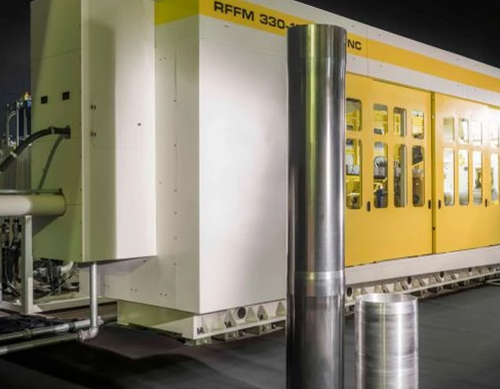
Repkon builds machine tools, not munitions. Its catalogue is organised around metal-forming processes: flowforming and shear forming for thin-walled cylindrical or conical parts, hot spinning for heated metal, and hydraulic presses in C-frame, H-frame and four-column layouts.
Those processes matter for ammunition because a modern projectile body or cartridge case is, at bottom, a precisely formed piece of metal. Flowforming thins and lengthens a rotating blank under rollers, which gives tight wall tolerances and consistent grain structure. Shear forming serves similar geometries, and the company lists anti-tank ammunition components among the parts its machines produce.
Outside defence, the same technology turns out automotive wheels, leaf springs and LPG cylinders. That civilian base is part of the story. A firm that sells to several industries can keep its machine-building know-how alive between defence orders, something pure munitions makers rarely manage.
How Did a Turkish Machine Builder Land U.S. Army Work?
The turning point was the U.S. Army’s effort to rebuild its 155 mm supply chain after the war in Ukraine drained stockpiles. The plan had two parts: more capacity for metal parts, and domestic sources for the energetics inside the shells.
In November 2024 the Army announced that Repkon USA-Defense LLC had won a contract, with a reported ceiling of roughly 425 to 435 million dollars (outlets gave slightly different figures), to design and build a TNT production plant in Graham, Kentucky. An Army statement said the award would reestablish TNT production on U.S. soil for the first time in decades. Reporting at the time described it as the first American TNT source since the mid-1980s, and earlier coverage pointed to a build period of about 48 months. Capacity figures were not given in the announcement.
A separate contract covers the design and construction of a production line for 155 mm combustible cartridge cases in Texarkana, Texas. Combustible cases burn away when the charge fires, which makes them a key component for modular propellant systems.
What Is Repkon USA Building in Texas and Kentucky?
Repkon USA has grown by acquisition as well as by contract. In April 2025 it announced the purchase of General Dynamics Ordnance and Tactical Systems’ operations in Garland, Texas, a 38-acre site that makes metal parts for defence and aerospace customers. It had also agreed to buy the engineering firm McCormick Stevenson, a deal expected to close the following month.
Repkon USA president Bryan Van Brunt described the Garland purchase as giving the company a large heavy-manufacturing footprint in which to apply advanced manufacturing techniques. Employee numbers at the site were not disclosed in the announcement.
The Mesquite plant, discussed below, was publicly tied to a planned output of about 30,000 shells a month. Officials in Washington said in 2024 that lines in Texas could eventually supply roughly a third of American 155 mm production, though as it turned out that target has not been met.
The pieces fit together. Kentucky is about energetics, Texarkana about cartridge cases, Garland about machined and formed metal. A company that once shipped machines from Istanbul now owns plants, workforce and Army paperwork in three U.S. states.
Where Does Mesquite Fit In?
The Army opened its Universal Artillery Projectile Lines facility in Mesquite, Texas, in May 2024, operated by General Dynamics Ordnance and Tactical Systems. Reports from the time described Turkish technicians unpacking and assembling robotic and forming equipment at a plant near Dallas, and Repkon has been linked in coverage to equipment for that effort. Treat the exact scope of its machinery role as reported rather than confirmed here, since contract documents are not public in detail.
What is better documented is the trouble. According to reporting on a 2026 Pentagon inspector general review, the roughly 469 million dollar Mesquite facility had by March 2026 not delivered projectile bodies that met contract specifications, and the Army halted two of three lines in August 2025. Those problems belong to the program and its prime contractor, and nothing in the public record we found ties them to Repkon equipment specifically. They do show how hard it is to stand up forming lines for 155 mm bodies, and why the Army has looked at more than one supplier.
Is There a Pakistan Connection?
Yes, and it is a sizeable one on paper. Reporting from the IDEAS 2024 exhibition in Karachi in November 2024 said Repkon signed an agreement with Wah Industries Limited, part of Pakistan’s state-run ordnance complex, to set up 155 mm shell body production and filling lines. Annual capacity was reported at 120,000 shells, aimed at the Pakistani military and foreign customers.
That figure comes from press reports of the signing, not from a commissioning announcement. Schedule and delivery status have been thin in open sources, so read it as an announced project rather than a running plant. For scale, the same coverage noted that Ukraine was firing thousands of shells a day at the time, which is why even a six-figure annual line draws interest from buyers outside Pakistan.
The company also appeared at the AUSA 2025 exhibition under the Repkon USA name, which signals that Washington, not Ankara, is now its main stage.
Why Does the Machine Matter More Than the Shell?
A shell is cheap relative to the line that makes it. A forming line is a multi-year capital asset: it takes long to design, commission and qualify, and a single bottleneck machine can cap the whole plant. That is why governments scrambling for ammunition quickly discover that the scarce item is not steel but forming capacity and the engineers who can run it.
Specialist suppliers of heavy forming equipment are a small group, and demand has risen sharply since 2022. A builder that can deliver the machines, install them and then operate the plant offers buyers a shortcut, which helps explain why Repkon has been willing to take on ownership of sites instead of only shipping equipment.
It also carries risk. Owning the plant means owning the schedule, the quality results and the political attention that comes with an Army contract. Machine-tool margins and munitions-plant obligations are very different businesses.
How Does Repkon Compare With Other Turkish Ammunition Players?
Repkon sits at a different layer from the state-owned arsenal. MKE makes the ammunition and increasingly builds plants abroad; Repkon makes the machinery and, in the United States, operates as a manufacturer in its own right. The two are complements more than rivals, and the pattern of Turkish defence factories abroad now includes both models.
For Europe the question is different. Whether Turkish output can feed NATO and EU buyers depends on regulation and quality assurance as much as capacity, which we examined in our piece on Türkiye’s ammunition supply to Europe. A machine-tool supplier sidesteps part of that problem, because the shells are made locally under local rules.
The wider debate over how self-reliant Ankara’s industry is applies here too. Türkiye still imports some inputs while exporting production know-how; our look at defence production independence covers that trade-off.
What to Watch Next
Three things will show whether Repkon’s U.S. expansion holds up. First, whether the Graham TNT plant reaches production on its reported timeline. Second, whether the Texarkana cartridge case line delivers to the Army’s schedule. Third, how the Garland site is integrated with the engineering capability acquired through McCormick Stevenson.
Execution risk is real. The Mesquite experience shows that equipment arriving on site is only the start. Ramp-up, first article testing and qualification take time, and the Army has shown it will halt lines that miss targets. Repkon’s advantage is that it controls both the machine design and, increasingly, the factory floor, which shortens the feedback loop between them.