How the Altay Tank Compares With Germany’s Leopard 2A7

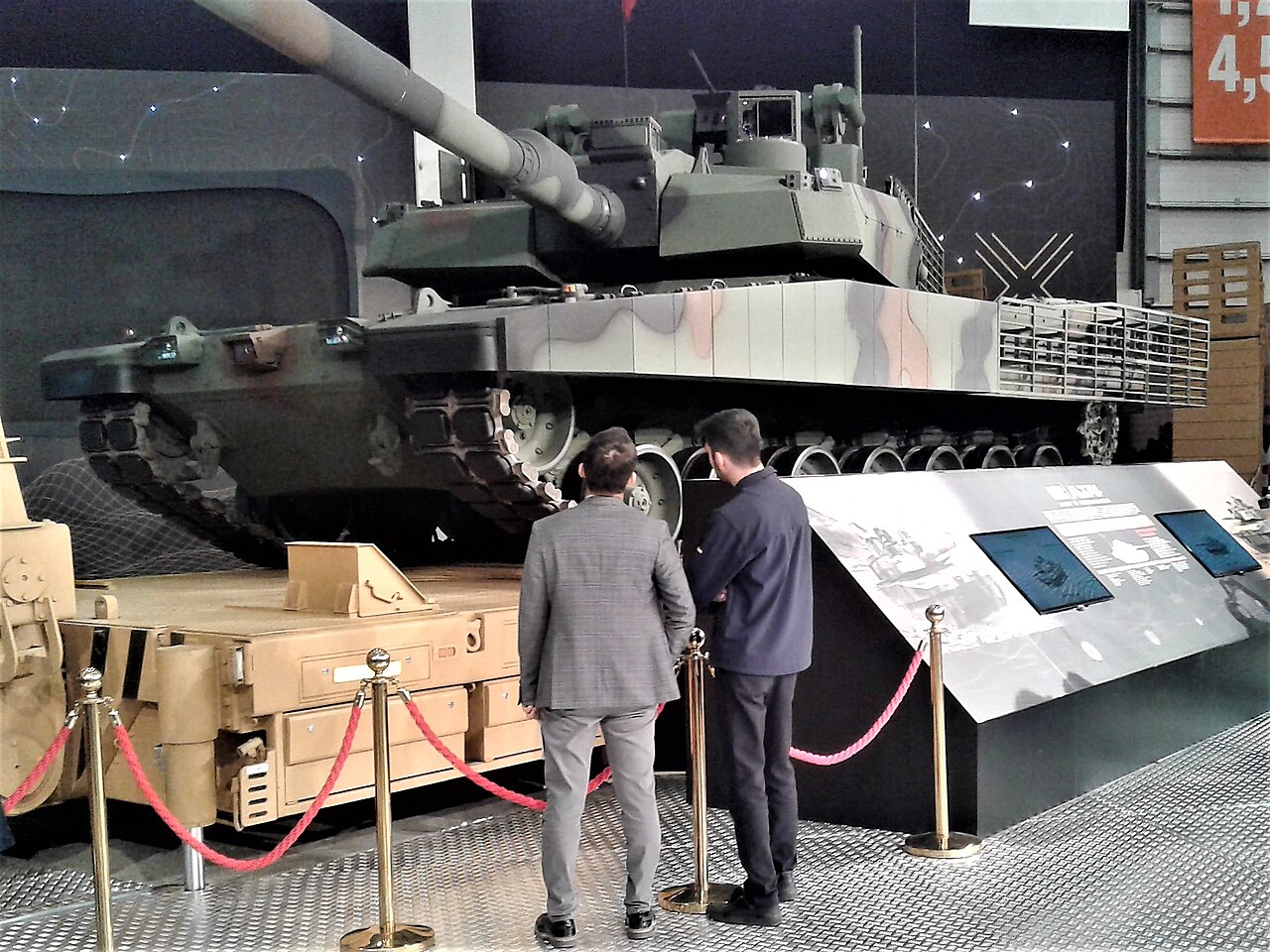
Turkish and German tankers are not going to meet on a test range any time soon, so every Altay versus Leopard 2 comparison is a paper exercise. That does not make it useless. The two tanks share a 120 mm gun family, a four-man crew and a weight near 65 tonnes, yet they come from very different industrial situations. One is a 1970s German design refined over five decades. The other is Türkiye’s first domestically built main battle tank, which only began to reach troops in late 2025.
This piece compares the ALTAY with the Leopard 2A7, a widely fielded German upgrade standard, using published specifications and flags where the numbers are soft.
What Do the Basic Specifications Show?
On the headline figures the two tanks sit close together. Differences appear in the details, and in how well each number is documented.
| Feature | ALTAY (T1) | Leopard 2A7 |
|---|---|---|
| Builder | BMC (Türkiye) | KNDS Deutschland (Germany) |
| Crew | 4 | 4 |
| Combat weight | About 65 tonnes | About 66.5 tonnes (2A7V) |
| Main gun | 120 mm L/55 smoothbore (MKE-produced) | 120 mm L/55 smoothbore (Rheinmetall) |
| Engine | Doosan DV27K diesel, 1,500 hp (T1) | MTU MB 873 Ka-501 diesel, about 1,500 PS |
| Road speed | About 65 km/h (reported) | About 68 km/h |
| Road range | About 450 km (reported) | About 500 km |
| Active protection | ASELSAN AKKOR | None in the base standard; Trophy on upgraded vehicles |
| Entered service | First serial deliveries, October 2025 | 2014 (initial batch) |
The speed, range and weight figures come from reference sources and manufacturer-linked material rather than from army acceptance data, so treat differences of a few percent as noise. Neither side publishes armour thickness, and anyone who quotes exact protection values for either tank is guessing.
How Do Their Guns and Fire Control Compare?
Both tanks fire NATO-standard 120 mm ammunition from a 55-calibre barrel, which is the main reason their firepower looks so similar on paper. The L/55 length gives longer-range kinetic penetrators a higher muzzle velocity than the older L/44 barrel that equipped early Leopard 2 variants. The Altay’s gun is a Turkish-produced barrel from MKE, built under a Rheinmetall-derived design, according to published descriptions. For a country that has had to work around foreign export restrictions, producing the barrel at home matters more than the ballistics.
Fire control is where the comparison gets harder. The Altay’s fire control, command-and-control and turret drive systems come from ASELSAN. The Leopard 2A7 carries the digital fire control and sighting equipment developed through the A6 and A7 upgrade cycles. The German stack has decades of service feedback behind it. The Altay’s has a much shorter track record, and its real performance will only show up as units start training with it in numbers.
Which Tank Is Better Protected?
This is the question readers usually want answered, and it is the one the open sources answer least well.
The Altay uses a composite armour package developed by ROKETSAN, reportedly drawing on the armour design of South Korea’s K2 tank, which Türkiye learned about through its technology-transfer agreement with Hyundai Rotem. Its active protection system, AKKOR, is an ASELSAN product meant to defeat incoming anti-tank missiles. Whether serial-production Altays will carry it in all configurations is not something the public record settles cleanly.
The Leopard 2A7 has modular passive armour, extra belly protection against mines and IEDs, and mounting points for add-on armour against RPGs. Germany decided in February 2021 to buy Israel’s Trophy active protection system, with integration planned on upgraded 2A7A1 tanks. The next variant, the Leopard 2A8, unveiled in November 2025, is reported to carry Trophy from the factory. Germany has a reported firm order of 123 vehicles with first deliveries expected from 2027.
So both lines are converging on the same idea, a heavy passive shell plus a hard-kill layer. The Germans are there with a system that has seen combat use on other vehicles. The Altay’s AKKOR exists, but it has not been tested in the same volume of real combat.
Why Does Turkish Combat Experience Matter Here?
Türkiye also knows the Leopard from the inside. Its land forces operate Leopard 2A4 tanks, reported at around 350 vehicles, bought second-hand from Germany. During the Euphrates Shield operation in northern Syria in 2016 and 2017, several of them were lost around al-Bab, mostly to anti-tank guided missiles and in urban terrain, as documented by open-source analysts.
Those tanks were an early Leopard 2 variant without the later armour and protection upgrades, so the losses say little about the 2A7. They do explain why the Turkish requirement for the Altay put so much weight on active protection and urban survivability, and why AKKOR sits so visibly on the Altay’s specification sheet.
What Powers Each Tank, and Who Controls the Supply?
On paper, both engines deliver 1,500 horsepower. The bigger difference is where the power pack comes from.
The Leopard 2A7 uses a German MTU engine. The first Altay batch does not. The T1 variant pairs a South Korean Doosan DV27K diesel with an S&T Dynamics EST15K transmission. The original plan called for German components, but reporting says Germany blocked MTU engines and RENK transmissions over Türkiye’s operations in Syria. Korean suppliers filled the gap, and the program has since pushed ahead with BMC Power’s BATU engine for the T2.
According to the latest public reporting, the BATU engine completed factory acceptance testing at the end of 2025, while its matching transmission is still being qualified. That leaves the T2 as the real test of Altay’s independence story. It is also why the T1 is better described as a bridge than as a finished answer. For the wider question of how far Turkish industry has actually moved away from imports, see Is Türkiye Fully Independent in Defence Production?
What About Numbers, Cost and Exports?
The contract covers 250 Altay tanks, 85 of the T1 type and 165 of the T2 type, with options reported for more. Deliveries began on 28 October 2025, and the published schedule spreads the T1 batch across 2026 to 2028. A unit cost of roughly $13.75 million for the T1 has been reported; treat it as an estimate rather than a contract price.
The Leopard 2 has a very large installed base, with about 3,600 vehicles built across all variants by reference counts, and a spare-parts and training ecosystem that any newcomer will need years to build. Germany’s current fleet plan points to around 430 battle tanks once the 2A8 deliveries are complete, according to German reporting.
On exports, no Altay sale has been publicly confirmed. Qatar is a shareholder in BMC rather than a declared buyer, and the country has been mentioned in connection with earlier development funding. Turkish armour has found foreign buyers in other classes, notably wheeled and tracked vehicles, and the reasons those customers cite are mostly speed of delivery and price. A 65-tonne main battle tank is a harder sell, because buyers also weigh logistics and proven combat performance.
So Which One Wins on Paper?
The Leopard 2A7 wins on maturity. It has a proven drivetrain, a large user community, a documented upgrade path into the 2A8 and a fielded hard-kill protection system. Anyone who has to choose a tank to fight with next year would pick it.
The Altay wins on a different axis. It gives Türkiye a modern heavy tank whose design, production and future upgrades it controls, with a domestic gun, armour and electronics supply chain around it. The test is whether BMC can deliver the T2 power pack on time, and whether the tank earns the same trust in the field that the Leopard has had half a century to build. The Turkish defence industry’s broader record on selling into NATO armies suggests the next few years of deliveries will matter as much as any specification table.