How ULAQ Went From an Antalya Prototype to a Qatari Export Sale

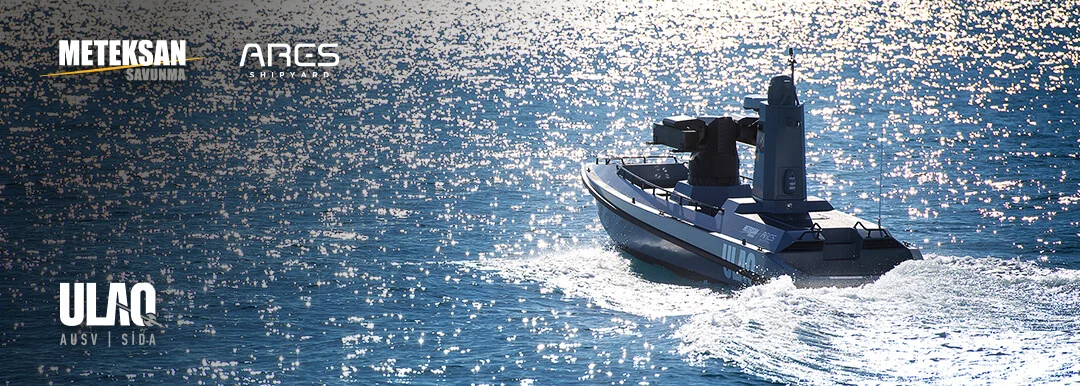
Turkish defence journalism tends to file the ULAQ under “first armed unmanned surface vessel” and move on. The more useful story is how a boat sketched in 2020 by a private shipyard and a defence electronics house ended up in naval service and, separately, on a Gulf coast guard’s books. This piece follows that path and checks the figures that circulate about it.
| Item | Detail |
|---|---|
| Name | ULAQ, also written ULAQ SİDA (Silahlı İnsansız Deniz Aracı, armed unmanned sea vehicle) |
| Developers | Ares Shipyard (hull and construction) and Meteksan Defence (control station, electronics, software) |
| Type | Composite-hull unmanned surface vessel, autonomous or remotely operated |
| Reported speed and range | About 35 knots, about 400 km |
| Reported sea state limit | Sea state 5 (Baird Maritime) |
| Export customer | Qatar (ULAQ 11 PSV variant) |
Who Built ULAQ and Why Did It Start in Antalya?
ULAQ is a private-sector project. Ares Shipyard, based in Antalya, builds fast composite craft. Meteksan Defence, an Ankara company, brought the electronic mission systems and software. Defense News reported in November 2020 that the prototype design had been finalized that August, with Ares responsible for the vessel and Meteksan for the mobile coastal control station.
The name was chosen with some ceremony. Ares chief executive Utku Alanç described it to Defense News as a reference to an envoy from ancient Turkish culture. Meteksan’s leadership stressed “maximum indigenousness” in the electronics, which aligned with the Turkish Armed Forces’ requirements. Our profile of Meteksan covers the company’s sonar and radar background, which later mattered for the anti-submarine version.
What Did the First Prototype Carry?
Baird Maritime’s 2021 vessel review gives the most detailed description of the original armed boat. It lists a displacement of roughly 6 tonnes, a length of 12 metres, a beam of 2.71 metres and a draught of 0.6 metres, with a single diesel engine driving a stern drive. Other outlets quote 11 metres for the same family, so treat the length as a variant-dependent figure rather than a fixed one.
Armament was the point of the exercise. The review lists two L-UMTAS laser-guided missiles and four Cirit 70 mm laser-guided rockets, both from Roketsan, plus a mount for a 7.62 mm or 12.7 mm machine gun that was not yet fitted on the prototype. Sensors included an X-band navigation radar, day and night cameras and an electro-optical tracking sensor. Communications were encrypted and anti-jam.
The control concept matters as much as the hull. An operator can drive and fire the boat from a mobile coastal control station that can sit on a vehicle, in a headquarters or aboard a larger ship. Meteksan has also said it is working on swarming, a field where satellite-link suppliers matter. We covered one such effort in CTech’s hybrid satcom link for Turkish USV swarms.
When Did ULAQ First Fire and Exercise With the Navy?
Wikipedia’s timeline puts the prototype launch in Antalya on 12 February 2021 and a first Cirit firing on 25 May 2021. Janes added in 2022 that ULAQ fired live missiles during the Navy’s 2021 “Sea Wolf” exercise in the Mediterranean, described there as the first time private companies took part in a Turkish Navy exercise. I could verify that only through Janes’ summary, so the exercise details are reported rather than confirmed.
The same Janes piece, from DIMDEX 2022 in Doha, quoted Alanç saying the companies had enquiries from 39 countries and expected contracts with one or two nations that year. That did not happen on schedule. The first export contract arrived in October 2024, more than two years later, which says something about how long unmanned naval sales take even with a firing record behind them.
How Does the Navy Version Differ From the Export Boat?
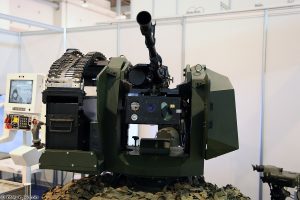
The Turkish Navy received its armed ULAQ at a ceremony at the Istanbul Naval Shipyard Command attended by President Erdoğan, according to Anadolu Agency. The boat carries a 12.7 mm remotely controlled weapon station from Best Defence, a subsidiary of Sarsılmaz. The station is reported to use AI-assisted target detection and stabilised imaging, and to hold 500 rounds of 12.7 mm or 1,000 of 7.62 mm. Turkish press coverage also reported a domestically developed marine engine with about 90 percent local content; I could not tie that figure to an official release.
At IDEF 2025, Naval News described an ASuW ULAQ under the new ULAQ Global brand with a 460 hp engine from Turkish maker TÜMOSAN and a Best Defence weapon station, and said the boat was in final acceptance testing.
Qatar’s boat is a different animal. It is the ULAQ 11 PSV, a port security variant, and Naval News reports it carries Aselsan’s SARP-DUAL 12.7 mm station, a naval radar, electro-optical sensors and Meteksan’s autonomy software, with a shore control station. Naval News gives its dimensions as 11 metres by 2.6 metres, with up to ten hours at cruising speed. Breaking Defense reported in 2024 that the deal had two phases, a 12-month training period followed by procurement of more boats and command infrastructure, and that Meteksan did not disclose value or quantity.
What About the Anti-Submarine Version?
Janes reported in November 2024 that the Defence Industry Agency (SSB) had signed separate prototype contracts with several shipyards, and that the ULAQ ASW variant had finished its first sea-acceptance phase. That boat is larger, at about 12 metres long and 3.74 metres in beam. Its sonar is a Meteksan design for shallow water, derived from the Yakamos technology fitted to Ada-class corvettes, intended to find submarines, autonomous underwater vehicles and divers.
Wikipedia lists further variants, including a larger ULAQ 12 series with torpedoes and a ULAQ-6 KAMA expendable strike boat. Those entries are less well sourced than the Navy and Qatar deliveries, so I have not relied on them for specifications.
How Does ULAQ Compare With MARLIN and the Rest of Türkiye’s Sea Drones?
ULAQ is not the Navy’s only unmanned boat. Janes noted that MARLIN, from the Sefine Shipyard and Aselsan partnership, was commissioned in February 2024 and has been delivered in ASW and ASuW forms. Naval News at IDEF 2025 reported its ASW version with two ARMELSAN sonars and a control station able to manage up to 12 vessels, and its anti-surface version upgraded to carry Roketsan’s Çakır missile. HAVELSAN and Yonca Shipyard’s SANCAR, a mine countermeasures and ISR boat, is also in service, Naval News said.
The pattern is deliberate competition between pairs of shipyards and electronics houses, each with its own mission system. That keeps options open for the Navy, though it also means no single USV standard yet. For the shipyards behind these boats, see who builds Türkiye’s warships.
The division of labour is worth noting. In ULAQ’s case a small yard supplies the hull while an electronics company owns the autonomy software and the control station, so much of what an export customer actually buys is the control system and its software. Qatar’s contract fits that reading, as reported: a 12-month training phase comes first, and additional boats and command infrastructure follow in a second phase. Neither the number of boats nor the contract value has been made public.
What Is Still Unproven?
Several things are not public. No vessel price has been disclosed, Qatar’s order size is unstated, and I found no confirmed account of ULAQ operating against a real threat. Our earlier report on ULAQ entering service made the same point: commissioning shows a boat exists, not that its control link survives jamming. Sources also disagree on when Qatar took physical delivery, with some outlets saying late 2024 and others December 2025, so this article gives only the October 2024 contract date as firm.
The next checkpoints are the ASW boat’s delivery to the Navy, any second export customer after Ares said it expected more contracts in 2026, and whether the Navy settles on one control architecture across ULAQ, MARLIN and SANCAR.