KUZGUN Gives TÜBİTAK SAGE a 100-Kilogram Munition in Three Versions

Most Turkish precision munitions come from a company: Roketsan, ASELSAN, MKE. KUZGUN does not. It is an in-house project of TÜBİTAK SAGE, the state defence research institute, and it is built around one idea: a single 100-kilogram-class weapon body that can be fitted with different engines, seekers and warheads depending on who wants to carry it.
The family has been tested in the air and at sea, drawn a foreign letter of intent and a Southeast Asian sales pitch. What it has not publicly done is move into a confirmed production contract. That makes it one of the more interesting open questions in Turkish munitions.
What Is KUZGUN, Exactly?
TÜBİTAK SAGE lists KUZGUN on its own website as a “Modular Guided Munition Family” in its UAV munition group, next to KAYI, BOZOK, TOGAN and KGK-82-SİHA. The institute describes it as a new-generation product family in the 100-kg class, designed to be modular, low-cost, reusable and accurate, with limited collateral damage.
The design goal, as TÜBİTAK SAGE has stated it, is common parts and a common design that serve both unmanned combat aircraft and crewed combat aircraft. The weapon can also be launched from land and surface platforms. Because of its low weight, it was framed primarily as a UAV weapon.
| Item | Detail |
|---|---|
| Developer | TÜBİTAK SAGE (in-house institute project) |
| Class | Modular guided munition family, about 100 kg class |
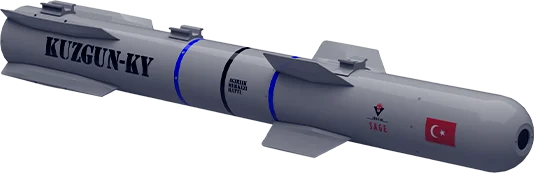
| Variants | KUZGUN-SS (free-fall), KUZGUN-KY (solid propellant), KUZGUN-TJ (turbojet) |
| Warhead options | Fragmentation, thermobaric, general-purpose, penetrator |
| Guidance | INS/GPS or INS only |
| Seeker options | Imaging infrared, millimetre-wave radar, laser |
| Launch platforms | Air, land and surface vessels (as described by the developer) |
How Do the Three Versions Differ?
The variants share a core and differ in how far they can travel.
KUZGUN-SS is the free-floating, unpowered version, a guided glide weapon in the same general family as the guidance kits covered in our look at Turkish guidance kits. KUZGUN-KY adds an integrated solid-propellant rocket motor, and KUZGUN-TJ carries a small turbojet for the longest reach.
Naval News, reporting from the DSA 2024 show in Kuala Lumpur, gave figures of more than 40 km for KY, more than 100 km for SS and more than 180 km for TJ. Those numbers were presented in the context of naval and land-based launchers and, as far as public sources show, have not been confirmed by a published test result at full range. Treat them as claimed ranges.
The seeker and warhead choices are the real modular element. An imaging infrared seeker suits a moving ship or a vehicle, a laser seeker suits designation by another aircraft or a ground team, and millimetre-wave radar helps in poor visibility. The penetrator and thermobaric options point to hardened or built-up targets rather than ships alone.
What Tests Has KUZGUN Passed?
Early plans were ambitious on timing. In 2021, Shephard reported that TÜBİTAK SAGE intended to carry out live-fire tests with KUZGUN before the end of that year, and Defence Turkey ran a similar schedule claim.
The better documented milestones came later. According to Defence Turkey, the first test firing of the KUZGUN-KY solid-propellant missile took place on 24 February 2023 at the Sinop Test Range. The same publication also reported a KY launch from the MARLIN unmanned surface vessel, a platform from Sefine Shipyard, which fits the naval angle. For background on that yard, see Sefine Shipyard’s move from ferries to frigates.
A TÜBİTAK SAGE post from 1 October 2024, quoted in Turkish media, described a ballistic test firing of the KUZGUN (KY) cruise missile from MARLIN. Separately, reports say a KUZGUN firing was carried out from the AKSUNGUR armed UAV developed by Turkish Aerospace, which is described in our profile of the AKSUNGUR. The details of that test, including the variant and range, were not given in the sources reviewed.
Why Build a Family Instead of One Weapon?
The logic is about cost and logistics. A shared body, shared control surfaces and common electronics mean one production line and one set of training for several roles. A customer that starts with the unpowered SS version could, in principle, move to a powered variant without relearning the weapon. The developer also lists adjustable detonation height, a dual-mode jam-resistant datalink and jam-resistant GPS among the features, which matter for a munition meant to be released from a drone operating under electronic attack.
It also explains the long list of options. Defence Turkey’s reporting in 2021 mentioned roughly nine configurations in total once seeker, warhead and propulsion choices were combined. No public source shows all nine built, so the number describes a design space, not a catalogue.
The trade-off is familiar from other modular weapons. Every option adds integration and qualification work, and a customer pays for the variants it actually flies. Keeping the list short for the first service-ready version would be the usual way to get a weapon into the field.
Who Has Shown Interest Abroad?
Two foreign contacts are on the public record.
In May 2023 at the IDET fair in Brno, TÜBİTAK SAGE and the Czech company Excalibur Army signed a letter of intent covering fire support platforms built around KUZGUN. As the Czech side described it, Excalibur could develop combat systems around the munition while SAGE would gain access to Czech-built vehicle platforms. A letter of intent is not a purchase.
In May 2024 at DSA, Naval News reported that the Malaysian company Dayatech Merin proposed fitting KUZGUN to Royal Malaysian Navy vessels, showing launcher concepts with five cells for Laksamana-class corvettes and Perdana-class missile boats. Plans for the navy to see live firings in Türkiye were mentioned, and the report said no final decision had been made.
Why Is It Not Simply Replacing Existing Weapons?
KUZGUN-KY and TJ overlap with other things Türkiye already fields. At sea, Roketsan’s larger ATMACA sits in a different weight class and range band, so KUZGUN would be a smaller, cheaper option for small craft rather than a frigate weapon. On UAVs, the competition is the established family of micro and smart munitions from industry.
The difference is institutional. SAGE is a research and design body, and a design done there normally has to be handed to an industrial partner for serial production. Public sources reviewed do not name a production partner or a Turkish procurement order for KUZGUN. That gap, rather than technology, is what determines whether it stays a demonstrator or becomes a service weapon. SAGE’s wider role in the missile supply chain is explained in our piece on how SAGE designs what industry builds, and the broader research network in this overview of TÜBİTAK’s defence institutes.
What to Watch Next
Three signals would show real movement: a named industrial producer, a customer order from a Turkish service or an export buyer, and a full-range turbojet demonstration. Until at least one of those is public, KUZGUN stays a credible design with partial test evidence and open commercial questions.