How Roketsan’s MAM Munitions Turned Small Drones Into Precision Strikers

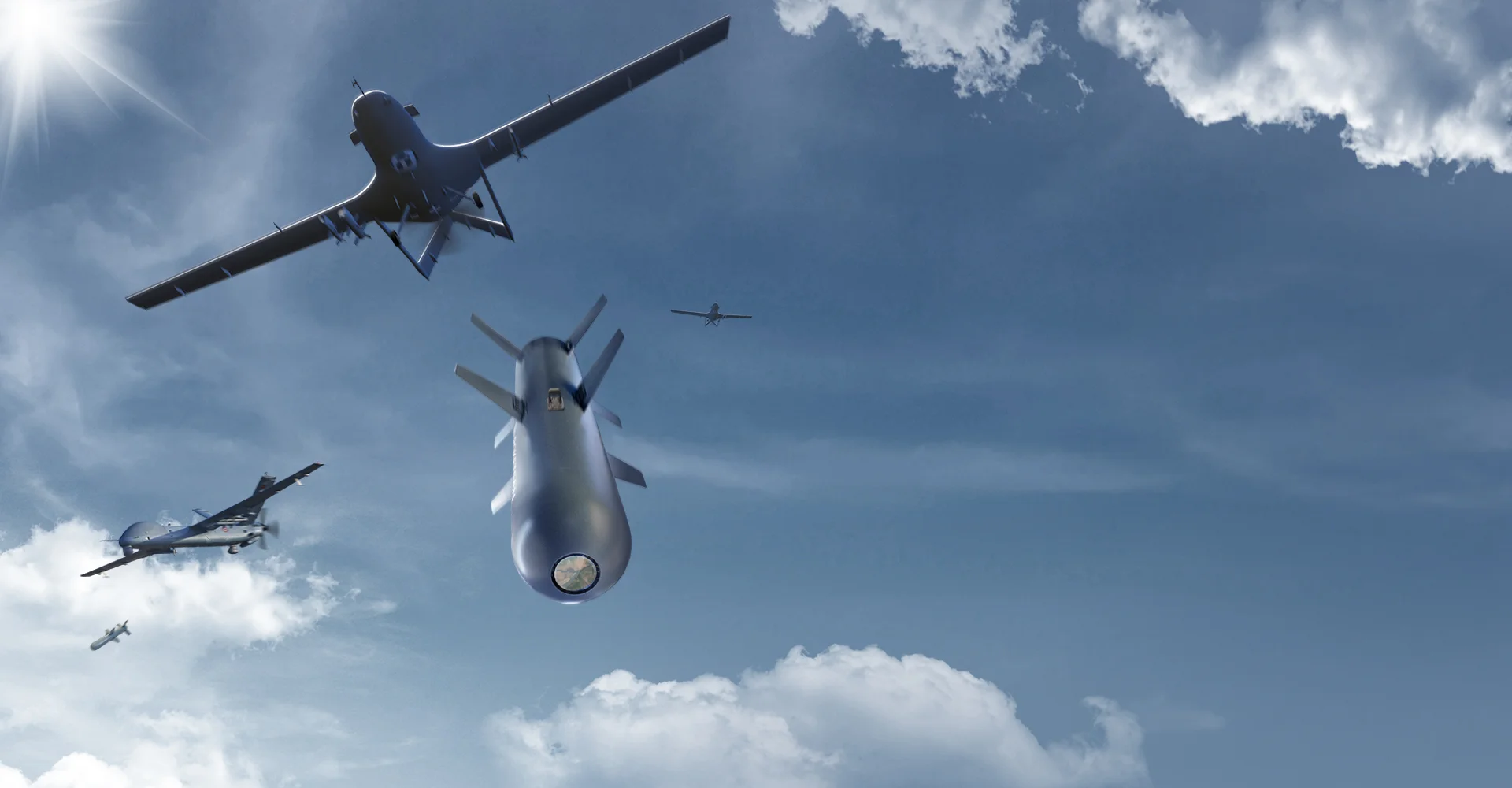
A Bayraktar TB2 can stay airborne for a long time, but it cannot carry much. That single constraint shaped one of the more consequential weapons lines to come out of Türkiye in the past decade. Roketsan’s MAM family, short for Mini Akıllı Mühimmat or “smart micro munition”, exists because small unmanned aircraft needed guided weapons that were light enough to fit under their wings and cheap enough to fire in numbers.
Three munitions now carry the name: MAM-C, MAM-L and MAM-T. They share a laser seeker concept and a basic idea, a precision-guided glide weapon in place of a full missile, but they differ sharply in size, reach and the targets they suit.
What Exactly Is the MAM Family?
According to Roketsan’s product pages, the munitions were developed for unmanned aerial vehicles and light attack aircraft in air-to-ground roles. They are designed against fixed and mobile targets, and the company offers several warhead options depending on the variant.
Roketsan, the Ankara-based missile house described in our company profile, positions MAM as the light end of its guided munitions portfolio. Heavier anti-tank missiles such as those covered in our UMTAS and OMTAS comparison sit above it in weight and cost.
| Item | MAM-C | MAM-L | MAM-T |
|---|---|---|---|
| Manufacturer | Roketsan | Roketsan | Roketsan |
| Diameter | 70 mm | 160 mm | 230 mm |
| Length | 970 mm | 1 m | about 1.4 m (reported) |
| Weight | 6.5 kg | 22 kg | 95 kg |
| Range | 8 km | 15 km | 30+ km from a UAV |
| Seeker | Laser | Laser | Laser |
| Warhead options | Multi-purpose or high-explosive blast fragmentation | Armour-piercing, high-explosive blast fragmentation, thermobaric | High-explosive blast fragmentation |
The figures above come from Roketsan’s published product data, apart from the MAM-T length, which comes from trade press coverage of the munition’s launch.
How Did MAM-L Come First?
MAM-L was the first to reach service. Trade reports put its entry into Turkish Armed Forces inventory at 2016, with the smaller MAM-C following in 2018. Both dates are drawn from Roketsan-sourced trade coverage, not from a standalone Ministry of National Defence statement.
At 22 kg and 15 km of range, MAM-L fills the middle of the family. Some outside analysts describe it as a derivative of the L-UMTAS laser-guided missile with the rocket motor removed. That description circulates in defence commentary, and Roketsan’s own page does not frame it that way, so treat it as an analyst characterisation.
The idea is easy to follow. A rocket motor is expensive and heavy. Drop it, let the carrier aircraft supply altitude and speed, and the weapon glides to the target guided by a laser designator. The saving in cost and weight is what lets a small drone carry several of them.
Why Does a Glide Munition Suit a Small Drone?
A missile like the UMTAS is a capable weapon, but it is a self-propelled one. A glide munition trades some reach for a lower price per round and a lighter load. For an aircraft with limited payload, that trade often wins.
The TB2 is the clearest example. Roketsan’s own MAM-L page includes a Bayraktar-carrying image, and trade sources list MAM-C, MAM-L and MAM-T among weapons associated with the type. Our Bayraktar TB2 programme overview covers the airframe, its operators and its export record.
Laser guidance also has a practical meaning. A seeker locks onto laser energy reflected from a target, which a designator illuminates. The designator can be on the launching aircraft, on a second aircraft or with troops on the ground. That flexibility is useful, and it is also a limitation: smoke, cloud and dust can degrade the laser, and the target has to stay illuminated until impact.
What Separates MAM-C, MAM-L and MAM-T in Practice?
The three munitions answer three different questions.
MAM-C, the lightest option
At 6.5 kg and 70 mm in diameter, MAM-C is built for aircraft where every kilogram counts. Roketsan describes it as suited to missions where weight is critical. Its 8 km range keeps the launching aircraft relatively close to the target, which is fine against exposed, lightly defended targets and less so against anything with air defence cover.
Its small warhead is the trade-off. A multi-purpose version combines blast fragmentation, armour-piercing and incendiary effects, while a second version uses high-explosive blast fragmentation. It is a weapon for soft and light targets, not for hardened ones.
MAM-L, the one most people mean
When commentators say “MAM” in the context of drone warfare, they usually mean MAM-L. It is the best-known member of the line, with three warhead choices: armour-piercing, high-explosive blast fragmentation and thermobaric. A thermobaric warhead is aimed at buildings, bunkers and enclosed spaces, an armour-piercing one at vehicles.
The same ground sits in the territory covered by CİRİT, a laser-guided 70 mm rocket, and MAM-L is the heavier and longer-ranged of the two choices.
MAM-T, the long-range one
MAM-T is a different animal. At 95 kg with a fixed-wing structure to extend its glide, it is roughly four times heavier than MAM-L. Roketsan lists a range of more than 30 km from a UAV. Trade coverage of its unveiling cites 60 km from a light attack aircraft and 80 km from a fighter, though those higher figures depend on the launch height and speed of the carrier.
The weapon was shown at DIMDEX in Doha in March 2022. Roketsan said at the time that it had been test-fired from a Bayraktar AKINCI the previous April, and that serial production preparations were complete. Because of its weight, MAM-T is a weapon for heavier drones; our comparison of AKINCI and TB2 explains why that matters when customers choose a platform.
Where Has MAM Been Used?
Public detail here is uneven, and it is worth being careful. Reference summaries list MAM use in Syria, the Second Nagorno-Karabakh War and the war in Ukraine, and note that more than a dozen countries are reported to operate the family. Roketsan itself does not publish a customer list, and individual claims about strikes and numbers come mostly from video footage, official statements by the user and third-party reporting, which are hard to verify independently.
One widely repeated data point is Ukraine’s 2022 receipt of TB2 drones with a reported 200 MAM-L munitions. The figure was reported by trade and regional media and has not been confirmed by Roketsan in the sources reviewed for this article.
What can be said with more confidence is that MAM gave exporters of Turkish drones something to bundle. A customer buying TB2 aircraft can also buy a matching, Roketsan-made weapon family without sourcing munitions elsewhere. That pairing is a large part of the commercial logic discussed in the line between loitering munitions and missiles, where cost per effect, not raw capability, drives purchase decisions.
The family also shows how Roketsan thinks about integration. Each munition is sold as a weapon for several carriers, not as an accessory to one drone. Roketsan’s catalogue language speaks of unmanned aerial vehicles and light attack aircraft in general, which leaves room for customers to fit the weapons to whatever platforms they already fly, subject to the integration work each aircraft needs.
What Are the Limits of the Design?
MAM has real constraints, and they are worth stating plainly.
- Laser dependence. The seeker needs a designated target. Weather, obscurants and jamming of the designator can all hurt accuracy.
- No self-propulsion. A glide weapon cannot manoeuvre aggressively or chase a fast target, so it works best against stationary or slow-moving ones.
- Exposure of the carrier. Even with MAM-T’s reach, drones must still operate within reach of a designator and, against a capable opponent, air defence. Modern air defences have made that a harder proposition than the early drone campaigns suggested.
- Small warheads. The lighter variants cannot defeat modern heavy armour or hardened shelters reliably.
Roketsan has also been working on adjacent concepts. A newer MAM-derived round called NEŞTER, described in reference summaries as using deployable cutting blades and a proximity sensor for low-collateral strikes, points to where the family may head. Public detail on it remains thin, so it is not covered further here.
Why Did a Small Weapon Matter So Much?
The MAM family is not the most advanced thing Roketsan builds. Its cruise missiles and ballistic missiles are far more technically ambitious. What MAM did was match the weapon to the aircraft. Drones that were once limited by what they could carry gained a precision weapon sized for them, and operators gained a lower-cost way to engage targets that did not justify a larger missile.
For a buyer, the practical points are these. MAM-C suits the lightest aircraft. MAM-L is the all-rounder with the widest warhead choice. MAM-T gives a heavier drone a stand-off option beyond 30 km.
Roketsan has not published production quantities or unit prices for the family, and none are cited here.