How UMTAS and OMTAS Divide Turkish Anti-Tank Work by Range

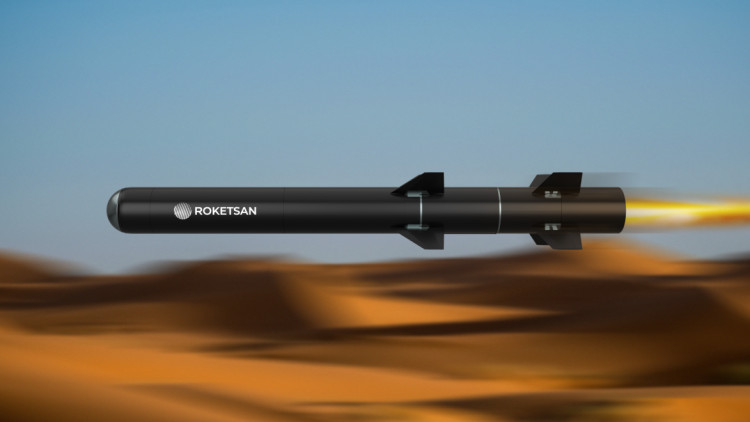
Turkish anti-tank doctrine used to lean on imported missiles. Today two ROKETSAN designs, UMTAS and OMTAS, cover the long and middle bands of the engagement envelope with a shared imaging infrared seeker and a data link that lets the crew change their mind after launch. A third, shorter-range weapon, KARAOK, fills the bottom end.
This piece explains what each missile does, where the two overlap, and which vehicles and aircraft carry them.
| Field | UMTAS | OMTAS |
|---|---|---|
| Manufacturer | ROKETSAN, Türkiye | ROKETSAN, Türkiye |
| Class | Long-range anti-tank missile | Medium-range anti-tank weapon system |
| Range (ROKETSAN) | 0.5 to 8 km | 0.2 to 4 km |
| Weight | 37.5 kg | 35 kg (missile and launch tube) |
| Diameter and length | 160 mm, 1.8 m | Not listed on the product page |
| Seeker | Imaging infrared, RF data link | Imaging infrared, RF data link |
| Modes | Fire-and-forget, fire-and-update, direct and top attack | Fire-and-forget, fire-and-update, lock-on before or after launch |
| Warhead | Tandem anti-tank blast fragmentation | Tandem armour-piercing |
| Main platforms | Attack helicopters, light attack aircraft, land vehicles, naval platforms | Tripod and land platforms with open or closed turrets |
What Is UMTAS and Why Was It Built for Helicopters?
UMTAS stands for Uzun Menzilli Tanksavar Sistemi, the long-range anti-tank system. ROKETSAN describes it as a precision-guided missile developed primarily for integration with attack helicopters, though the same round can also be fitted to light attack aircraft, ground vehicles and ships.
The key is the seeker. An imaging infrared head lets the missile see a target by its heat picture, by day or night and in poor weather, rather than depending on a laser spot held on the target by the shooter. A radio data link between launcher and missile allows the operator to lock on before launch or after it, and to update the aim point in flight.
That matters for survival. A helicopter crew that can fire and then break away, or launch from behind a ridge and pick the target afterwards, is exposed for far less time than one that must keep a laser on a tank until impact. ROKETSAN lists fire from behind cover as a stated capability.
How Did UMTAS Reach Service?
ROKETSAN announced in 2015 that the programme had reached its final phase. According to the company, multiple targets were hit during firing tests on 2 and 3 July 2015 at the Karapınar range in Konya, with the project in design verification and qualification expected to begin that year.
Qualification of the product and its production line was reported complete in 2017, and industry press said the Turkish Armed Forces formally received its first UMTAS launcher with eight missiles in June of that year. Those figures come from trade reporting rather than an official delivery notice, so treat them as reported.
The missile’s natural home is the T129 ATAK helicopter, which is reported to carry UMTAS alongside the smaller CİRİT rocket. A Turkish gunship armed with a Turkish missile is also easier to market abroad, since the weapon comes from the same national supply chain.
What Does the L-UMTAS Variant Change?
ROKETSAN also lists L-UMTAS, a laser-guided version of the long-range missile. The laser seeker gives up the fire-and-forget convenience of the imaging infrared head, and in exchange the target is illuminated by the launching platform or another designator.
The company has since shown an extended-range development, presented by Janes as UMTAS-GM at IDEF 2023. In a more recent test, covered in our report on the Seahawk firing, ROKETSAN tried L-UMTAS GM in an air-to-air role, which shows the family being stretched beyond its original armour-killing job.
Where Does OMTAS Fit?
OMTAS, the Orta Menzilli Tanksavar Sistemi, is the medium-range partner. ROKETSAN quotes a range of 0.2 to 4 km and a weight of 35 kg including the launch tube. It uses the same style of imaging infrared seeker and RF data link, with a tandem warhead built to defeat armour.
Where UMTAS is an air-launched weapon first, OMTAS is a ground weapon first. The company says it can be fired from a tripod or integrated into land platforms with open or closed turrets. Insensitive munition characteristics against fuel fire and bullet impact are also listed, which matters when missiles are stowed inside a crowded armoured vehicle.
The 200 metre minimum range is short enough for fighting in broken or urban terrain, where tanks often appear at close distance. The data link again lets the gunner lock on after launch, which helps when the target is hidden at the moment of firing.
Which Vehicles Carry OMTAS?
ROKETSAN’s own gallery shows OMTAS turrets on FNSS KAPLAN and PARS 4×4 vehicles, and Turkish press has reported deliveries of tank destroyer versions to the army. One report counted 26 KAPLAN tank destroyers delivered, with the latest batch the first to use ROKETSAN’s OMTAS turret. The numbers are reported, not confirmed by an official release.
The vehicle maker behind those platforms has its own export story, told in our FNSS profile. The pairing follows a familiar Turkish pattern: a domestic chassis, a domestic turret and a domestic missile.
OMTAS qualification was reported finished in 2016, a year ahead of UMTAS, and Asian Military Review reported ROKETSAN saying in late 2018 that both missiles were ready for serial production.
How Do UMTAS and OMTAS Compare With KARAOK?
The three missiles work as a ladder. KARAOK is the short-range option. OMTAS covers the middle distances out to 4 km, and UMTAS stretches to 8 km and is mostly launched from the air.
KARAOK recently drew attention when it hit an aerial target, as described in our KARAOK test report. It points to a trend across the family: anti-tank missiles with imaging seekers are being tried against helicopters and drones, not just armour.
CİRİT sits below all three as the cheap option. Our look at the CİRİT laser-guided rocket explains why a crew might save an UMTAS for a tank and use the smaller round on a truck.
What Are the Limits?
A range figure on a datasheet does not say how these missiles behave against modern active protection systems. Tandem warheads are designed to defeat reactive armour, but public evidence of performance against specific threats is thin, and ROKETSAN does not publish kill probabilities.
Helicopter-launched missiles also depend on the platform surviving long enough to fire. Recent wars have punished low-flying gunships, which is one reason the fire-and-update mode and launch from cover are emphasised.
What the pair does give Türkiye is a national supply chain for the anti-tank role. The wider company picture is in our ROKETSAN company profile.