
AKSUNGUR or ANKA, Which Turkish Aerospace Drone Fits Which Mission

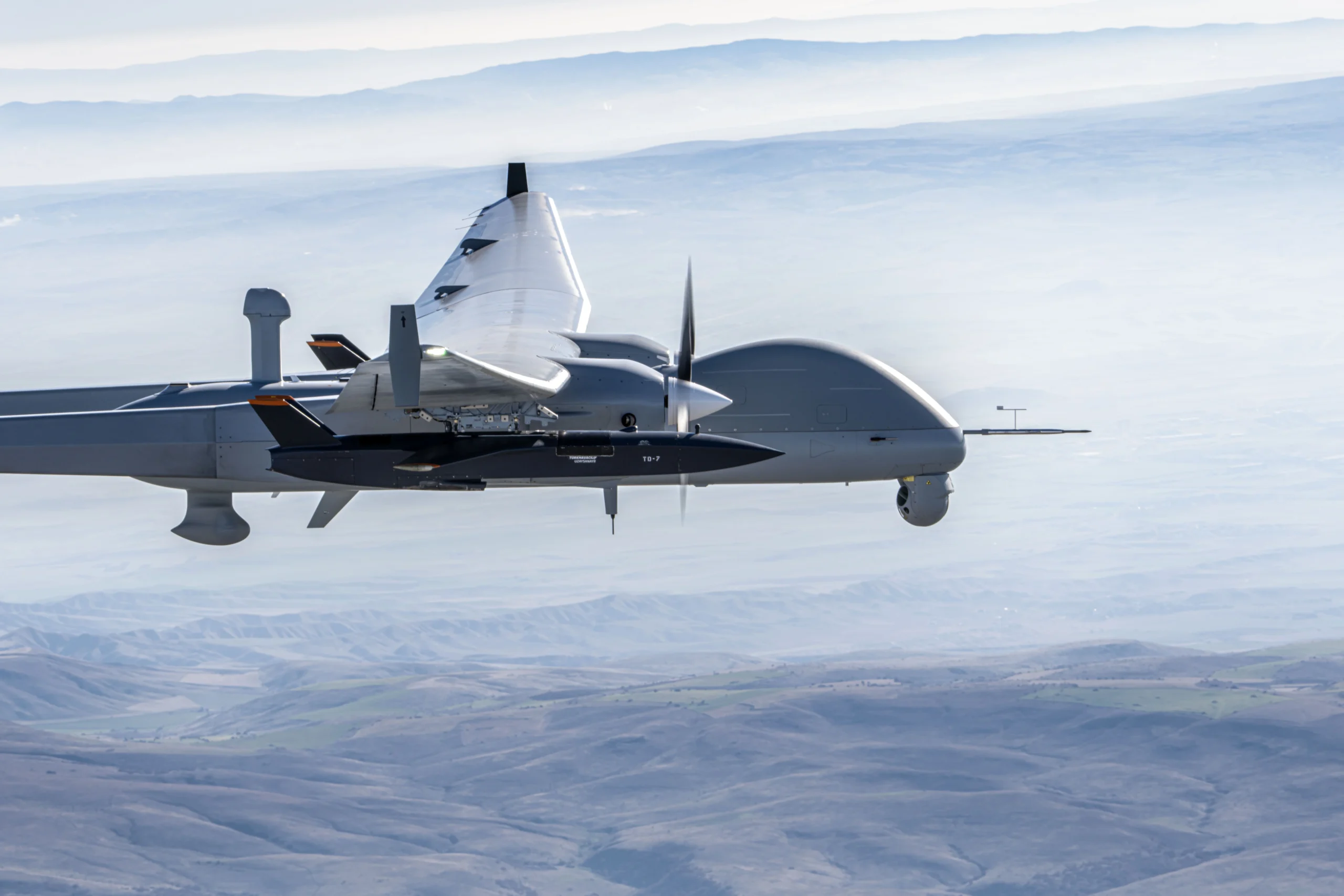
Turkish Aerospace (TUSAŞ) sells two medium-altitude, long-endurance drones that look similar on a ramp and are meant for different jobs. ANKA is the lighter single-engine workhorse. AKSUNGUR is the twin-engine heavyweight that grew out of it. Comparing the two is less a question of which is better and more a question of what the customer wants to hang under the wings and how far from home it has to fly.
How Do AKSUNGUR and ANKA Compare on Paper?
The figures below come from the manufacturer’s own product pages. Real-world performance depends on payload, fuel load, altitude and weather, so the endurance numbers are best read as ceilings, not guarantees.
| Specification | ANKA | AKSUNGUR |
|---|---|---|
| Manufacturer | Turkish Aerospace (TUSAŞ) | Turkish Aerospace (TUSAŞ) |
| Class | MALE UAV, single engine | MALE UAV, twin engine |
| Wingspan | 17.5 m | 24 m |
| Length | 8.6 m | 12.5 m |
| Maximum take-off weight | 1,700 kg | 3,300 kg |
| Payload capacity | 350+ kg | 750+ kg |
| Endurance | Up to 30 hours | Up to 50 hours |
| Service ceiling | 30,000 ft | 40,000 ft |
| Line-of-sight datalink | 250+ km | 250+ km |
| Satellite link range | 2,500+ km | 5,000+ km |
The gap is roughly a factor of two on weight and payload. Wingspan grows by about 40 percent. That is the usual penalty and reward of adding a second engine: more lift capacity, more redundancy, and a much larger airframe to move, store and maintain.
Why Did TUSAŞ Build a Second, Bigger Drone?
ANKA came first. Development began in the mid-2000s, and the prototype is generally reported to have flown for the first time at the end of 2010. The family later split into variants: ANKA-A for reconnaissance, ANKA-B with a synthetic aperture radar, and ANKA-S, the production version with a satellite link and a nationally developed flight computer. The history is covered in more detail in our ANKA development history.
AKSUNGUR was the answer to a limit that every single-engine MALE drone runs into. Once you want heavy munitions, a large radar, an electronic intelligence suite and long loiter time in the same sortie, the airframe runs out of weight allowance. According to widely cited accounts, AKSUNGUR’s first flight took place in March 2019, and it was first shown to the public at the 2019 Istanbul defence fair. It was designed from the start with two TEI-PD170 turbocharged diesel engines, a twin-boom layout and a payload class well beyond ANKA’s. Its early project name is reported to have been ANKA-2, which tells you how TUSAŞ saw the lineage.
What Does the Extra Engine Actually Buy?
Three things stand out.
Payload. The 750-plus kilogram figure is what lets AKSUNGUR combine sensors and weapons that ANKA would have to trade against each other. TUSAŞ lists precision-guided bombs, laser-guided rockets and anti-tank missiles for both aircraft, but a larger airframe can carry more of them and still keep fuel for a long patrol.
Altitude. A 40,000 ft ceiling puts AKSUNGUR above much of the weather and above most low-level traffic. For maritime surveillance and radar imaging, extra height means a wider horizon.
Redundancy. Two engines give an engine-out margin over open water or hostile terrain. That is a quiet but real selling point for navies, which is one reason the maritime role features so heavily in AKSUNGUR’s story. The Turkish Naval Forces are reported to have received the type in October 2021. We looked at that mission in our piece on AKSUNGUR’s maritime patrol role.
Sensors are where the two aircraft overlap most. TUSAŞ lists the same broad menu for both: electro-optical and infrared cameras, SAR and GMTI/ISAR radar, and communications and electronic intelligence payloads, plus AIS and TCAS for operating in busy airspace. The difference is how many of those can ride together. On ANKA an operator usually chooses a primary mission fit. On AKSUNGUR, the weight margin leaves room to carry a radar, an intelligence pod and weapons on the same flight, which is what makes the 12-hour attack-profile figure cited in the company’s flyer noteworthy next to the 50-hour surveillance headline.
Both are described as fully autonomous in take-off and landing, with automatic return to base if the datalink drops. That shared flight-control approach is a large part of why operators treat them as one family.
Where Does ANKA Still Win?
Cost and footprint. A 1,700 kg airframe is easier to transport, needs less runway and burns less fuel per hour. For a country that wants persistent surveillance over a border or a coastline without paying for a heavy strike platform, ANKA is the sensible fit. It also has a longer track record, which matters to buyers who weigh maturity of the supply chain, spares and operator training.
The export record reflects this. ANKA is reported to be in service or on order with several foreign air forces, while AKSUNGUR’s export list is shorter and newer, with Kyrgyzstan and Chad most often named in open sources. Because customer details often surface through photographs and trade press rather than official announcements, treat any unit count as reported. Our ANKA operators roundup tracks what is publicly known for the lighter aircraft.
How Do They Fit With Baykar’s Drones and ANKA-3?
Both aircraft sit in the same segment as Baykar’s Bayraktar AKINCI, which carries a similar class of payload on a different design. The AKINCI against TB2 comparison on this site shows how the same logic of “two aircraft, two jobs” applies on the other side of the Turkish drone industry; see AKINCI and TB2.
TUSAŞ is also moving beyond conventional layouts. ANKA-3, a flying-wing design aimed at lower observability, is meant for a different threat environment altogether, and it is not a replacement for either of the two aircraft discussed here. The company’s stealth drone effort is covered in our ANKA-3 article.
Which One Suits Which Customer?
- Border and internal security, modest budget: ANKA, with its lower acquisition and operating cost and a long-endurance sensor payload.
- Maritime patrol and long-range ISR: AKSUNGUR, thanks to its higher ceiling, 5,000-plus km satellite link range and twin-engine margin.
- Mixed strike and intelligence missions on one sortie: AKSUNGUR, where the 750 kg payload class avoids trading sensors against weapons.
- Fleet commonality: both come from the same manufacturer, share the same design philosophy of redundant flight control and autonomous take-off and landing, and use a DO-178B/DO-254 compliant approach, which can ease training and integration for operators who start with one and add the other.
It is also worth noting what the comparison does not settle. Loss rates, combat performance and mission-ready availability are not published by the manufacturer. Open-source reports of AKSUNGUR losses in operations have appeared, but they are not independently confirmed in the sources reviewed here, so they are left out of the comparison above.
Both aircraft are built by Turkish Aerospace, which positions them as a ladder, not a rivalry: a customer starts with ANKA, then steps up to AKSUNGUR when the mission outgrows the smaller airframe.


