HİSAR Missiles Fill the Middle Layer of Türkiye’s Air Shield

For decades the soft spot in Türkiye’s air defences sat in the middle. Man-portable missiles and anti-aircraft guns covered the last few kilometres, and long-range cover was something the country hoped to buy from abroad. Everything between roughly 5 and 25 kilometres belonged to ageing Rapier batteries and improvisation. The HISAR air defence system family was created to close exactly that band. Today the tracked HİSAR-A+ and the truck-mounted HİSAR-O+, built by ASELSAN and ROKETSAN, are in service with the Turkish Armed Forces and form the middle layers of the layered architecture Ankara now markets as the Steel Dome.
This guide walks through where the programme came from, what the two missiles actually do, how the batteries are organised in the field, and where the family fits between SUNGUR at the bottom and SİPER at the top.
Where the HİSAR Programme Came From
The Presidency of Defence Industries, then still known as SSM, launched separate low-altitude and medium-altitude air defence missile projects in 2007 under the Turkish names Alçak İrtifa and Orta İrtifa Hava Savunma Füze Sistemi, abbreviated HİSAR-A and HİSAR-O. The word hisar means fortress in Turkish, which tells you how the procurement agency saw the job.
Development contracts followed in 2011, with ASELSAN as prime contractor for both systems and ROKETSAN responsible for the missile itself. The first ballistic test firing of a HİSAR-A round took place in October 2013, and guided test campaigns ran through the second half of the decade at the Aksaray and Sinop ranges. Along the way the requirement evolved. The configurations that finally entered service carry a plus sign, HİSAR-A+ and HİSAR-O+, reflecting upgraded seekers, fuzes and extended engagement envelopes compared with the original designs.
The timing mattered. Türkiye’s parallel attempts to buy a long-range system abroad, first the cancelled Chinese HQ-9 deal and later the politically costly S-400 purchase, convinced planners that every tier the country could build at home, it should. HİSAR became the proof that a fully domestic surface-to-air missile, radar and fire control chain was achievable.
How ASELSAN and ROKETSAN Split the Work
The division of labour follows a pattern familiar from other Turkish missile programmes. ASELSAN delivers everything that finds, tracks and assigns the target, including the KALKAN family of 3D search radars, the fire control units, communications and electro-optical sensors, and it integrates the complete battery. ROKETSAN designs and produces the interceptor, from the airframe and the dual-pulse solid propellant motor to the warhead. TÜBİTAK SAGE contributed as well; reporting around the A+ configuration credits the institute with the RF proximity fuze that replaced the earlier laser-based design.
That split means a HİSAR battery is not one product but a small ecosystem of vehicles, and it is one reason the system has been comparatively quick to adapt. New seekers, new radars and new launcher platforms can be introduced without redesigning the whole chain.
What Is Inside a HİSAR Missile
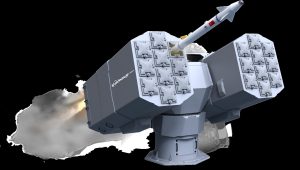
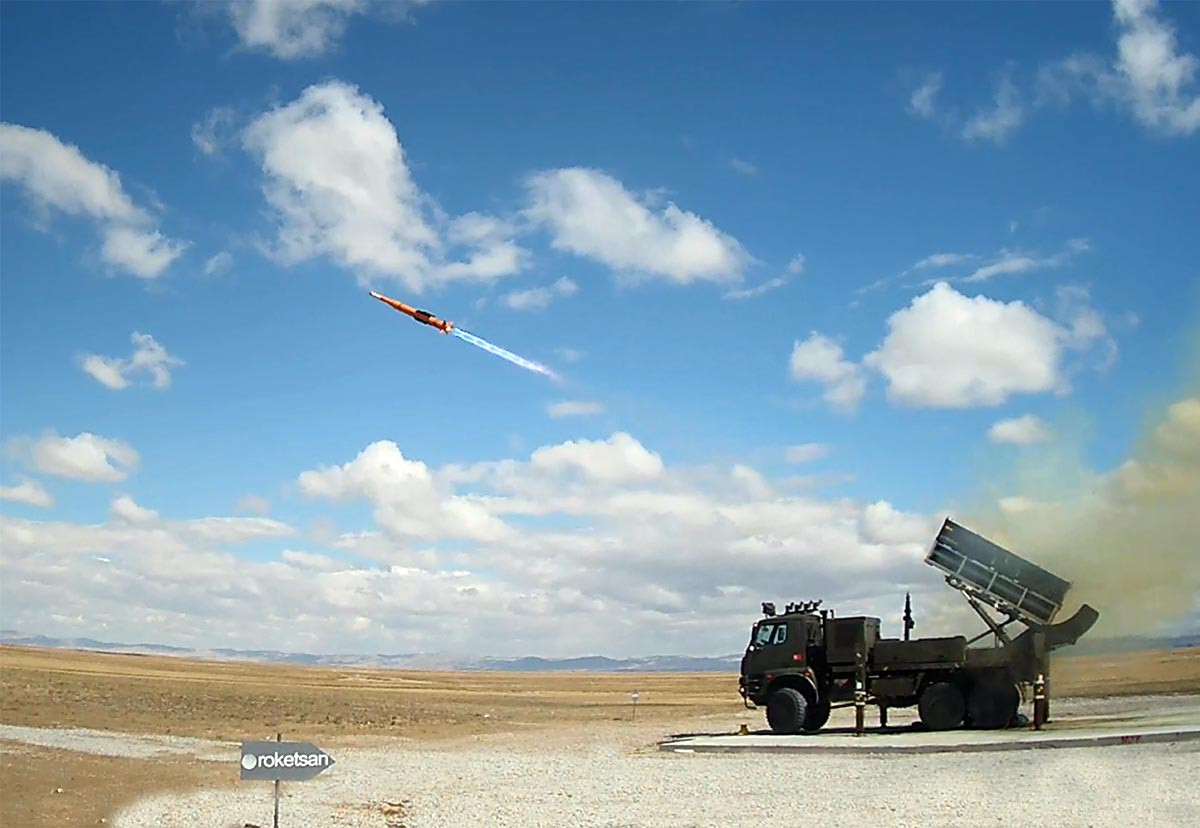
Both members of the family share a common design language. The missiles are launched vertically from canisters, which gives a battery 360-degree coverage without slewing a launcher towards the threat. A thrust vector control system tips the missile over towards its target immediately after launch. Propulsion comes from a dual-pulse solid rocket motor, meaning the motor burns in two stages so the missile keeps energy in reserve for the endgame, where most intercepts are won or lost.
Guidance follows a layered logic of its own. The missile flies midcourse on inertial navigation with updates over a one-way data link from the fire control centre, then switches to an imaging infrared seeker for the terminal phase. An IIR seeker is passive, so the target aircraft receives no radar warning that a missile is closing. The warhead is a high-explosive blast fragmentation type with impact and proximity fuzing. ROKETSAN lists fixed-wing aircraft, helicopters, cruise missiles, air-to-ground missiles and unmanned aircraft as the target set for both variants.
A common canister and umbilical connection across the family simplifies logistics, and it is what allowed later variants, including a ship-launched version, to emerge from the same production line.
HİSAR-A+ and HİSAR-O+ Side by Side
| Field | HİSAR-A+ | HİSAR-O+ |
|---|---|---|
| Role | Low-altitude, short-range air defence | Medium-altitude, medium-range air defence |
| Manufacturer | ASELSAN (system), ROKETSAN (missile) | ASELSAN (system), ROKETSAN (missile) |
| Range | 15+ km | 25+ km (IIR); 40+ km reported for the RF-seeker variant |
| Engagement altitude | Approximately 8 km (reported) | Approximately 15 km (reported) |
| Length | 3.95 m (reported) | 4.6 m (reported) |
| Guidance | INS and data link midcourse, imaging infrared terminal | INS and data link midcourse, imaging infrared terminal; active RF seeker on HİSAR-O+ RF |
| Propulsion | Dual-pulse solid propellant, thrust vector control | Dual-pulse solid propellant, thrust vector control |
| Launch | Vertical, 360-degree coverage | Vertical, 360-degree coverage |
| Warhead | High-explosive blast fragmentation | High-explosive blast fragmentation |
| Primary platform | Self-propelled system on FNSS ACV-30 tracked chassis | Launcher on 6×6 military truck chassis |
| Service entry | 2021, Turkish Armed Forces | Deliveries from 2022, Turkish Armed Forces |
A note on the numbers. ROKETSAN’s own catalogue gives the deliberately open-ended figures of 15+ and 25+ kilometres, and the altitude and dimension figures above come from defence media rather than manufacturer datasheets, so treat them as reported rather than guaranteed.
How HİSAR-A+ Keeps Pace with Armoured Units
What sets HİSAR-A+ apart from most short-range systems in its class is that it is genuinely autonomous. The self-propelled variant packs the search radar, fire control electronics and four vertical launch canisters onto a single FNSS ACV-30 tracked chassis, the same base vehicle used for the KORKUT gun system. One vehicle can detect, track and engage on its own, which is the point, because its job is to move with mechanised brigades rather than sit behind them.
The system is credited in Turkish reporting with engaging multiple targets simultaneously, with six often cited, out to 15 kilometres and up to roughly 8 kilometres in altitude. In practical terms, a HİSAR-A+ vehicle travelling with an armoured column gives that column organic protection against armed drones, attack helicopters and aircraft launching stand-off munitions, threats that Turkish units have faced directly in Syria and that shaped the upgrade from the baseline HİSAR-A.
What a HİSAR-O+ Battery Looks Like in the Field
HİSAR-O+ trades mobility for reach. The battery architecture is distributed, with the missile launching systems mounted on 6×6 military trucks, widely reported as the Mercedes-Benz Zetros, each carrying six vertically launched missiles, alongside separate radar and fire control vehicles. Turkish media describing the order of battle put three launchers in a battery, for 18 ready missiles, with a battalion fielding nine launchers. Those figures come from press reporting rather than official documents, so some caution is warranted.
The variant worth watching is the RF-seeker version, often written HİSAR-O+ RF or simply HİSAR-RF. In August 2024 the SSB announced that a mass-produced battery had downed a target aircraft at a range beyond 40 kilometres, and a further test in January 2025 repeated the success with the infrared-seeker round. An active radar seeker gives the system an all-weather engagement option and pushes HİSAR-O+ into territory that starts to overlap with the lower end of SİPER coverage, which is precisely how a layered network is supposed to work.
Deliveries to the Turkish Armed Forces
HİSAR-A+ entered the inventory in 2021, with then SSB President İsmail Demir announcing the delivery that July. HİSAR-O+ followed, with deliveries reported from early 2022, and batteries have since been deployed operationally, including, according to Turkish press reports, along the Syrian border.
The programme shifted into a higher gear in December 2023, when ASELSAN, ROKETSAN and TÜBİTAK SAGE signed serial production contracts worth more than 1.5 billion dollars covering HİSAR variants and SİPER for the Land Forces and Air Force, with deliveries scheduled between 2025 and 2029. In August 2025 the SSB announced the handover of three complete HİSAR-O systems comprising 21 vehicles in a single batch, a sign that production has moved well past the initial low-rate phase.
The family is also spreading beyond land. A navalised round, referred to as HİSAR-D, was test fired in 2024 and is intended for vertical launch cells on Turkish surface combatants, effectively giving the fleet a domestic point-defence missile grown from the same airframe.
Where HİSAR Sits in the Steel Dome
Turkish planners describe their national air defence as a ladder, and the rungs are now mostly domestic. At the very bottom sit the SUNGUR missile and the KORKUT 35 mm self-propelled gun, covering the final handful of kilometres against drones and low-flying aircraft. HİSAR-A+ takes over the low tier out to 15 kilometres, HİSAR-O+ holds the medium band beyond 25 kilometres, and SİPER provides the long-range roof. Binding them together is the Steel Dome concept, in which the HAKİM command and control network fuses radar pictures across all layers and assigns each threat to the cheapest effector able to kill it.
That last point is the economic heart of the design. Nobody wants to spend a SİPER round on a slow drone that a HİSAR-A+ or a gun could take, and a networked, layered structure is what makes that discipline possible. The Steel Dome elements, including both HİSAR variants, were fielded together as an integrated architecture for the first time during Exercise EFES 2026, according to Turkish defence outlets.
Is Anyone Buying HİSAR Abroad
Turkish air defence systems have become a serious export line, and the HİSAR family is part of the sales catalogue at every major defence fair. Confirmed, publicly documented export contracts for HİSAR remain scarce, though. Indonesian interest has been reported in connection with Jakarta’s layered air defence plans, Ukraine was reported to have requested the system after 2022, and regional media have floated further candidates, but none of this has been formally confirmed by the SSB or the manufacturers. Given how quickly Turkish air defence exports have grown, from radars to KORKUT-class guns, a first announced HİSAR customer would surprise nobody in the sector.
For now the priority is filling Turkish inventories. With the 2023 serial production contracts running through 2029, the naval HİSAR-D in testing and the 40-kilometre-class RF variant proven in live firings, the family that began as a gap-filler between guns and a roof Türkiye did not yet own has become the load-bearing middle of the whole structure.