
Where a Loitering Munition Stops Being a Missile and Starts Being a Drone

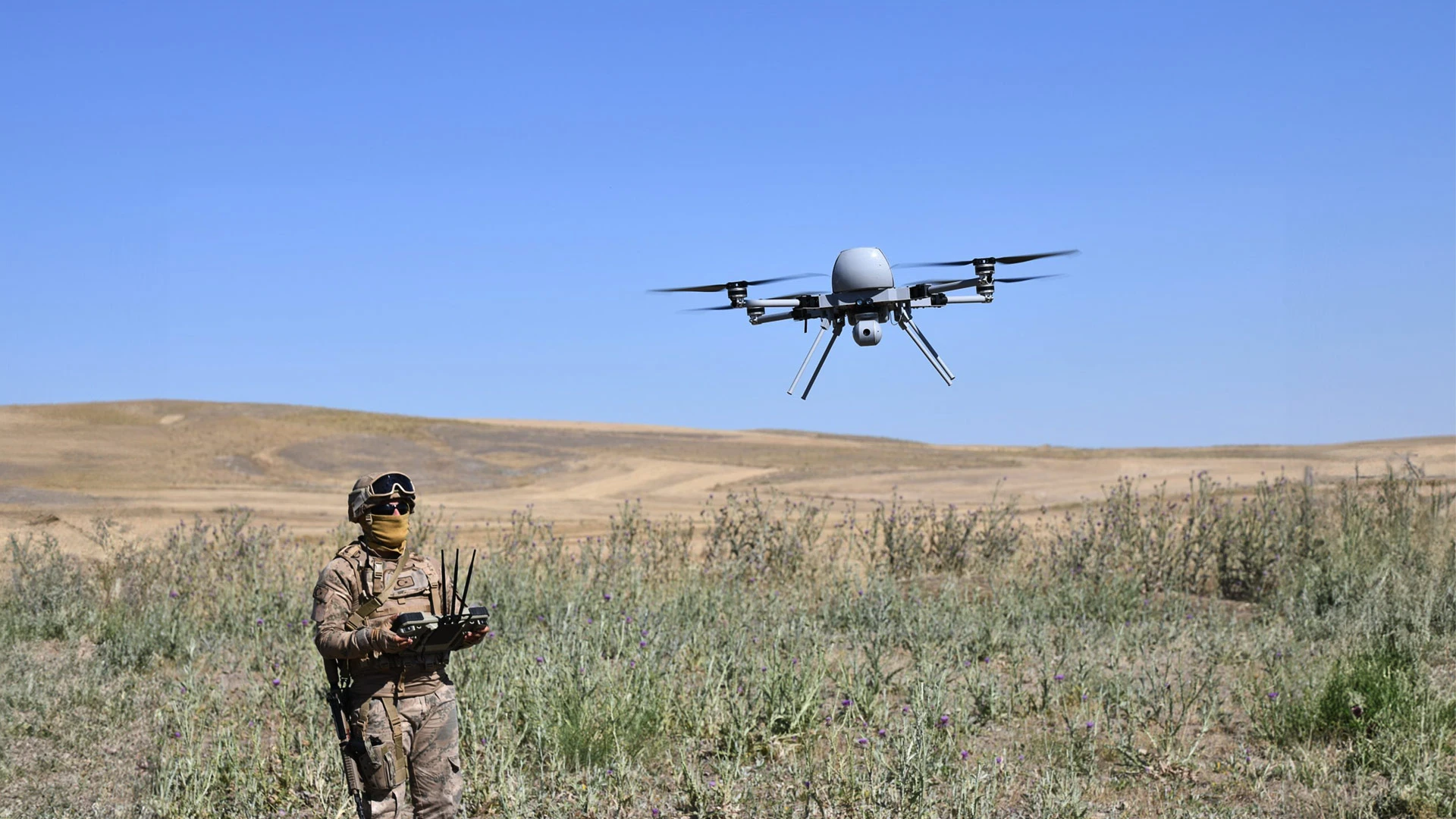
Ask a soldier what a loitering munition is and you may hear “a drone that blows up.” Ask an arms-control lawyer and you will hear “a weapon with a seeker.” Both are right, and neither explains why the category has become one of the busiest corners of Turkish defence exports. The technology sits between a cruise missile and an armed drone, and the Turkish designs now on offer cover almost the whole span between them.
What Separates a Loitering Munition From a Missile or a Drone?
Three traits define the class. The weapon carries its own warhead and is expended when it hits. It can stay airborne over an area for a meaningful time instead of flying a fixed route to a fixed point. And a human can usually refine the target, redirect the weapon or call it off in flight.
A cruise missile is built for a pre-planned hit at long range and does not hang around over the target area. An armed drone such as a UCAV drops or fires munitions and comes home. The loitering munition borrows the sensor and the patience of the second and the one-way ending of the first. The concept goes back decades: Israel’s Harpy entered production in the late 1980s to hunt air-defence radars, as summarised on Wikipedia, and the class later spread to infantry-level tools such as the American Switchblade 300.
The wave-off option is the practical selling point. AeroVironment describes the Switchblade 300 as a system that lets a team fly to a target area, search and hold before attacking, with time to refine target data or abort if the situation changes. Israel Aerospace Industries says its Harop is supervised by human-in-the-loop mission control and can be aborted if required. That is the logic Turkish manufacturers have adopted too.
How Do the Turkish Designs Differ From Each Other?
Ankara’s industry did not build one loitering munition. It built three distinct sizes, and the differences say more about the technology than any single spec sheet.
| System | Maker | Class | Key published figures |
|---|---|---|---|
| KARGU | STM | Rotary-wing, one-soldier tactical | 10 km mission range, about 30 minutes endurance with payload, 7.7 kg take-off weight |
| TOYCA-10E | Skydagger | Catapult-launched, electric fixed-wing | 250 km range, 10 kg warhead (as announced) |
| SİVRİSİNEK (UM) | Baykar | Long-range catapult-launched | 1,000 km range, 9+ hours endurance, 20 kg warhead, 76 kg MTOW |
Figures come from STM’s and Baykar’s product pages and from reporting on the TOYCA-10E announcement. The SİVRİSİNEK figures are the manufacturer’s for the UM variant; the UMX is listed with 900 km range and 8+ hours.
At the small end, a multirotor needs no runway, launches in under a minute according to STM and fits in a backpack-sized footprint once folded. At the far end, a 76 kg airframe with nine hours of endurance behaves more like a slow, cheap cruise missile that can also circle. The medium class, represented by TOYCA-10E, fills the 100 to 300 km gap in which an artillery or rocket unit would otherwise have to wait for a more expensive missile.
What Does KARGU Actually Do on the Battlefield?
KARGU is the system that made the category visible. STM describes it as a portable rotary-wing attack drone for tactical reconnaissance and precision strike, operated by one person, with electro-optical and infrared cameras and a mobile ground control station. It is reusable if the mission is aborted, since it can return home. Published figures include a 10 km mission range with an external antenna (6.5 km with the onboard antenna), an operating altitude band of 50 to 500 m and a cruise speed of 20 m/s.
The company also lists anti-personnel and armour-piercing warhead options on the same platform, and it states that the precision strike is carried out by the operator under a man-in-the-loop principle. More detail on the programme sits in our KARGU profile, and the company’s wider portfolio is covered in the STM company profile.
Two newer additions show where the technology is heading. STM says a pod and software package lets KARGU dive-attack in environments where satellite navigation is jammed, and that it is developing an RF seeker that could detect and home in on emission sources, a kit it pitches against electronic-warfare assets, air-defence systems and FPV drone controllers. The seeker is described as under development, not fielded.
Is It Autonomous, and Who Decides to Fire?
This is the argument that follows the whole category. In March 2021 a UN Security Council Panel of Experts report on Libya (document S/2021/229) said that lethal autonomous weapons systems, including the KARGU-2, had been programmed to attack targets without requiring data connectivity between the operator and the munition. Coverage at the time framed it as a possible first autonomous engagement against human targets. The report’s wording was cautious, and it did not establish that the weapons had operated without any human decision.
STM’s position, as reported by Shephard Media after the report, is that the engagement cycle keeps a human in the loop. Its current product page makes the same claim: autonomous navigation, but precision strike performed by the operator. The gap between “can fly itself” and “chooses to kill by itself” is exactly where the legal debate lives, and neither the UN text nor the company’s statements fully settles how often, if ever, a KARGU has attacked without a person confirming the target.
What is certain is that the software is moving toward more machine involvement in the search phase. STM advertises deep-learning computer vision for object detection, classification and tracking, and the swarm software reaches the same logic one level up. For the operational picture on swarms, see our report on Türkiye’s drone swarms.
Why Is Swarming Such a Big Part of the Pitch?
STM says KARGU swarms run on its own swarm-intelligence software, with distributed control and drone-to-drone links. Units can form and hold formation, avoid collisions, split into sub-groups by mission or payload, scan areas cooperatively and be added or removed in flight, according to the company. The tactical logic is plain: a defender with one expensive interceptor per target loses the arithmetic against a dozen cheap airframes.
That arithmetic also explains the counter-drone push. The same cheap-and-numerous problem drives the demand for counter-drone guns such as ASELSAN’s KORKUT, which we cover in our KORKUT explainer.
Where Are These Weapons Going Next?
The newest data points all push in the same direction, towards longer range and lower cost.
Skydagger announced TOYCA-10E in late September 2026. It is an electric, catapult-launched aircraft with a 10 kg warhead and a stated 250 km range, with anti-jam capability and autonomous take-off, flight and terminal dive planned through Skydagger Flight Planner. The company describes it as the medium-range strike member of a family that also includes small multirotors and a smaller TOYCA 05 variant reported at about 5 kg of warhead. Our TOYCA-10E report has the details. Skydagger’s cheaper RTF multirotors have already found a customer abroad: Kosovo’s prime minister’s office said in October 2025 that thousands of Skydagger FPV kamikaze drones had been delivered three months ahead of schedule.
At the long end, Baykar lists SİVRİSİNEK with a 20 kg warhead and GNSS plus electro-optical terminal guidance. Reporting published on 24 September 2026 said it had been spotted in Azerbaijani Army service with the Nakhchivan Separate Combined Arms Army, and that Baykar announced in May 2026 that it would be produced jointly in Azerbaijan. That sighting is reported, not officially confirmed by Baku in the sources we reviewed. Read our SİVRİSİNEK coverage for the context.
Below all of them, STM’s backpack-class ALPAGU shows the opposite trend, shrinking the weapon until a single infantryman carries it; see the ALPAGU report.
The blur between missile and drone is therefore not a quirk of language. A 1,000 km, nine-hour airframe with a 20 kg warhead is closer to a slow cruise missile than to the 7.7 kg quadcopter at the other end of the Turkish catalogue. What links them is the same recipe: a sensor that can wait, a warhead that is spent on impact and, on paper at least, a human who makes the final call.


