Roketsan’s Barbaros Coastal Defence System Wins First Export Order, From Azerbaijan

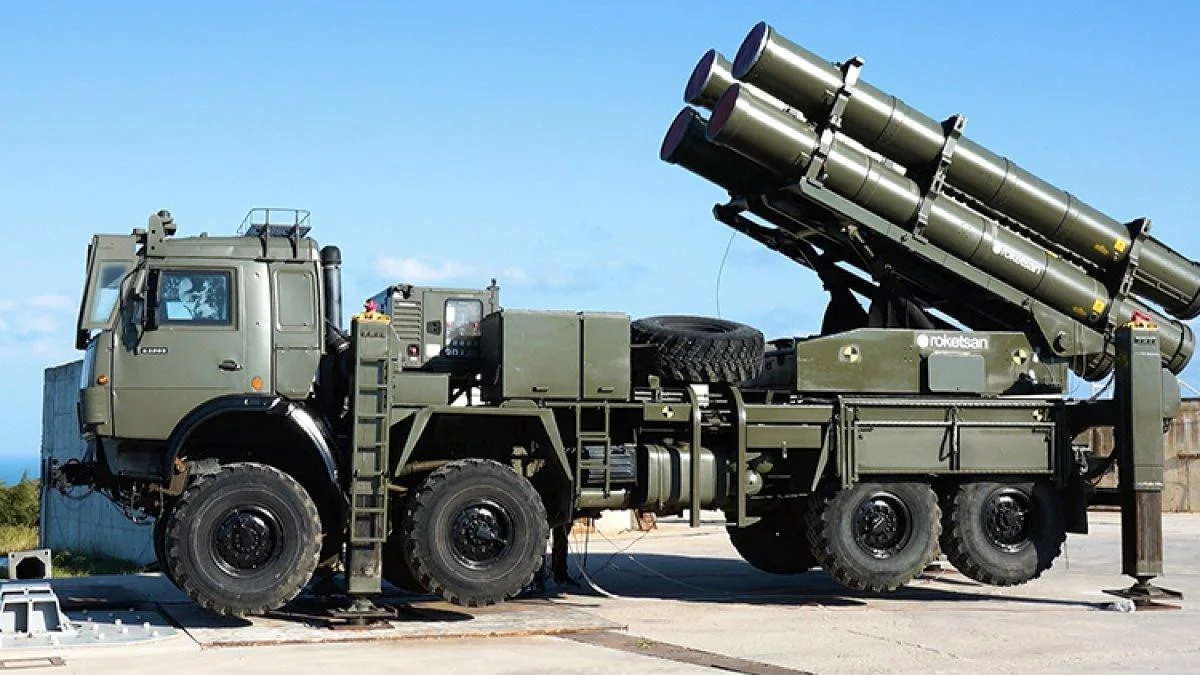
ROKETSAN has signed its first export contract for the BARBAROS coastal defence system, agreeing to supply the mobile anti-ship missile battery to Azerbaijan’s Ministry of Defence Industry. The deal was signed on September 30, the opening day of the Azerbaijan International Defence Exhibition (ADEX) in Baku, and gives the Turkish missile maker its first confirmed customer for a system it has displayed at defence shows since 2015 without previously disclosing a sale.
“We are very pleased that our Barbaros Coastal Defence System will be added to the inventory of the Azerbaijani army,” Roketsan General Manager Murat İkinci said at the signing. “With its capabilities, Barbaros will play a strategic role as Azerbaijan’s new guardian on its coastline.” Roketsan and Azerbaijani officials have not disclosed the contract’s value, the number of batteries involved or a delivery schedule.
What Barbaros Does
BARBAROS is a truck-mounted, road-mobile coastal defence battery built around Roketsan’s two cruise missile families. A single battery can carry four ATMACA anti-ship missiles or six ÇAKIR cruise missiles on its launcher vehicle, alongside a separate command-and-control vehicle that can network with external radar and surveillance feeds through Roketsan’s ADVENT combat management system. Roketsan says the battery can relocate in under five minutes of firing, a “shoot-and-scoot” profile meant to keep the launcher alive against counter-battery fire or air attack.
ATMACA is Roketsan’s subsonic, sea-skimming anti-ship missile, with a publisher range of 250 km and a 220 kg warhead; it is already in Turkish Navy service and has been sold to Indonesia and Malaysia. ÇAKIR is the shorter-range member of the family, built around the same KTJ-1750 turbojet developed with Kale Arge, and was only fired from a mobile ground launcher for the first time this past August. Pairing the two missiles on one truck gives BARBAROS both an over-the-horizon anti-ship option and a shorter-range land-attack capability from a single battery, without requiring the customer to buy two separate launcher types.
A System That Waited a Decade for a Buyer
Roketsan has exhibited BARBAROS at defence shows going back to at least 2015 but had not announced an export sale for the system before this contract. That gap is not unusual for coastal defence batteries, a category with a narrow buyer pool limited to states with coastlines to defend and budgets for truck-mounted missile systems rather than naval vessels; Sweden’s RBS15-based coastal batteries and Norway’s NASAMS-adjacent coastal systems have faced similar export constraints. Azerbaijan’s purchase makes it the first country to add BARBAROS to its order book, and a reference sale that Roketsan can point to as it markets the system to other Caspian and Black Sea states.
For Azerbaijan, BARBAROS extends a coastline-defence requirement that has grown more pointed since the 2020 Second Nagorno-Karabakh War demonstrated the value of mobile, hard-to-target missile batteries. The Caspian Sea borders five states — Azerbaijan, Russia, Iran, Kazakhstan and Turkmenistan — and a mobile coastal system gives Baku an anti-ship capability it can redeploy and conceal rather than fixed shore batteries.
Part of a Larger Baku Package
The BARBAROS contract was one of five Turkish agreements signed with Azerbaijan on ADEX’s opening day, part of a package SSB chief Haluk Görgün said was worth more than $500 million. The same day, Turkish Aerospace agreed to deliver 14 HÜRKUŞ-II trainer aircraft, ASELSAN signed a radar MoU and an electronic-warfare contract, and Baykar agreed to supply its Mızrak loitering munition and Antidot systems — deals DefenceTürkiye covered in full at the time. Türkiye brought its largest-ever delegation to this year’s show, a sign of how much commercial weight Ankara is putting behind the Baku market.
The agreement continues a run of missile exports that has made rockets, missiles and smart munitions Türkiye’s largest defence export category, ahead of unmanned systems. Roketsan has separately been building a local manufacturing presence in Azerbaijan through AZROKSAN, its joint venture with Azerbaijani state firm STP, which is preparing to begin assembling 122mm artillery rockets once its new facility is complete — a parallel sign that Ankara’s exports to Baku are shifting from arms sales toward shared production.
Because the BARBAROS agreement was announced as a signed procurement contract rather than a memorandum of understanding, it ranks as a firmer commitment than several of the other instruments signed at ADEX this year. What remains unconfirmed is the practical detail that usually follows a launch customer: how many batteries Azerbaijan is buying, what it is paying, and when the first units will reach the Azerbaijani Armed Forces’ coastal units along the Caspian.