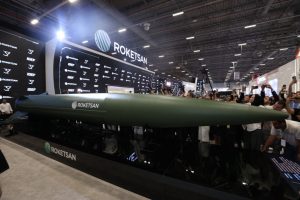
Roketsan’s KARAOK Anti-Tank Missile Scores First Hit on Aerial Target

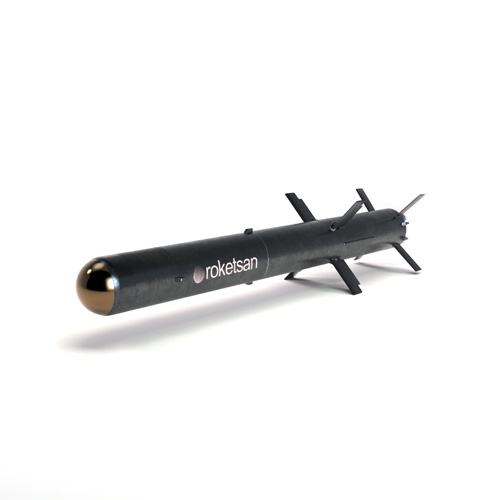
Roketsan said on September 23 that its KARAOK short-range anti-tank guided missile has hit an aerial target for the first time, a capability the Turkish missile maker had not previously demonstrated or marketed for the man-portable system.
Roketsan General Manager Murat İkinci announced the result on the company’s social media channels, saying KARAOK “has expanded its operational scope by successfully hitting an aerial target for the first time” and that the company was continuing to add capabilities to the system “in line with the changing needs of the battlefield.” Roketsan did not disclose the date, location or type of aerial target used in the test, nor whether the engagement used a modified seeker, software update or the missile’s stock configuration.
What KARAOK Is
KARAOK — Turkish for “Black Arrow” — is a 125mm, fire-and-forget, man-portable anti-tank guided missile developed by Roketsan to give infantry squads a shoulder-fired weapon comparable to the US FGM-148 Javelin. According to Roketsan’s own published specifications, the missile and launch tube together weigh under 16 kg, have a maximum range of 2.5 km, and use an imaging infrared seeker that allows the gunner to lock onto a target before firing and walk away, since the missile tracks and homes in on its own.
The tandem warhead is built to defeat explosive reactive armor, and the missile can strike in either direct-attack or top-attack mode, hitting armored vehicles through their weaker top armor. Roketsan validated the system against ground targets at ranges from 76 meters out to roughly 2,050 meters earlier this year, firing in both direct and top-attack profiles with the company reporting hits in every case.
Until now, KARAOK’s stated role has been strictly anti-armor: knocking out tanks, armored personnel carriers and fortified positions. An infrared-homing, fire-and-forget missile that can also track and destroy an aerial target — most plausibly a slow, low-flying threat such as a quadcopter, fixed-wing drone or helicopter, given the seeker’s design and the missile’s short engagement envelope — would let the same infantry-carried system pull double duty as a last-ditch counter-drone weapon, without adding hardware to a soldier’s load.
Why the Timing Matters
The announcement lands in the middle of a broader push by Turkish manufacturers to give ground-based, close-in weapons an anti-drone role, driven largely by the drone-saturated battlefields of Ukraine and the wider Middle East. Roketsan itself has spent 2026 testing multiple systems against aerial threats: its BURÇ mobile launcher fired the SUNGUR missile for the first time in mid-September, and its LEVENT missile intercepted a high-speed drone the same week. ASELSAN’s new SMASH 300 naval remote weapon station, unveiled days earlier, was likewise built around AI-assisted drone detection and engagement.
KARAOK’s case is different from those purpose-built counter-drone systems because it was never designed as one. If Roketsan can validate the aerial-engagement mode reliably and add it as a standard capability rather than a one-off demonstration, it would let existing and future KARAOK customers add a limited air-defense function to inventory they already operate, rather than buying a separate weapon.
Export Position
KARAOK’s only confirmed export customer to date is Malaysia, which signed a roughly $20 million contract — Roketsan’s first foreign order for the system — covering 18 launchers and about 108 missiles plus instructor training, with deliveries scheduled to begin in 2026 to replace Malaysia’s Russian-made 9K115-2 Metis-M anti-tank systems. Roketsan has not said whether Malaysia’s order, or any future customer contract, will include the newly demonstrated aerial-engagement mode, and no other government has been publicly confirmed as a KARAOK operator or buyer.
Roketsan is one of five Turkish defense firms that cracked the global top 100 rankings in 2026, and the company has said it wants to climb from its current position into the top 50 and eventually the top 20 worldwide. Turkey’s overall defense and aerospace exports passed $10 billion for 2025, with precision-guided munitions — a core part of the same precision-strike portfolio Roketsan showcased at MSPO 2026 — among the fastest-growing export categories. Background on the company’s broader product line and export record is available in DefenceTürkiye’s Roketsan company profile.
What to Watch
Roketsan has not stated whether the aerial-hit test represents a one-time demonstration, a qualification milestone toward a marketed “anti-drone” variant of KARAOK, or a capability that will be offered as a software or seeker upgrade to existing users. The company also has not released video or imagery of the test itself, which is typical for early-stage capability demonstrations before a system is formally qualified. Confirmation of the target type, engagement range and whether the test used a standard-configuration missile would clarify how close KARAOK is to fielding this as an operational mode rather than a proof of concept.