Sefine Shipyard Moved From Ferries to Frigates and a Fleet Replenishment Ship

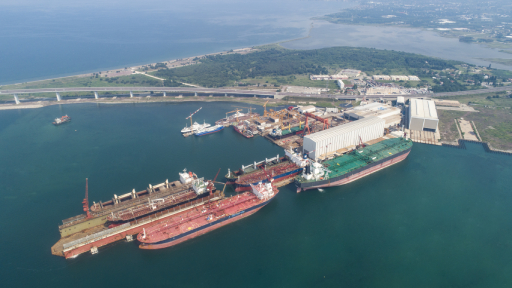
For most of its life, the Sefine yard in Altınova, on the Marmara shore of Yalova, was known for ferries, tugs and cargo ships. Today the same slipways turn out a replenishment ship for the Turkish Navy, a frigate for the national MİLGEM family and an unmanned surface vessel. That shift happened in a handful of years, and it explains why the Sefine shipyard now appears on almost every list of Turkish naval builders.
| Item | Detail |
|---|---|
| Company | Sefine Shipyard (Sefine Tersanesi) |
| Location | Altınova, Yalova, on the Sea of Marmara |
| Parent group | Koloğlu Holding |
| Operating since | 2007, according to the company |
| Core business | New construction, repair and conversion, large steel structures |
| Dock lifting capacity | 40,000 tons, per the company |
| Naval work | DİMDEG replenishment ship (TCG Derya), İstif-class frigate TCG İçel, MARLIN USV (with Aselsan) |
What Was Sefine Building Before the Navy Came Calling?
The company describes itself as one of the few Turkish yards able to do new construction, ship repair and conversion, and heavy steel structures at the same time. Its own project list shows general cargo ships in the 13,000 to 26,000 DWT range, double-ended ferries, aluminium rescue boats and ice-breaking tugs. It converted a bulk carrier into a cement carrier and delivered a live fish carrier. On the steel side, it processed roughly 17,000 tons of structural steel for a viaduct on the Istanbul–İzmir motorway.
Open-source profiles add export customers in northern Europe, among them Norwegian and Estonian ferry operators. These are reported figures from secondary sources, but the pattern is clear. Sefine learned to build complex, outfitted vessels for demanding commercial clients long before it touched a warship.
That matters because modern naval auxiliaries and frigates are, at the hull and outfitting stage, big and intricate steel projects. A yard that can deliver a fitted-out ferry to Scandinavian standards already owns much of the discipline a navy wants.
How Did the DİMDEG Contract Change the Yard?
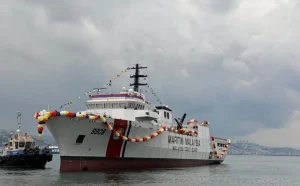
The turning point came on 10 July 2018, when the Presidency of Defence Industries (SSB) signed the Denizde İkmal Muharebe Destek Gemisi, or DİMDEG, contract with Sefine. The ship was to replenish task groups at sea and support operations far from shore. At the signing, ASELSAN and HAVELSAN also agreed to develop the combat systems together, with Sefine’s general manager Demir Koloğlu signing for the yard.
The ship that emerged is TCG Derya (A-1590). Published figures put it at about 194.8 metres long, 24.4 metres in beam and some 26,000 tons displacement, which makes it the second-largest vessel in the fleet after the amphibious assault ship TCG Anadolu. Two General Electric LM2500 gas turbines are reported for propulsion, and Naval News cites a top speed above 24 knots. STM is reported to have handled design packages such as structural analysis and 3D modelling.
Derya can supply several ships at once with fuel, water, food, ammunition and medical stores, and it can pass loads to helicopters. It was delivered to the Turkish Navy on 19 January 2024, in the same ceremony that handed over other platforms. The original plan had pointed to 2023, so the slip was modest for a first-of-type vessel of this size.
For a private yard with no previous experience of ships this large and this heavily armed, it was a considerable step. Sefine’s own website still lists 40,000-ton lifting capacity among its assets, which is what a ship of Derya’s displacement demands.
Is Sefine Part of the MİLGEM Frigate Story?
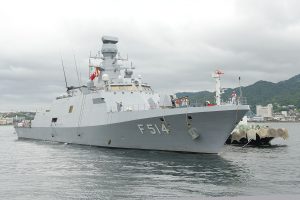
Yes. In 2025 the yard moved from support ships to combat ships. TCG İçel (F-518), the fourth İstif-class frigate, was launched at Sefine in Yalova on 1 September 2025. Steel cutting had started on 15 June 2023. İçel is the eighth ship of the wider MİLGEM project, and reported tasks include surveillance, anti-submarine and surface warfare, air defence and search and rescue in sea state 5.
The frigate is not a Sefine solo effort. STM acts as the design and programme lead for the class, and several yards share the hulls, as our explainer on the İstif-class serial production sets out. STM’s own role is covered in its company profile. Sefine’s value lies in adding build capacity while the navy tries to field the class faster.
What About Unmanned Vessels?
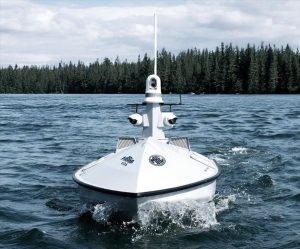
Sefine also partnered with Aselsan on the MARLIN unmanned surface vessel. The TCB Marlin SİDA was built at Altınova, is about 15 metres long, and is reported to reach around 35 knots. It entered Turkish Navy service on 19 January 2024, the same day as Derya. The vessel is small by shipyard standards, but it shows that the yard does not see itself only as a builder of large hulls.
Janes has also reported that DİMDEG is expected to operate alongside unmanned surface vessels, which hints at where the Turkish fleet is heading.
Did Sefine Build Ukraine’s Corvettes?
This question comes up often, because Sefine’s name sits in the same news cycle as the Turkish-built warships for Ukraine. Based on available reporting, it should be answered carefully. The first Ukrainian MİLGEM-type corvette, Hetman Ivan Mazepa, was launched in Istanbul on 2 October 2022, and Naval News credits RMK Marine with that launch. Reporting on the second ship, Hetman Ivan Vyhovskyi, points to STM as the contractor. We found no verified source placing Sefine as the builder of either Ukrainian corvette, so the yard’s naval record rests on DİMDEG, İçel and MARLIN rather than on Ukraine’s order. For the wider shipyard map, see who builds Türkiye’s warships.
How Does Sefine Compare With Other Naval Yards?
Unlike state-linked yards, Sefine grew from a commercial base. Another private yard, Dearsan, followed an export-first route, which we covered in its Turkmenistan record. Sefine’s route runs through large domestic programmes. One yard looks outward for customers, the other leans on SSB contracts and STM and Aselsan partnerships.
The open question is repetition. A single replenishment ship and a few frigate hulls prove capability but not a long production line. Whether the yard wins further military hulls, or an export order of its own, will decide if Sefine stays a ferry builder with a navy sideline or becomes a permanent prime.