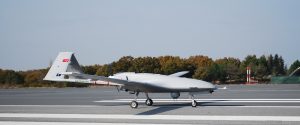
STM’s ALPAGU Is a Loitering Munition Light Enough for One Soldier to Carry

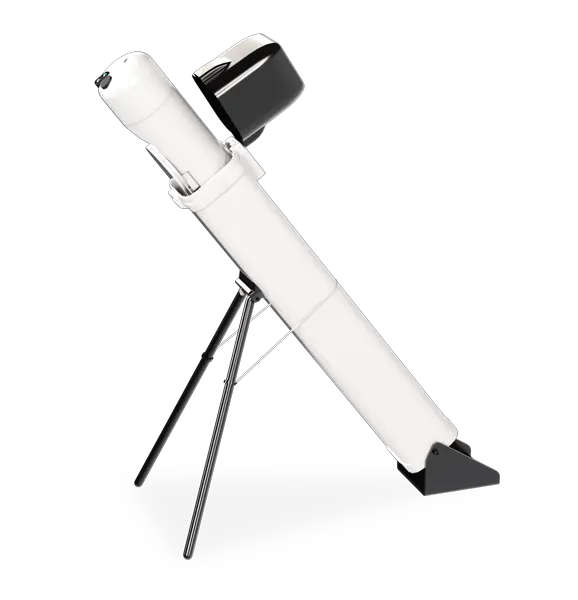
Most loitering munitions ask for a vehicle, a crew or at least a serious load carrier. STM’s ALPAGU asks for a soldier with a rucksack. The fixed-wing munition takes off at roughly 1.9 kg, and the air vehicle plus its pneumatic launch tube weigh about 3.5 kg together, according to reporting from European Defence Review. That is the whole pitch: strike capability at platoon level, without waiting for a higher echelon to hand over a drone.
| Item | Detail |
|---|---|
| Manufacturer | STM (Savunma Teknolojileri Mühendislik ve Ticaret A.Ş.), Ankara, Türkiye |
| Type | Fixed-wing tactical loitering munition |
| Take-off weight (ALPAGU) | About 1.9 kg; system with launch tube about 3.5 kg (reported) |
| Launch | Pneumatic launch tube |
| Warhead (reported) | About 300 g plastic explosive with fragmentation cubes |
| Larger variant | ALPAGU-B, 20 kg, 4 kg warhead, 40 km line-of-sight control distance, 40 minutes endurance (STM datasheet) |
What exactly is ALPAGU?
ALPAGU is a small fixed-wing drone that carries its own explosive charge. The operator launches it from a tube, flies it toward a target area using a tablet-based ground control unit, watches the camera feed and then commits it to a strike. If the target turns out to be wrong, the system is described as supporting mission abort.
STM, the Ankara-based defence contractor better known for frigates, submarines and its rotary-wing KARGU, designed it for the dismounted infantry role. Our STM company profile covers how the firm moved from naval projects and engineering services into small armed drones.
How small is small?
Numbers on the original ALPAGU vary between trade-show appearances, because the system has been refined since its 2021 debut. Reports have put its take-off weight at 1.9 kg, a wingspan around 70 cm, and a range of about 10 km with an external antenna fitted. Endurance figures published in the press run near ten minutes. Treat these as reported values; STM’s current public material emphasises the “ultra-lightweight, single-soldier” concept more than a fixed spec line for the baseline model.
The warhead is the other trade-off. Defence press reports describe an anti-personnel charge of around 300 grams of plastic explosive with embedded 4 mm fragmentation cubes. STM’s R&D team was reported to be working on thermobaric and armour-piercing options. A charge this size suits soft targets such as personnel, light vehicles and equipment, not tanks.
What does ALPAGU-B change?
The B variant is a different class of machine. STM’s datasheet lists a 20 kg air vehicle with a 4 kg warhead, a 6 kg payload capacity, 40 km control distance over line of sight, 40 minutes endurance and a 108 km/h cruise speed. Operating altitude is given as 50 to 1,000 m above ground, wind resistance 15 m/s, and the data link is AES-256 encrypted. It uses an EO/IR camera.
STM describes ALPAGU-B as a tactical-level system for striking targets beyond line of sight, which can also serve reconnaissance and surveillance. The system has three parts: the munition, a launcher and a ground control station. Safety, arming and fuze systems are stated to follow MIL-STD-331.
So the family splits cleanly. The baseline ALPAGU is a squad weapon you carry. ALPAGU-B is closer to a company or battalion asset you transport.
How does it find and hit a target?
STM markets ALPAGU with real-time, embedded image processing and deep-learning algorithms, plus a low radar cross-section design. In practice that means the onboard software can help detect and track targets in the camera view, easing the workload on a soldier who is also watching for threats around him. The operator stays in the loop for the engagement decision. STM also stresses night and day use against both fixed and moving targets.
Because the airframe is so light, launch from a pneumatic tube matters as much as the aircraft. It removes the need for a runway or catapult rail and lets the drone go up from a trench or a vehicle bed. An eight-cell launcher was shown at IDEF 2021, pointing toward salvo use of several munitions at once.
Where does it sit next to KARGU?
STM’s best-known loitering munition is KARGU, a quadcopter. Rotary-wing designs hover, hold position and can strike from any angle, which suits urban fighting. A fixed wing trades that agility for speed, range and efficiency, so it reaches farther on a small battery. ALPAGU is STM’s answer for open ground and longer approaches. Our KARGU profile explains the rotary side, and the September 2026 export tour shows how STM is now carrying its drones abroad.
The two are not alone in the Turkish market. A crowded field of domestic makers is mapped in who else builds Türkiye’s drones besides Baykar. A further STM line, the TUNGA-X interceptor drone and TOGAN family, is covered in field test coverage.
Why do infantry units want a drone they can carry?
The appeal is speed of decision. A platoon that has to request a larger drone or an artillery mission waits minutes or hours. A unit with its own loitering munition can look over a ridge, a treeline or a building and strike within the same engagement. The cost is a small warhead and short reach, which is exactly why STM offers the heavier ALPAGU-B for work at 40 km.
There is also a logistics angle. At under 4 kg per system, a section can carry several tubes without losing much else. Against a drone that needs a vehicle and a launch crew, that changes who can field the capability. Ukraine and other recent conflicts have made small, cheap, disposable strike drones a regular item in infantry planning, and ALPAGU fits that pattern rather than inventing it.
Who has bought it?
ALPAGU was reported to be scheduled for delivery to the Turkish Land Forces from 2021. In November 2023 defence outlets reported the system’s first export success, though the customer was not named in the coverage found for this article, so it is left unidentified here. STM has not published a full operator list.
What is ALPAGUT, and is it the same thing?
No. ALPAGUT is a separate smart loitering munition developed jointly by ROKETSAN and STM and shown at SAHA EXPO 2022. Reported figures include an operational radius of 60 km, endurance above 60 minutes and a dual-mode seeker. STM lists it as its own product page. Do not mix it up with ALPAGU or ALPAGU-B.
What should readers watch?
Two things stand out. First, whether STM publishes firm specifications for the baseline ALPAGU now that the B variant has an official datasheet. Second, whether the eight-cell launcher and new warhead types reach production. If they do, ALPAGU stops being only a backpack drone and becomes a platform for small-unit salvo fires.