
ASELSAN Takes Its Counter-Drone and EW Arsenal to MSPO 2026


ASELSAN will bring its full counter-drone and electronic warfare lineup to MSPO 2026, the Kielce defence exhibition that opens Tuesday as the largest edition in the show’s 34-year history, with more than 1,000 exhibitors from 40 countries and every square metre of the Targi Kielce halls sold out.
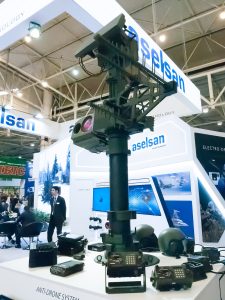
Türkiye’s largest defence electronics company confirmed it will exhibit systems drawn from three of its main product families: layered counter-UAV defence, electronic warfare, and airborne and naval sensing. The company frames the display around its “integrated architecture” pitch — selling not single boxes but a networked layer-cake of sensors, jammers and interceptors that Türkiye markets domestically as Çelik Kubbe (Steel Dome).
What ASELSAN is bringing
On the counter-drone side, ASELSAN’s stand will include the İHTAR 100 counter-UAS system, the GÖKBERK 10 laser weapon, the KORKUT 100/25 SB gun-based anti-drone system, the GÖKALP autonomous kinetic drone-kill interceptor, the EJDERHA/AD 200 high-power electromagnetic (HPEM) counter-UAV system, and the ŞAHİN DUAL 40mm hard-kill mount — the same family of systems that make up the lower tiers of Türkiye’s own layered air defence.
The electronic warfare portfolio centres on KORAL AD, a mobile electronic-attack and detection platform, alongside the ANTIDOT family of airborne EW systems designed for integration onto unmanned aircraft. On the sensing and maritime side, ASELSAN is showing the FULMAR multi-mission radar family and the KILIÇ family of autonomous maritime and underwater platforms.
None of these are new unveilings — most have already been shown at SAHA Expo, IDEF or TEKNOFEST over the past year — but MSPO is a different audience. It is Central and Eastern Europe’s largest defence trade fair, and this year Poland’s own state-owned Polish Armaments Group (PGZ) is the show’s strategic partner, with Canada as lead nation fielding 180 companies. Germany, the United States, Australia and the United Kingdom are the next-largest national contingents.
Why Poland matters to ASELSAN specifically
ASELSAN’s presence in Kielce is not a cold pitch. In December 2025, the company signed a $410 million export contract with Poland’s State Treasury – Armament Agency to supply electronic warfare and counter-UAS systems, winning the deal in open competition against international rivals — a rare case of a Turkish company beating Western competitors for a core capability contract with a major NATO army. Poland has also been integrating ASELSAN’s ARSUS 100 reconnaissance and surveillance mast onto the AMZ-Kutno-built Bóbr-3/Kleszcz reconnaissance vehicle since late 2025, under a framework agreement that runs through 2027 and potentially to 2035. Polish President Karol Nawrocki visited ASELSAN’s Ankara facilities earlier this year, a level of head-of-state attention Turkish suppliers rarely get from a NATO government that isn’t already a customer for major combat platforms.
That existing relationship is the real story behind ASELSAN’s MSPO stand: this is a supplier defending and expanding a beachhead in a NATO country’s electronic warfare and counter-drone modernisation, at a moment when Poland — sitting on NATO’s eastern flank next to Belarus, Kaliningrad and a war in Ukraine — is spending more on air and drone defence than almost anyone else on the continent. ASELSAN says its order backlog now exceeds $20 billion and employs more than 14,000 people; European counter-drone and EW money is a meaningful share of where the company expects that backlog to keep growing.
The bigger picture
The counter-UAS market ASELSAN is chasing in Poland is also the market it has built at home out of hard experience. Türkiye’s own Steel Dome architecture was assembled partly in response to years of drone and rocket threats on its southern borders, and systems like KORKUT and the broader İHTAR family were combat-tested before they were export products. That track record — as opposed to a paper design — is what Turkish officials and company executives lean on when pitching NATO buyers who are only now building out layered counter-drone defences of their own, a gap that Russia’s drone incursions into Polish and Romanian airspace over the past two years made impossible to ignore.
Whether MSPO 2026 produces a new contract announcement or simply reinforces the existing one remains to be seen; ASELSAN has not signalled a new deal timed to the show. But for a NATO ally shopping for exactly the kind of layered, combat-referenced counter-drone and EW systems Türkiye has spent the past decade fielding, the pitch in Kielce this week is less about introducing new products than about showing up as the incumbent.
Sources: Defence Industry Europe, Shephard Media, Defensehere, MILMAG.
Related reading on DefenseTurkiye:


[…] put Turkish sensor masts on Polish army reconnaissance vehicles. The agreement was signed at the MSPO 2026 defence exhibition in Kielce, where Poland’s President Karol Nawrocki visited the ASELSAN stand alongside […]
[…] at the SAHA Expo defence exhibition in Istanbul in May 2026, not long after ASELSAN brought its own counter-drone and electronic-warfare arsenal to MSPO 2026 in Poland — a sign of how crowded Türkiye’s counter-UAS product line has […]
[…] Kalkanı arrives in a Turkish counter-drone market that has grown rapidly over the past two years. ASELSAN’s İHTAR, GÖKBERK and KORKUT systems cover the layered end of the spectrum with jammers, lasers and cannon, while MKE’s TOLGA and […]