DESAN Launches First Multi-Purpose Mission Ship for Malaysia’s Coast Guard

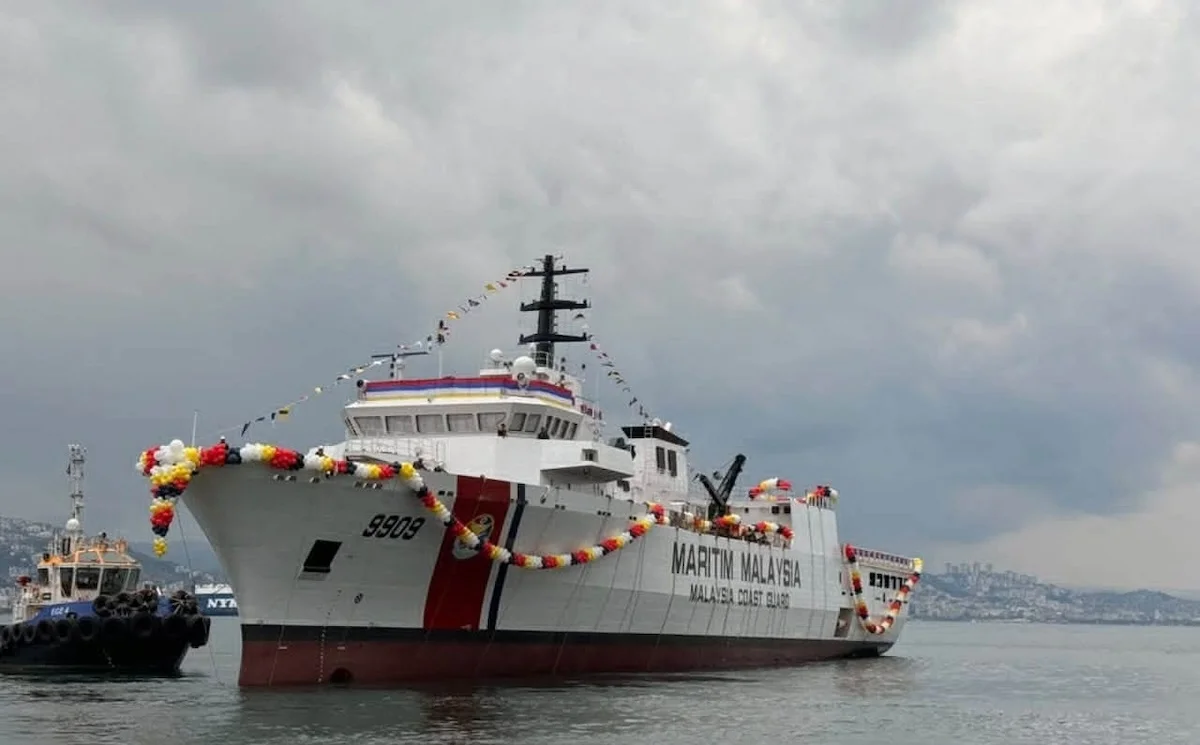
A Turkish-built coast guard vessel entered the water in Kocaeli on October 2, when DESAN Shipyard launched the first Multi-Purpose Mission Ship (MPMS-1) it is building for Malaysia’s Maritime Enforcement Agency (MMEA). The launch, held at the private yard’s facility on the Gulf of Izmit, was attended by Turkish Interior Minister Mustafa Çiftçi, Turkish Industry and Technology Minister Mehmet Fatih Kacır, and Malaysian Home Affairs Minister Datuk Seri Saifuddin Nasution bin Ismail, underlining the government-to-government weight both countries have put behind the programme.
MPMS-1 is not yet complete. DESAN says the hull is roughly 85 percent finished, ahead of the pace needed to meet its own internal target, and the vessel will now move into fitting-out and systems testing before delivery to Malaysia, currently planned for January 2027.
What MMEA Is Buying
The MPMS class is built as a 99-metre, 17-metre-beam “mother ship” rather than a conventional patrol boat. MMEA’s requirement called for a vessel able to stay at sea for up to 30 days, carry a crew of around 70 plus roughly 30 additional personnel, operate a helicopter from a flight deck, and launch fast interceptor craft and unmanned aerial vehicles for boarding and surveillance work. That combination is meant to let Malaysia keep a persistent presence over its maritime enforcement zones, including the South China Sea approaches, without having to return to port as often as its existing patrol vessels.
Malaysia has ordered two of the ships. The first was contracted to DESAN for roughly $68.8 million; a second, larger-scope contract covering MPMS-2 followed in 2026 at around $83.75 million, bringing the combined order to about $152.5 million. MPMS-2 had its keel laid in June 2026 and was reported in early October at roughly 34 percent structural completion, ahead of its own 32 percent target.
DESAN’s Export Footprint
DESAN is a privately owned yard, part of the Kaptanoğlu Group, which sets it apart from state-linked builders such as ASFAT that handle much of Türkiye’s corvette and frigate export business, including the MILGEM-based ships delivered to Pakistan. The MPMS contract gives DESAN a reference project in a different segment of the market: mid-size, multi-role coast guard and enforcement vessels rather than frontline combatants. That is a category where Turkish yards compete less against Western naval shipbuilders and more against South Korean, Chinese, and Gulf-based builders chasing the same coast guard modernisation budgets across Southeast Asia.
For Malaysia, the MPMS programme sits alongside a broader run of defence-industrial engagement with Türkiye. Malaysian and Turkish companies have also worked together on armoured vehicles — FNSS has long counted Malaysia among its export customers for tracked platforms built under license. The MPMS deal extends that relationship into shipbuilding, with MMEA officials signalling they expect the programme to include training and capacity-building elements beyond the vessels themselves, though neither government has published a formal technology-transfer schedule.
Why It Matters Beyond Two Ships
Two coast guard vessels worth a combined $152.5 million will not move the needle on Türkiye’s defence export statistics, which are increasingly dominated by billion-dollar armoured vehicle and air defence contracts. The significance here is narrower but real: it is a reference sale that a private Turkish yard can point to when bidding against established coast guard shipbuilders elsewhere in the region. MPMS-1 is scheduled to make its public debut at the Langkawi International Maritime and Aerospace Exhibition (LIMA) in 2027, which will put a finished Turkish-built hull in front of the exact regional buyers DESAN would want to reach next.
It also adds another data point to a pattern that has become familiar across Turkish shipbuilding over the past two years: exportable, mid-tier naval designs — coast guard cutters, offshore patrol vessels, light corvettes — moving out through multiple yards at once rather than concentrating in a single state champion. Türkiye’s naval export pipeline now spans several shipyards building to different customer requirements, from Pakistan’s MILGEM corvettes to Gulf fast-attack craft to, now, a Malaysian coast guard mother ship.
Neither DESAN nor the Malaysian government has disclosed terms for an option on further vessels. MMEA’s stated fleet-renewal plans suggest more enforcement tonnage will be needed in the coming years, but for now the programme stands at two ships, with the first due in Malaysian waters in just over three months.