ATAK-2 Takes Türkiye’s Attack Helicopter From Five Tonnes to Ten

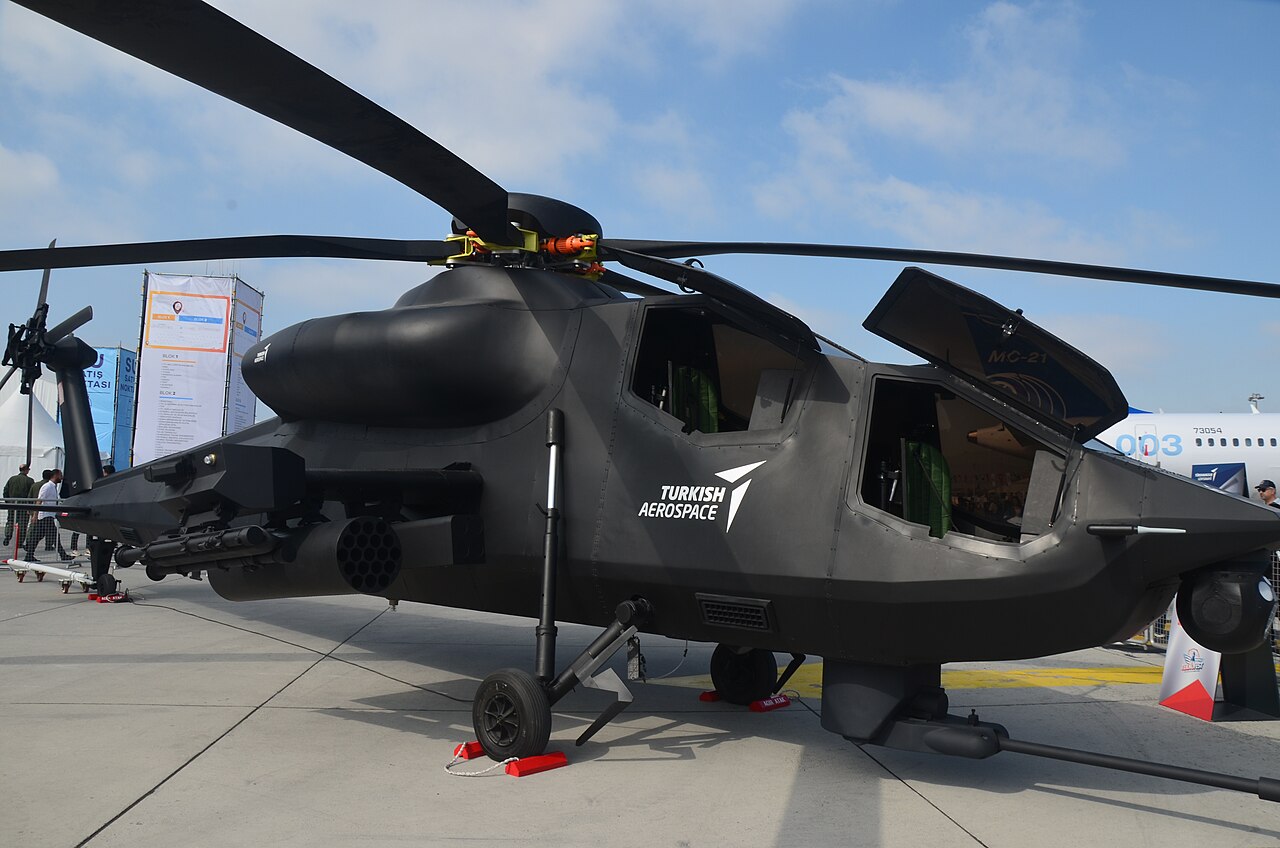
Turkish Aerospace has spent two decades learning how to build attack helicopters by adapting someone else’s design. The T929 ATAK-2 is the first time the company is drawing the airframe itself. It is a tandem-seat, twin-engine gunship in the ten-tonne class, roughly twice the weight of the T129 that now equips the Turkish Army, and it is meant to sit in the same bracket as the AH-64 Apache and the Russian Ka-52.
The aircraft is still a development programme. One prototype has flown, delivery dates have slipped, and the engine question is unresolved. What follows separates what is documented from what is still promised.
| Designation | T929 ATAK-2 (also written ATAK II) |
|---|---|
| Developer | Turkish Aerospace (TUSAŞ) |
| Intended users | Turkish Land Forces; naval use from TCG Anadolu also cited |
| Class | Heavy attack helicopter, about 10 tonnes maximum take-off weight (figures vary by source) |
| Crew | Two, tandem cockpit |
| Engines (prototype) | Two Motor Sich TV3-117VMA-SBM1V turboshafts, about 2,500 shp each |
| Development contract | Signed with the SSB in February 2020 |
| First flight | 28 April 2023, Ankara |
| Status | Prototype testing; series delivery not yet announced |
Why Build a Second ATAK When the First One Sells?
The T129 ATAK is an adaptation success. Turkish Aerospace took Italy’s A129 Mangusta, reworked it with Turkish avionics and weapons, and has delivered it to the Army, the Gendarmerie and export customers. But it is a light attack helicopter of about five tonnes, and its LHTEC CTS800 engines are Anglo-American, which gave Washington a say over exports. The long-stalled Pakistan deal is the usual example.
The ATAK-2 answers two problems at once. The Army wants a heavier, better-protected aircraft with more payload and endurance. And Turkish Aerospace wants a helicopter whose design authority sits in Ankara, not in Italy.
The SSB started the heavy-class effort in 2018 and signed the development contract with Turkish Aerospace in February 2020, according to public references. The company has described the work as fast: the first airframe’s body and final assembly were reported to take only three to four months.
What Did the First Flight Show?
The P0 prototype took off from Turkish Aerospace’s Ankara plant on 28 April 2023 and stayed airborne for about ten minutes, according to Turkish defence press. It was a basic handling check, not a weapons or systems demonstration.
Two things stand out. The aircraft flew on Ukrainian engines, and it flew early. Observers noted how quickly the programme went from contract to flight compared with the decades the Apache and Mi-28 took, although those programmes carried far more new technology.
A second prototype, P1, has been reported as slightly smaller in dimensions with a revised nose. That is a normal step between a proof-of-concept airframe and a production standard, and it means the design is not frozen.
How Does It Compare With the T129?
The gap is large. The T129 has a maximum take-off weight of about 5,000 kg; the ATAK-2 is described as a ten-tonne-class machine. Some sources give a maximum figure closer to 12 tonnes, which probably reflects different loading conditions, so treat the weight as approximate.
Reported performance includes a top speed near 318 km/h and a service ceiling of about 6,100 metres (20,000 ft). Those numbers come from reference compilations rather than a published data sheet, and they may change as testing proceeds.
The cockpit is tandem with a digital display architecture and a four-axis autopilot. The airframe is described as having ballistic protection and a low infrared signature.
What Will It Carry and See With?
Much of the mission equipment is domestic, which is the point of the exercise. According to The War Zone’s early reporting, the avionics are integrated by ASELSAN and include an ASELFLIR-300T targeting turret, a mast-mounted MilDaR fire-control radar, a helmet-mounted cueing system and a Turkish electronic warfare package. Open references also list an infrared and ultraviolet missile-warning system and a tail-mounted directed infrared countermeasure.
On the weapons side, the aircraft has six under-wing stations rated for about 1,500 kg in total, plus a 30 mm chin cannon. Reports differ on the gun: ASELSAN’s T-30H appears in some accounts and a 30×113 mm VENOM-type cannon in others. The missile options are Turkish, led by Roketsan’s UMTAS and L-UMTAS anti-tank missiles and the Cirit 70 mm laser-guided rocket, with air-to-air missiles and unguided 70 mm rockets also cited.
The Navy’s interest in operating the type from TCG Anadolu is mentioned in open sources as a secondary requirement. No naval variant has been shown.
Who Supplies the Engines?
This is the programme’s weak point. It is also where a common assumption needs correcting: the ATAK-2 does not fly on the TEI TS1400. That engine is a 1,400 shp turboshaft, rated up to about 1,500 shp, built for the T625 GÖKBEY, and it is too small for a ten-tonne twin. The prototype uses two Ukrainian TV3-117-series engines of roughly 2,500 shp each.
Turkish Aerospace ordered 14 of them from Motor Sich, enough for seven aircraft, according to Defence Turkey and other trade outlets. Deliveries were reported to have been delayed by the war in Ukraine. Motor Sich then told the Turkish side it could not supply more engines once the contract was filled, per the same reporting, so Ankara needs another powerplant.
The candidate is the larger TS3000 turboshaft. Janes and the Turkish press reported in August 2026 that the TS3000 and the TF35000 turbofan moved from TEI into TEI Teknoloji, the renamed TRMotor. The change is covered in our TEI company profile and in the wider look at who builds Türkiye’s aircraft engines. We found no public report of a TS3000 flying on a helicopter.
The practical effect is a ceiling on fleet size. Fourteen imported engines equal seven airframes. Anything beyond that depends on an engine that is not yet in service.
When Will the Army Get It?
Dates have been optimistic. Turkish Aerospace’s chief executive said in 2023 that the first three helicopters would reach Land Forces Command in 2025, as The War Zone reported. Reference sources now give 2026 as the planned introduction year, and no production delivery has been announced.
The Army will run a mixed fleet for years. More than 50 T129s are in service and further deliveries of that type continue, so the ATAK-2 complements it in the short term.
Export is where the ITAR argument bites. The ATAK-2 on Ukrainian engines avoids American export licensing, which could open customers the T129 could not reach. But an engine with an uncertain supply line is a poor basis for a sales pitch, and buyers will want to see the domestic powerplant fly first. The manufacturer is profiled in the Turkish Aerospace company profile.
What Would Settle the Programme’s Future?
Four events will decide whether the ATAK-2 becomes a fielded gunship or a long-running demonstrator:
- First weapons firings from a prototype carrying the full ASELSAN sensor fit.
- A flight with a Turkish-built engine in the 2,500 shp class.
- A confirmed Army delivery schedule and order quantity from the SSB.
- Confirmation of whether the P1 configuration becomes the production standard.
Until at least two of those happen, the headline figures above are design goals, not service capabilities.