How Turkish Guidance Kits Turn Ordinary Bombs Into Precision Weapons

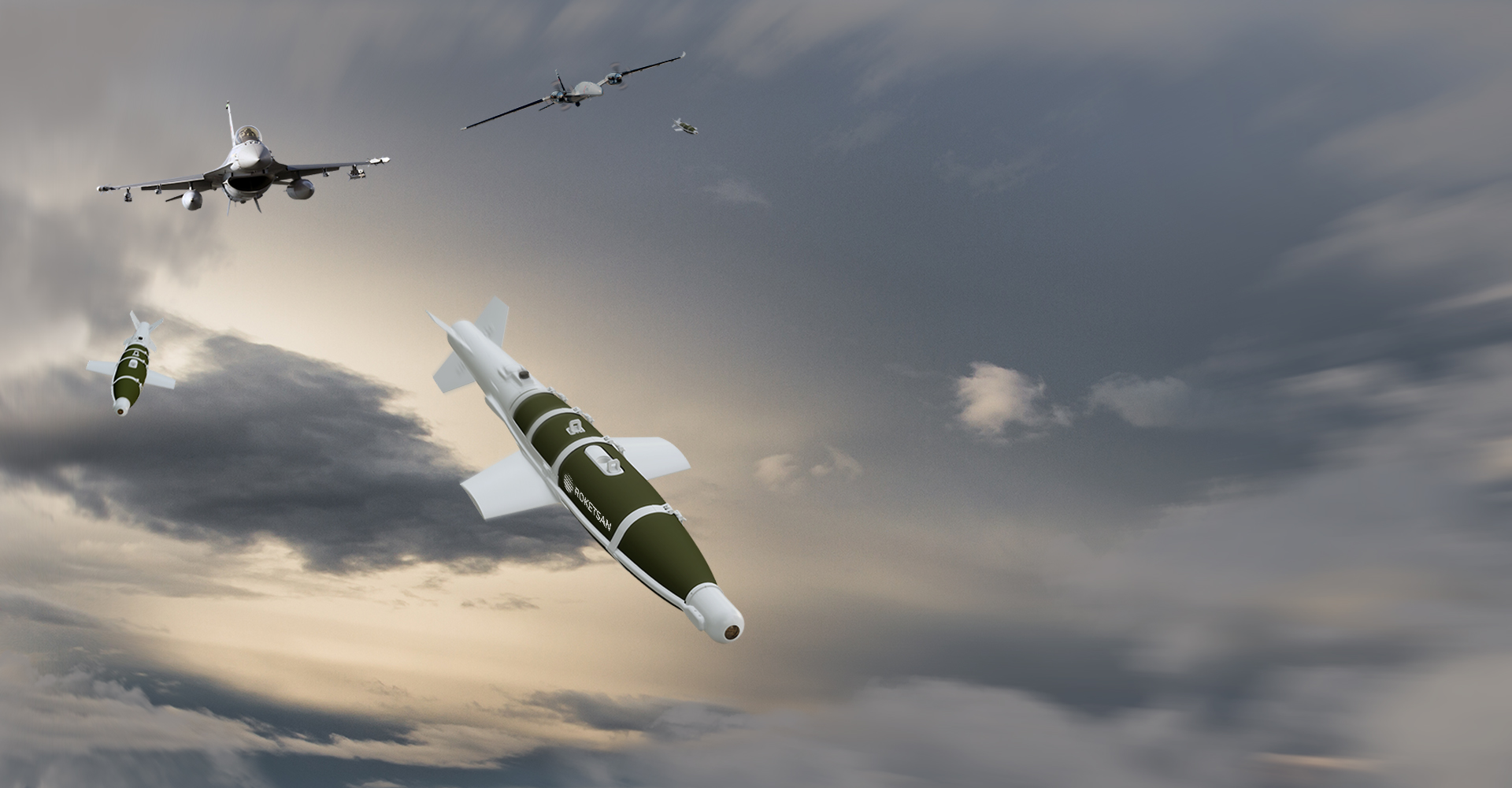
A Mk-82 bomb is a cheap, 500-pound slab of steel and explosive that has been around since the 1950s. Dropped the old way, it lands wherever physics and the pilot’s timing send it. Bolt a guidance kit to it and the same bomb becomes a weapon that can be aimed at a single building. Türkiye has built a small family of these kits, and they now sit behind much of the air-to-ground strike capability the country fields from F-16s and, increasingly, from armed drones.
Three names cover most of the ground: HGK and KGK from TÜBİTAK SAGE, and TEBER from Roketsan. A newer line, GÖZDE, adds a laser seeker and is slated for ASELSAN production.
What does a guidance kit actually do to a bomb?
A kit replaces the bomb’s nose and tail with a guidance section and control fins. Inside sit an inertial navigation system (INS) that tracks where the bomb is, a GPS receiver that corrects drift, and in some versions a laser seeker that homes on a spot painted by a designator. The warhead itself stays the standard general-purpose bomb, which is why the approach is so economical. Air forces keep their stock of unguided bombs and upgrade them as needed.
The trade-off is plain. A kit costs a fraction of a purpose-built guided missile, but it has no engine, so range comes from release altitude, speed and, for some designs, small wings.
How does the HGK family work?
HGK, short for Hassas Güdüm Kiti or Precision Guidance Kit, is the oldest of the line. According to TÜBİTAK SAGE, the family covers three bomb sizes: HGK-82 for 500 lb Mk-82 bombs, HGK-83 for 1,000 lb Mk-83 bombs, and HGK-84 for 2,000 lb Mk-84 bombs, including penetrator versions. Public references generally date the original kit’s service entry to around 2004, with the Turkish Air Force as the launch operator.
Guidance is INS with GPS, designed to resist jamming. SAGE lists a circular error probable (CEP) below 10 metres for the GPS-aided mode. A separate LHGK-84 variant adds a laser seeker for stationary and moving targets, and SAGE puts its accuracy below 3 metres when the seeker is used. The institute also says the kits are certified on the F-16 PO-III and the F-4E/2020 and comply with the MIL-STD-1760 weapons interface.
The HGK-82 and HGK-83 can be released from a BRU-57 ejector rack, which lets one aircraft carry and drop several kits in one pass and retarget them in flight. For the HGK-83, SAGE quotes a reach of 15 nautical miles from high altitude.
| Kit | Developer | Bomb body | Guidance | Stated accuracy | Stated reach |
|---|---|---|---|---|---|
| HGK-82 / 83 / 84 | TÜBİTAK SAGE | Mk-82 / Mk-83 / Mk-84 | INS/GPS | CEP below 10 m | HGK-83: 15 nm from high altitude |
| LHGK-84 | TÜBİTAK SAGE | Mk-84 | INS/GPS plus laser | Below 3 m with seeker | Not published |
| KGK | TÜBİTAK SAGE | Mk-82 / Mk-83 | INS/GPS, winged | CEP below 10 m | Up to 100 km |
| TEBER-81 / 82 | Roketsan | Mk-81 / Mk-82 | INS/GPS plus semi-active laser | CEP below 3 m | 2 to 28 km |
| GÖZDE | TÜBİTAK SAGE, production by ASELSAN | Mk-82 | INS/GPS and/or laser | Below 10 m (GPS), below 3 m (laser, stationary) | 15 nm from fighters, 8 nm from UCAVs |
Figures are the developers’ own and depend on release conditions.
Why does KGK reach 100 kilometres?
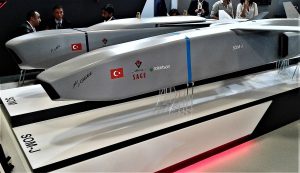
The KGK is the winged cousin. Fold-out wings turn a falling bomb into a glider, so it covers distance rather than dropping along a ballistic arc. SAGE says the kit takes Mk-82 and Mk-83 bombs out to roughly 100 km in the best case, about 60 nautical miles from high altitude and 20 nautical miles from low altitude. The point is standoff: the aircraft can release the weapon without flying into the engagement zone of enemy air defences.
Like the HGK, it uses INS and GPS with encrypted GPS support, can follow waypoints, accepts retargeting during captive flight and lists a CEP under 10 metres. SAGE says a single kit fits both Mk-82 and Mk-83 bodies. A KGK-82 version for UCAVs also appears on the institute’s product list.
What makes TEBER different?
TEBER comes from Roketsan rather than SAGE, and its distinguishing feature is the laser seeker. According to Roketsan, the kit combines an inertial measurement unit, GPS and a semi-active laser seeker, so the bomb can be steered to a target that a ground team or the aircraft’s own targeting pod is illuminating. That makes it usable against moving targets as well as fixed ones.
Roketsan’s specification sheet lists two sizes. TEBER-81 is about 2.1 metres long and roughly 155 kg for the Mk-81; TEBER-82 is about 2.6 metres and roughly 270 kg for the Mk-82. Range is given as 2 to 28 km, accuracy as CEP under 3 metres, and a proximity sensor can trigger detonation at 2 to 15 metres. Roketsan also markets related kits, including LAÇİN, described in trade coverage as a TEBER development with a man-in-the-loop option, and ELÇİN, a laser guidance kit.
Foreign interest has been reported, with Gulf states mentioned in trade coverage of the system, but no export contract for TEBER is confirmed in the sources reviewed for this article.
Where does ASELSAN fit?
SAGE designs GÖZDE; ASELSAN is named as its producer. The kit is a Mk-82 conversion that can run in laser/INS/GPS, laser/INS, INS/GPS or INS-only modes. SAGE lists sub-10 m accuracy with GPS and below 3 m on stationary laser-guided targets, a reach of up to 15 nautical miles from a fighter at altitude and 8 nautical miles from a UCAV, and the ability to engage targets moving at more than 50 km/h. It is certified on the AKINCI, the F-16 PO-III and the F-4E/2020.
ASELSAN has been building out its precision-weapons business more broadly. This site has covered its guided munitions demonstration and its guided-weapons production plant. Reports of an ASELSAN LGK-82 laser-guided kit appear in coverage of recent drone trials; check the company’s own product pages for the current designation.
Which aircraft drop them?
The F-16 is the workhorse; both HGK and KGK list F-16 certification. The more interesting trend is unmanned. According to The Aviationist, on 30 July 2026 the Bayraktar KIZILELMA dropped a TEBER-82 and a TOLUN-P glide bomb from its internal weapon bays at the Çorlu test centre. The TEBER-82 reportedly struck a marked target, while the TOLUN-P landed away from the bullseye in that trial. It was described as the first release of munitions from internal bays rather than underwing pylons.
Quwa reported an earlier test in late June 2026 in which the KIZILELMA, using ASELSAN’s TOYGUN electro-optical sensor to find and laser-designate the target, hit it with a TEBER-82 and an LGK-82 kit. The same report mentions earlier firings in March 2026 and late 2025. Both accounts are secondary reporting of company and official statements.
The AKINCI is also named on SAGE’s certification list for GÖZDE. For a drone, a guided bomb is a sensible partner: it is cheap enough to carry in numbers and does not need its own propulsion.
How do these kits compare with missiles and rockets?
A kitted bomb carries a much larger warhead than a laser-guided rocket such as CİRİT, and costs far less than a missile with its own seeker and motor. What it gives up is speed and stand-off. Without wings, the bomb must be released relatively close; with wings, as on the KGK, it flies slowly and can be easier to track. Planners tend to use the kits against fixed or semi-fixed targets and save missiles for fast or heavily defended ones.
Behind all of it sits the research base. SAGE, which designs HGK, KGK and GÖZDE, is profiled in our look at TÜBİTAK SAGE, and the split between a state institute designing and industry producing is how much of Türkiye’s munitions work now runs.