Türkiye Builds Its Own Jammers, and a NATO Army Is Buying

Ask which Turkish defence products have reached the front pages and the answer is drones, frigates and fighter jets. Ask which ones a NATO army has bought in open competition and the answer is less obvious. In December 2025 ASELSAN disclosed a US$410 million export contract for electronic warfare systems with an unnamed NATO-member customer, and Turkish defence media identified that customer as Poland. It is a large number for a field most people never see.
Turkish electronic warfare, or EW, is the quiet part of the industry. It has no airframe to photograph and no kill count to quote. It decides whether a radar sees the aircraft flying at it, whether a drone keeps its data link, and whether a missile finds its target. Over roughly fifteen years Türkiye has moved from importing these capabilities to fielding its own on land, at sea and in the air.
What Does Electronic Warfare Actually Cover?
The discipline has three parts. Electronic support listens: it detects, identifies and locates emitters such as radars and radios. Electronic attack acts on what it hears, through jamming or deception. Electronic protection is the defensive half, keeping your own sensors and links usable when someone does the same to you.
A jammer that does not know what it is jamming wastes power and gives away its own position. That is why Turkish programmes almost always pair a sensing half with an attacking half, and why the work rests on software as much as on transmitters.
Where Did the Turkish Programme Start?
The anchor is ASELSAN, founded in 1975 in Ankara. Its Radar and Electronic Warfare Systems business sector is one of the company’s main divisions, and in March 2015 it opened a dedicated Radar and Electronic Warfare Technology Center in the Gölbaşı district of Ankara, reported to have cost about US$157 million. A gallium nitride chip plant that began operating in 2017 supplies the power devices that modern radars and jammers depend on.
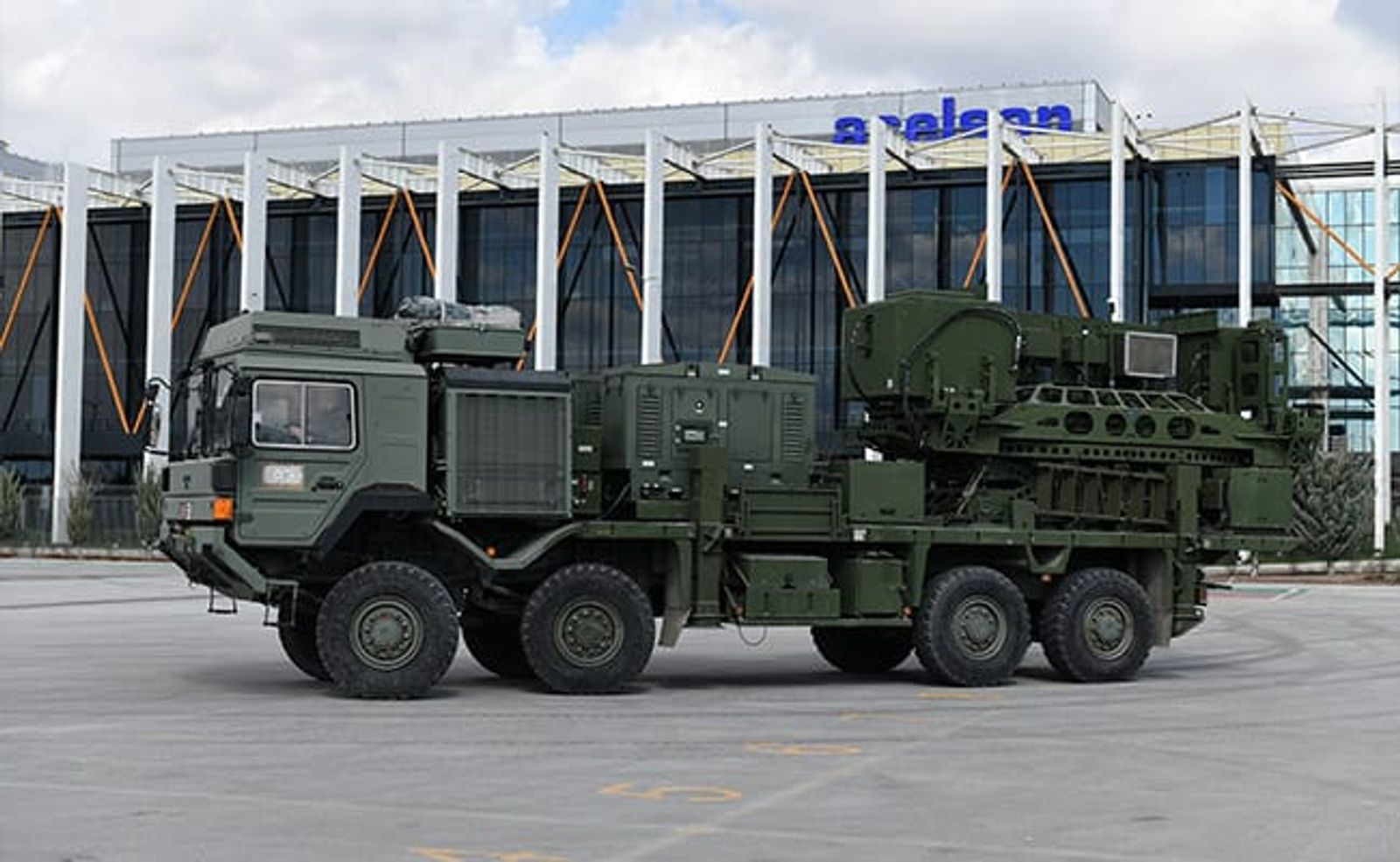
The first landmark product was KORAL, a land-based stand-off jammer. The Land-Based Stand-Off Jammer project began around 2009, testing ran from 2013, and ASELSAN handed the system to the Turkish Air Force at a ceremony on 23 February 2016, as reported by Defense News. Turkish trade press reports it was tested against S-300 radars at the Konya electronic warfare test range. That range matters: a jammer cannot be qualified without real threat emitters to practise against, and Konya provides them.
How Has KORAL Changed Since 2016?
ASELSAN has used several names for the family: KORAL, KORAL/NG, KORAL II and KORAL 200, plus KORAL 100 for the modernised original. Our detailed KORAL II profile sorts through the naming. The documents suggest the newer names describe one continuously developed product, although ASELSAN has not said so outright.
What is on the record is this. In October 2025 ASELSAN said it had finished a comprehensive modernisation of the original system, adding wider frequency coverage, higher output power, AESA beam steering and simultaneous jamming of several targets. In early 2026 the head of the Presidency of Defence Industries (SSB) said KORAL 200 would enter Turkish Armed Forces inventory during the year. KORAL also sits inside the Steel Dome layered air defence architecture, alongside the REDET, PUHU and VURAL electronic warfare systems, where its job is to blind enemy air defences so that strike aircraft and drones can get through.
What Protects a Turkish Fighter or Warship?
Ground jammers are the visible end. The platform-level systems do more daily work.
For the air force’s F-16 Block 50C fleet, ASELSAN led development of SPEWS-II, a self-protection suite based on the AN/ALQ-178(V)5+. According to DefenceTurk, it combines a radar warning receiver with an RF jammer and also controls the chaff and flare dispensers, with MİKES and BAE Systems IESI as partners. Flight tests at Konya in 2017 used five surface-to-air missile radars plus an F-4 and an F-16 as threats. Reported results were 22 sorties by three aircraft and more than 40 hours against live threats. The suite is also described as adaptable to other platforms through its modular design.
At sea, ASELSAN’s ARES-2N electronic support measures and ARES-2NC electronic countermeasures equip Turkish warships. Open sources list them on the Istanbul-class frigates of the MİLGEM programme, next to the HIZIR torpedo countermeasure and KARTACA-N decoy launcher.
| Domain | System (ASELSAN) | Role |
|---|---|---|
| Land | KORAL, KORAL 200 | Radar electronic support and attack, air-defence suppression |
| Land | VURAL, REDET | Electronic warfare systems named in the Steel Dome architecture |
| Air (crewed) | SPEWS-II | Radar warning and jamming for F-16 Block 50C |
| Air (uncrewed) | ANTIDOT pods | Electronic support and attack from drones such as the Bayraktar TB2 |
| Naval | ARES-2N, ARES-2NC | Radar ESM and ECM on warships |
| Anti-drone | KANGAL, GERGEDAN, ILGAR | RF and GNSS jamming against small UAVs (ranges not officially confirmed) |
Why Put an Electronic Warfare Pod on a Drone?
Because it is cheaper than buying a specialised aircraft. On 18 September ASELSAN flew two Bayraktar TB2 drones in Konya before delegations from 18 countries. One carried an ANTIDOT electronic support pod and an electronic attack pod, the other a FULMAR 200 radar pod. The support pod found and geolocated a threat radar, and the attack pod disrupted it using digital radio-frequency memory, which records a radar’s own pulse and sends it back altered. Our report on the Konya demonstration covers the sequence; the test stopped short of an actual strike.
The logic is the same one behind much of Turkish industry. An air force that already flies TB2s can add a mission without a new airframe. According to open sources, the ANTIDOT electronic support pod draws about 300 watts, a load small tactical aircraft can carry.
What Does the Anti-Drone Fight Add?
The same spectrum skills now point downward. KANGAL, GERGEDAN and ILGAR are the RF and GNSS jamming answers to small drones, and ASELSAN presents them inside a layered counter-UAV offer rather than as stand-alone boxes. Jamming a data link or a satellite navigation signal is often the cheapest way to stop a hostile drone, which is why these systems are multiplying even as the hard-kill options get more attention. Public range and band data for them is thin and not officially confirmed, so treat figures circulating online with caution.
Who Buys Turkish Electronic Warfare?
An earlier export customer was Morocco, reported in 2021 to have signed a US$50.7 million deal for KORAL. The Polish contract of December 2025 is eight times larger. ASELSAN’s disclosure named only a NATO-member customer and the direct sale of electronic warfare systems, and Turkish outlets attributed it to Poland. The contents have not been detailed publicly; Turkish media reports suggest electronic warfare and counter-UAS equipment.
If accurate, it is unusual for a NATO army to pick a Turkish supplier for a capability this sensitive. ASELSAN used the September 2026 MSPO show in Kielce to display its counter-drone and EW line-up and to sign a separate ARSUS reconnaissance mast agreement with AMZ Kutno.
Why Has Türkiye Stuck With Domestic Systems?
The clearest reason is the threat library. An electronic warfare system is only as good as its database of emitter signatures, and keeping that database current depends on national intelligence and field data. A foreign-built system can mean asking the producing country for permission, or for help, each time a new radar appears. Writing the software at home removes that dependency.
There is a speed argument too. Electronic warfare is iterative, and a domestic team that owns the source code and the test range can update a threat library far faster than an export customer can. Türkiye’s own AESA radar work feeds the same pipeline, because the antenna technology in a modern radar is also the core of a modern jammer.
What Is Still Unproven?
Quite a lot. Performance figures for EW systems are rarely published, and most Turkish claims about jamming range or multi-target capacity come from the manufacturer or from trade press repeating it. KORAL 200’s entry into inventory is a stated 2026 target, not a confirmed delivery. The ANTIDOT demonstration used a pod on a drone and did not complete a strike chain. And a jammer that radiates becomes a target itself, so doctrine about when to transmit counts for as much as the hardware.
What can be said with confidence is narrower. Türkiye has a domestic EW industry that covers ground, air and naval platforms, it has a dedicated test range, and a NATO customer has reportedly put US$410 million behind it. A decade ago that sentence could not have been written.