Türkiye–Poland Defence Cooperation: What Warsaw Actually Buys

Poland is Türkiye’s largest defence customer inside the European Union, and the relationship now runs well past the 24 Bayraktar TB2 drones that started it. Since 2021 Warsaw has bought a Turkish combat drone fleet, signed an electronic warfare contract with ASELSAN through its state Armament Agency, and fitted Turkish sensors to Polish-built reconnaissance vehicles. But Türkiye–Poland defence cooperation has a ceiling that is easy to miss. Poland’s flagship programmes keep going to American, South Korean and now Norwegian suppliers. The growth area for Turkish industry is subsystems inside Polish platforms, not Turkish platforms in Polish service.
That distinction matters far beyond Warsaw. Poland is the test case for whether Turkish defence firms can sell into a wealthy NATO and EU market that is simultaneously spending record sums and trying to spend them at home. The answer so far is a qualified yes, with a clear shape to it.
DEFENCETÜRKIYE DATA BOX
Relationship: Türkiye–Poland defence industrial cooperation
Main Turkish suppliers: Baykar, ASELSAN, MKE
Main Polish counterparties: Ministry of National Defence / Armament Agency (Agencja Uzbrojenia), AMZ Kutno, PGZ
First contract: May 2021, four Bayraktar TB2 systems
Platforms in Polish service: 24 Bayraktar TB2 aircraft, final delivery 16 May 2024
Largest single Turkish contract: ASELSAN automated reconnaissance and jamming system, signed with the Armament Agency on 19 December 2025. Value not disclosed officially; reported at roughly PLN 2 billion gross, with ASELSAN quoted at USD 410 million
Longest-running agreement: ASELSAN–AMZ Kutno framework, cooperation planned through 2035
Status of Turkish bids for Poland’s flagship programmes: none won to date
What Poland has actually bought from Türkiye
Published Polish and Turkish contract records produce a short, specific list. It is worth setting out before any argument about significance, because the English-language debate about Türkiye in Europe tends to run on announcements rather than signatures.
| When | Turkish supplier | What | Polish counterparty | Status | Reported value |
|---|---|---|---|---|---|
| May 2021 | Baykar | Four TB2 systems — 24 aircraft, ground control stations, MAM-L and MAM-C munitions, two simulators, training for 192 personnel | Ministry of National Defence, no tender, urgent operational need | Delivered; final batch 16 May 2024 | About USD 270 million |
| 2024 | ASELSAN | ARSUS 100 mast — ground surveillance radar, electro-optics and inertial navigation in one unit | AMZ Kutno (private vehicle builder) | First vehicles fitted November 2025 | About EUR 16.6 million |
| October 2024 | Baykar, contracted through NSPA | Three-year TB2 fleet support and availability, extendable by two years | NATO Support and Procurement Agency, on Poland’s behalf | Running | Not disclosed |
| 19 December 2025 | ASELSAN | Automated reconnaissance and jamming system, including radio-frequency jamming to bring down drones | Armament Agency (Agencja Uzbrojenia) | Contracted | Not disclosed officially; reported about PLN 2 billion gross, ASELSAN quoted at USD 410 million |
| 8 September 2026 | ASELSAN | 24 further ARSUS reconnaissance and surveillance sets | AMZ Kutno | Signed; deliveries 2028–2029 | Not disclosed |
| 10 September 2026 | MKE | TOLGA short-range air defence system — memorandum of understanding only | PGZ (state defence group) | No contract, no quantity, no timeline | Not applicable |
Two things stand out. The best-known item on the list, the drone fleet, is also the oldest and the smallest of the three money contracts. And three of the six entries involve ASELSAN against two for Baykar, which is the opposite of how the relationship is usually described.
Why the TB2 came first, and why it was bought without a tender
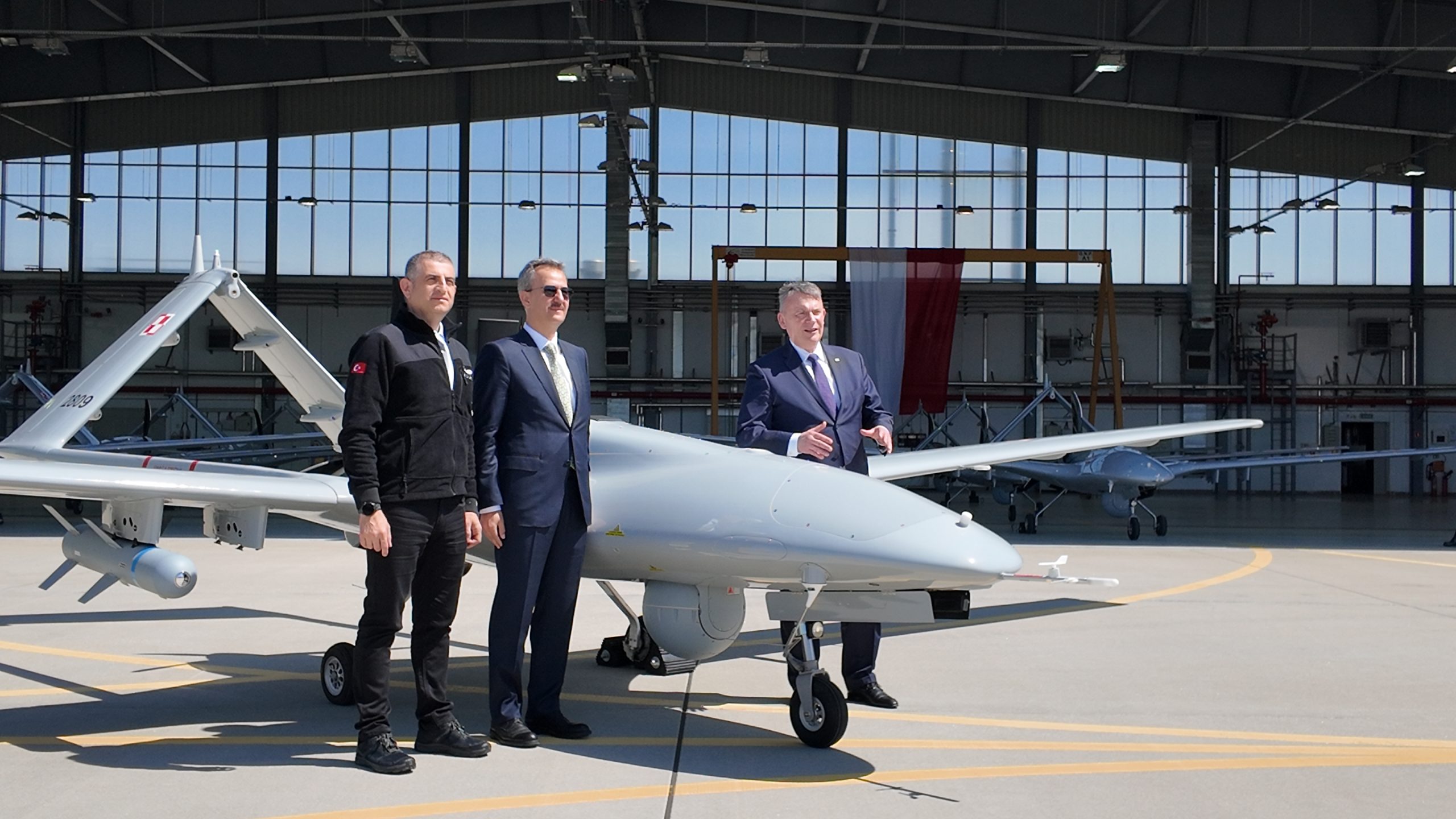
Poland signed for four Bayraktar TB2 systems in May 2021 for about USD 270 million. Each system comprised six aircraft and three ground control stations, giving 24 airframes in total, along with Roketsan MAM-L and MAM-C guided munitions, two simulators, spare parts and training for 192 Polish personnel. The Polish Ministry of National Defence concluded the contract without a competitive tender, under an urgent operational need procedure.
That procedural detail explains the purchase better than any argument about Turkish technical superiority. In 2021 Poland had no armed medium-altitude long-endurance drone and no near-term route to one. The MQ-9A was available to Poland only on lease, and that lease did not begin until 2023. The TB2 could be contracted, delivered and flown inside the same parliamentary cycle, with its weapons included in the same signature. Availability and a single integrated package, not price alone, were the deciding factors — the same pattern visible in why countries buy Turkish drones more generally.
Deliveries ran from October 2022 to a final handover on 16 May 2024. The aircraft serve with Poland’s unmanned aviation base at Mirosławiec. In October 2024 the NATO Support and Procurement Agency contracted three years of fleet support, extendable by two more — a detail that matters to any buyer weighing Turkish after-sales support, because it routes sustainment of a Turkish platform through a NATO common agency rather than a bilateral arrangement.
Poland has also done something no other TB2 operator has done publicly. Warsaw announced in late 2021 that it intended to trial-fit Leonardo Osprey 30 AESA radars to part of the fleet, and from 2025 Polish TB2s were photographed carrying a cylindrical radome in place of the usual electro-optical turret. Neither Baykar nor the Polish Ministry of National Defence has confirmed the configuration or declared the integration complete, so it should be read as reported rather than established. If it is the Osprey 30, Poland is modifying a Turkish airframe with a British sensor on its own initiative — a level of customer autonomy that export buyers rarely get and that says something useful about how open the TB2 programme is to third-party integration.
The contract that matters more than the drones
On 19 December 2025 Poland’s Armament Agency signed a contract with ASELSAN Elektronik Sanayi ve Ticaret A.Ş. for an automated reconnaissance and jamming system. The Polish Ministry of National Defence described the subject as anti-drone systems — radio-wave jamming equipment that enables drones to be brought down — and placed the deal in a wider frame: it called the contract a prelude to a major anti-drone defence contract under the SAN programme, then still in negotiation.
The ministry did not publish a value. Polish reporting put the contract at roughly PLN 2 billion gross with deliveries running to 2035, and quoted ASELSAN giving a figure of USD 410 million. Those numbers are not official and should be treated as reported.
Even without a confirmed figure, this is the most consequential item in the relationship, for three reasons. It is a direct state-to-company purchase by Poland’s central procurement body rather than a deal with a private integrator. It is in electronic warfare, which is the hardest category for a non-traditional supplier to break into because it touches national signals intelligence. And it is a counter-drone capability bought by the EU state with the most immediate airspace problem, after repeated incursions by Russian drones and debris. A customer buying jammers for live defence of its own airspace is making a technical judgement, not a diplomatic gesture.
The ARSUS model: Turkish sensors inside a Polish vehicle

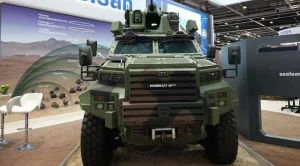
The ARSUS line is the part of the relationship that Turkish industry is most likely to replicate elsewhere in Europe. ARSUS 100 is a single stabilised mast combining a ground surveillance radar, an electro-optical and infrared head and an inertial navigation unit. It detects, recognises and tracks targets automatically, levels itself on sloping ground and passes target coordinates straight into a digital command network. ASELSAN sells it as platform-agnostic; Envanter Medya has a Turkish-language technical breakdown of the ARSUS system and its Polish export for readers who want the sensor detail rather than the market argument.
The mast rides on the LOTR Kleszcz, an amphibious armoured reconnaissance vehicle built by AMZ Kutno on its Bóbr-3 4×4 chassis to replace Poland’s Soviet-era BRDM-2 fleet. Poland agreed a framework for 286 of these vehicles on 28 February 2024, with deliveries scheduled from 2026 to 2035, and ordered the first 28 in August 2024 for a reported PLN 800 million.
ASELSAN’s framework agreement with AMZ Kutno, signed in 2024, is scaled to that programme and runs on the same horizon to 2035. The first vehicles were fitted in November 2025. At MSPO 2026 in Kielce on 8 September, the two companies signed for 24 further ARSUS sets with deliveries in 2028 and 2029. ASELSAN chief executive Ahmet Akyol framed it as expanding an existing electronic warfare relationship into reconnaissance and surveillance.
Underneath the contracts sits the detail that should interest any procurement analyst: ASELSAN has built a network of more than 20 Polish suppliers and keeps a permanent office in Poland. That is not an export arrangement. It is the beginning of a local industrial position, and it is what makes the Polish case different from Türkiye’s larger but shallower sales elsewhere in Europe.
WHY IT MATTERS
Poland is the only EU member state operating a Turkish armed drone, and the only one whose central procurement agency has bought a Turkish electronic warfare system. For foreign buyers watching whether Turkish equipment can clear Western integration and certification hurdles, Poland is the live proof case, inside NATO’s most exposed air defence problem.
It is also a warning against extrapolation. Four years of growing cooperation have produced niche sensor and jamming business, not a platform breakthrough. Any country modelling Turkish industry’s European prospects should model the Polish shape — components and partnerships — rather than the Polish headline.
What Poland did not buy
The honest measure of a supplier relationship is the competition it loses, and the Polish ministry itself set up the test. Having called the ASELSAN jamming contract a prelude to the SAN programme, Warsaw then awarded SAN elsewhere.
On 30 January 2026 the Armament Agency signed the SAN counter-drone contract with a consortium of PGZ, the Polish firm Advanced Protection Systems and Norway’s Kongsberg Defence & Aerospace. The package covers 18 anti-drone modules, with the defence ministry describing 18 batteries, 52 fire teams, 18 command teams and more than 700 vehicles. Kongsberg’s share alone has been reported at around NOK 16 billion; estimates of the total programme run far higher and are not officially confirmed. Kongsberg has since announced a counter-drone production plant in Pomerania, with serial production targeted for the first half of 2028.
No Turkish company is in the SAN consortium. Türkiye supplied the interim jamming capability and a Norwegian–Polish grouping took the programme of record. That is not a failure of Turkish equipment; it is a statement about how Poland allocates its largest contracts, and it is the single most useful data point in this entire file for a buyer trying to judge Turkish industry’s European ceiling.
The same pattern holds across Poland’s other large programmes. Armour, artillery, air defence and combat aircraft have gone to the United States and South Korea. Polish analysis of the Turkish relationship is explicit that Warsaw treats Türkiye as a diversification supplier in specific niches — electronic warfare, reconnaissance sensors, counter-drone, unmanned maritime systems — rather than a competitor to its main partners, and notes that Türkiye does not bid in heavy armour or frontline combat aircraft at all.
The 89 per cent problem
Poland’s spending power is the reason every exporter wants in. Its 2026 defence budget runs to roughly PLN 200 billion, about 4.8 per cent of GDP, the highest ratio in NATO. On top of that, Poland secured the largest national allocation under the European Union’s SAFE instrument: EUR 43.7 billion of a EUR 150 billion loan facility, with Warsaw signing its loan agreement on 8 May 2026 and becoming the first member state to draw on the scheme.
That money comes with a shape. The Polish government has said it intends up to 89 per cent of the SAFE funding to go to Polish defence companies. SAFE’s own rules push the same way, setting a floor on how much of a funded product’s component cost must originate in the European Union, the EEA-EFTA states or Ukraine. Türkiye is not a SAFE participant; Ankara’s application has not been taken forward, and Greek and Cypriot objections are generally cited as the obstacle.
Put those three facts together and the strategy writes itself. A Turkish company cannot sell Poland a finished platform with EU loan money at scale. It can sell a radar, a jammer, a sensor mast or an electro-optical head that a Polish company integrates into a Polish-built vehicle delivered to the Polish Army — which is precisely what ASELSAN is doing with AMZ Kutno, and precisely what MKE is attempting with PGZ on TOLGA. The commercial logic is not diplomatic goodwill. It is content rules.
BUYER VIEW
Delivery: Baykar delivered 24 aircraft in under three years from signature, with weapons and training in the same package. ASELSAN’s ARSUS deliveries are scheduled four to five years out, which is normal for a sensor tied to a vehicle production line.
Cost visibility: poor and getting poorer. The 2021 drone contract value is public. Nothing since has an official figure. Buyers should expect to negotiate without a public benchmark.
Industrial participation: the strongest argument in Türkiye’s favour here. ASELSAN’s Polish supplier network and local office show it will work as a subsystem vendor inside someone else’s platform, which many primes will not do.
Support: the TB2 fleet is sustained under a NATO Support and Procurement Agency contract, which de-risks sustainment for other NATO buyers considering the same route.
Political restrictions: none has bitten in Poland. The binding constraint is EU funding content rules, not export licensing.
What Warsaw was looking at in October 2026
General Wiesław Kukuła, Chief of the General Staff of the Polish Armed Forces, made an official visit to Türkiye from 13 to 15 October 2026, meeting his counterpart General Selçuk Bayraktaroğlu and the Turkish defence minister. The industrial leg of the trip is a fair guide to what Poland is examining next.
At ROKETSAN the delegation was briefed on long-range precision strike, air defence and counter-drone systems, including the TAYFUN long-range missile, TRG and TRLG guided artillery rockets, the ALKA laser and electronic warfare system, the PUSU counter-drone solution and the SUNGUR short-range air defence missile. At ASELSAN the briefings covered the HAKİM command and control system, the İHTAR, ŞAHİN and KORKUT counter-drone systems, the GÖKBERK laser weapon and EJDERHA/AD 200 directed-energy technology — several of which appear in our survey of who builds Türkiye’s laser weapons. At Turkish Aerospace the visit took in HÜRKUŞ, HÜRJET, ANKA, AKSUNGUR and ANKA-3 production.
Kukuła said Poland and Türkiye are linked by a high level of mutual trust and a shared understanding of threats, which he called a foundation for moving from a trusted partnership to strategic cooperation. Polish reporting on the visit noted that prospects for industrial cooperation were discussed with the SAFE instrument in mind.
The item worth flagging is the TAYFUN ballistic missile. Poland has been building a deep-strike capability around American and South Korean systems, and a Polish chief of the general staff inspecting a Turkish long-range missile is a signal rather than a transaction. No Polish purchase decision, procurement commitment or statement of interest in any specific Turkish system was reported, and nothing should be read into the visit beyond assessment.
Political cover for all of this is in place. President Karol Nawrocki made an official visit to Ankara on 23–24 June 2026, toured ASELSAN’s Gölbaşı facilities and, according to Anadolu Agency, described defence industry cooperation with Türkiye as indispensable. In September 2026 he visited the Turkish stands at MSPO in Kielce alongside SSB President Haluk Görgün — the kind of head-of-state attention that Turkish exporters rarely get in Western Europe.
Where the relationship is limited
Four constraints are visible in the public record, and buyers elsewhere should weigh all of them.
- No platform repeat. Poland has not announced a follow-on drone order in five years. Commentary about a possible TB3 buy is speculation with no procurement document behind it.
- Funding rules cut against Turkish content. With up to 89 per cent of Poland’s SAFE money earmarked for Polish firms and Türkiye outside the scheme, the realistic Turkish share is the component tier.
- One MoU is still just an MoU. The MKE–PGZ agreement on the TOLGA air defence system carries no contract value, quantity or timeline, and neither side has named a PGZ subsidiary to lead the work. It is Türkiye’s second European TOLGA partnership attempt after Hungary.
- Brand concentration. Polish analysis notes that Baykar still dominates Polish perceptions of Turkish defence industry, which works against ASELSAN, ROKETSAN and the rest of the Turkish portfolio.
What comes next
Three things are worth watching, in order of how much they would change the picture.
First, whether the ASELSAN reconnaissance and jamming contract delivers on time. Running to 2035 against a live airspace threat, it is the reference that every future Turkish bid in Europe will be measured against. A delay there would cost Turkish industry more than any single lost competition.
Second, whether the ARSUS line scales with the Kleszcz programme. The vehicle framework runs to 286 units through 2035 and the ASELSAN framework is written to the same horizon; 24 sets ordered in 2026 is a start, not a conclusion.
Third, whether any Turkish system reaches a Polish programme of record rather than a gap-filler. TOLGA converting from memorandum to contract would be the clearest sign. A Polish move on TAYFUN would be a larger one, and remains entirely hypothetical.
For the wider market, the Polish case supports a narrower claim than the one usually made about Türkiye in Europe. Turkish industry has not broken into a large Western procurement system as a platform supplier. It has broken in as a supplier of sensors, jammers and effectors to a market that wants to build its own vehicles. Readers who want the Turkish-language view of the bilateral relationship will find Envanter Medya’s survey of Poland–Türkiye defence industry ties inside NATO a useful companion; the European picture beyond Poland is in our review of Turkish defence exports to Europe.
FAQ
How many Bayraktar TB2 drones does Poland have?
Twenty-four. Poland contracted four systems in May 2021, each with six aircraft and three ground control stations. Deliveries ran from October 2022 to a final handover on 16 May 2024. No follow-on order has been announced.
Is Poland the only EU country that operates Turkish armed drones?
Yes. Poland was the first EU and NATO member state to buy the Bayraktar TB2 and remains the only EU operator of the type. Other European operators, such as Ukraine, are not EU members.
What is the largest Turkish defence contract in Poland?
The ASELSAN automated reconnaissance and jamming system signed with Poland’s Armament Agency on 19 December 2025. The Polish Ministry of National Defence has not published a value. Polish reporting put it at about PLN 2 billion gross, and ASELSAN was quoted giving a figure of USD 410 million. Neither figure is official.
Did Türkiye win Poland’s SAN counter-drone programme?
No. SAN was awarded on 30 January 2026 to a consortium of PGZ, Advanced Protection Systems and Norway’s Kongsberg. The earlier ASELSAN jamming contract was described by the Polish defence ministry as a prelude to SAN, but the programme itself went elsewhere.
Can Turkish companies be paid with EU SAFE money in Poland?
Only to a limited extent. Türkiye is not a SAFE participant, and SAFE sets a floor on how much of a funded product’s component cost must come from the EU, EEA-EFTA states or Ukraine. The Polish government has also said it wants up to 89 per cent of its EUR 43.7 billion allocation spent with Polish companies. Turkish content realistically enters as subsystems within a Polish-built product.
Is Poland buying Turkish missiles?
Not at present. Poland’s chief of the general staff inspected the TAYFUN long-range missile and other ROKETSAN systems during a visit to Türkiye from 13 to 15 October 2026, but no purchase decision, negotiation or letter of request has been reported.
Who integrates ASELSAN’s sensors in Poland?
AMZ Kutno, a private Polish vehicle manufacturer, integrates the ARSUS 100 mast onto the LOTR Kleszcz reconnaissance vehicle it builds on its Bóbr-3 chassis. ASELSAN also works with more than 20 Polish suppliers and keeps a local office.
Sources
- Ministry of National Defence of Poland — contract package of 19 December 2025, including the ASELSAN automated reconnaissance and jamming system
- Defense News — Poland to buy Turkish Bayraktar TB2 drones (May 2021)
- Defense News — Poland receives final TB2 delivery from Baykar (May 2024)
- Shephard Media — NSPA three-year TB2 support contract
- Defence24 — ASELSAN and AMZ Kutno, and the Polish view of cooperation with Türkiye
- MILMAG — MSPO 2026: AMZ Kutno expands ARSUS cooperation with ASELSAN
- Army Recognition — ARSUS 100 mast on the LOTR Kleszcz, and the 286-vehicle framework
- MILMAG — General Kukuła’s visit to Türkiye, 13–15 October 2026
- Militarnyi — Polish chief of general staff inspects the TAYFUN system
- Notes from Poland — SAN counter-drone contract with PGZ, APS and Kongsberg
- Notes from Poland — Poland’s EUR 43.7 billion SAFE allocation
- Anadolu Agency — President Nawrocki at ASELSAN, June 2026
- Defence Industry Europe — 24 ARSUS sets and the reported USD 410 million electronic warfare agreement