Can Türkiye’s Gökdoğan Missile Take AMRAAM’s Place on Its Fighters

For more than three decades, the medium-range air-to-air missile on a Turkish F-16 has been an American one. The AIM-120 AMRAAM, built by Raytheon, is the weapon that defines what a “beyond-visual-range” shot means for most NATO air forces. Gökdoğan, developed by TÜBİTAK SAGE, is the first Turkish missile that plausibly competes for that slot. Whether it can take it is a different question from whether it works.
This comparison sticks to what has been published. Where numbers come from press reports rather than official documents, they are labelled that way.
What Is Gökdoğan, and Where Did It Come From?
Gökdoğan is the beyond-visual-range half of the GÖKTUĞ air-to-air missile project, which TÜBİTAK SAGE started around 2013 under the Presidency of Defence Industries (SSB). Its short-range sibling is Bozdoğan. Both are covered in more detail in our earlier report on Türkiye’s two air-to-air missiles, and the institute behind them has its own profile at TÜBİTAK SAGE.
The public record has a few fixed points. A first flight test took place in 2018. In February 2025, Industry and Technology Minister Mehmet Fatih Kaçır reported a test in which Gökdoğan hit a target aircraft. On 19 October 2025, a Turkish F-16 fired Gökdoğan and Bozdoğan in the same sortie, and both reportedly struck pilotless target drones, according to The Aviationist.
How Does Gökdoğan Compare With AMRAAM on Paper?
| Feature | Gökdoğan | AIM-120 AMRAAM |
|---|---|---|
| Developer | TÜBİTAK SAGE (Türkiye) | Raytheon (United States) |
| Role | Beyond-visual-range, air-to-air | Beyond-visual-range, air-to-air |
| Seeker | Solid-state active RF seeker (ASELSAN-developed, reported as Ku-band) | Active radar seeker |
| Reported range | Over 65 km (published figure) | Varies by variant; open sources put the AIM-120D at roughly 160 to 180 km (reported, not an official figure) |
| Guidance features | Lock-on-after-launch, data-link compatible | Inertial guidance with datalink updates, GPS-aided on later variants |
| Fire-and-forget | Yes | Yes |
| Interfaces | MIL-STD-1553 and MIL-STD-1760 compatible | Standard on NATO-type fighters |
| Combat record | Test firings only | Used operationally by multiple air forces |
The range gap is the number people notice first. Gökdoğan’s published figure is a little over 65 km; AMRAAM’s newest variants are credited with far more. Some sources mention extended Gökdoğan versions beyond 100 km, but no official specification confirming that has been published, so treat those as aspirations rather than capability.
Range is not the whole contest. A missile’s real worth lies in its seeker’s resistance to jamming, its motor’s energy at the end of flight, and how reliably it hits when a target manoeuvres. None of that can be read off a brochure, and no public data allows a fair comparison between a missile with test firings and one with decades of use.
Who Supplies the Seeker, and Why Does That Matter?
The seeker is where much of the sovereignty argument sits. Reporting on Gökdoğan identifies a solid-state active RF seeker from ASELSAN, with a mechanical gimbal. An imported missile comes with an export licence, a spares pipeline and a software baseline controlled elsewhere. A domestic seeker puts those decisions in Ankara.
That is the practical value of the programme. The U.S. approval process shows the other side. In May 2025 the State Department cleared a possible sale to Türkiye of 53 AIM-120C-8 missiles and six guidance sections, with an estimated value of $225 million, according to the notification reported by European Security and Defence. It was a sale of the older C-8 variant, not the AIM-120D, and it came after a long wait. Anyone planning an air force around imported missiles has to plan around that kind of timeline.
Which Aircraft Can Carry It?
The first integration target is the F-16. SSB’s initial low-rate production project, signed with TÜBİTAK SAGE in July 2023, covers 25 Gökdoğan, 25 Bozdoğan and 14 launchers, with first deliveries planned for 2025, according to Defence Turkey. The work targets a newer F-16 configuration (PO-III), building on earlier integration work, and sits alongside the fleet’s local modernisation effort.
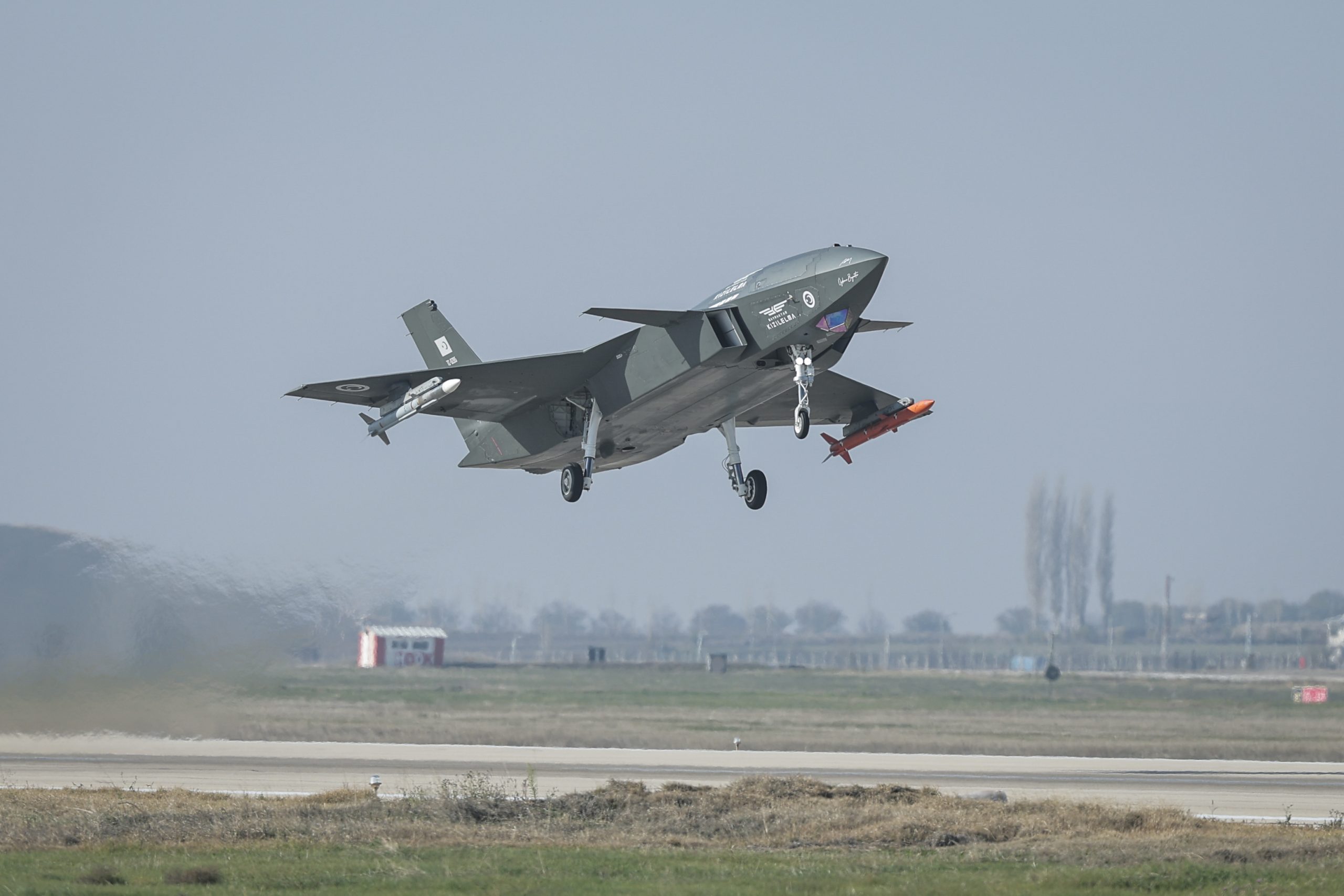
The more interesting carriage story is unmanned. On 29 November 2025, Baykar said its Bayraktar Kızılelma fired Gökdoğan off the Black Sea coast near Sinop and destroyed an aerial target, which Baykar and press coverage described as the first beyond-visual-range engagement by an unmanned fighter. Reports say the shot used ASELSAN sensors and a TÜBİTAK SAGE missile, with F-16s flying alongside as part of a manned-unmanned concept.
The weapon is also expected on the KAAN. Reporting on the programme names Kızılelma, KAAN and F-16 as target platforms, with JF-17 Block 3 aircraft, including those ordered by Azerbaijan, also mentioned in published coverage.
Does Bozdoğan Change the Comparison?
It does, because the Turkish pitch is a pair rather than a single missile. Bozdoğan is the short-range partner: an imaging infrared seeker, thrust-vector control, all-aspect engagement and a published range above 25 km. It first destroyed a Şimşek target drone in a live F-16 firing on 14 April 2021, and was said by officials at the time to carry a weight of around 140 kg and a speed near Mach 4.
Fitting both missiles on one rail system, using the same U.S.-standard interfaces, is what lets an air force treat them as a family. The AMRAAM story in Türkiye has never been paired that way: the short-range slot has long been filled by a separate American product line. A single national supplier for both slots simplifies support, even if neither missile yet matches the best imported option on range.
Will Gökdoğan Actually Replace AMRAAM?
Not soon, and probably not completely. Three things stand in the way.
- Numbers. The first contract covers 25 missiles. An air force’s working stockpile is many times larger, and the AMRAAM inventory exists today.
- Proof. Test hits against drones show that guidance, seeker and motor function together. They do not show how the weapon performs against jamming, small or fast targets, or long shots.
- Parallel purchases. Türkiye is buying Western missiles alongside its own. Alongside the AIM-120C-8 case, Meteor missiles were reported as part of the Eurofighter Typhoon deal with the United Kingdom, a purchase described in the press but not detailed in the sources reviewed for this article.
The likelier outcome is a mixed inventory. Imported missiles cover the high-end, long-range shots while domestic ones fill the stockpile, serve export customers and arm platforms such as Kızılelma, where Turkish control of the weapons integration is an advantage.
A longer-range ramjet sibling, Gökhan, was announced in 2021 as the answer to the range question. It is reported to be in development, but no delivery date was found and its quoted ranges are unverified.
What Should Readers Watch Next?
Three milestones will say more than any spec sheet. First, confirmation of delivered quantities and Air Force acceptance after the 2025 delivery window. Second, firing trials against manoeuvring or jamming-equipped targets at longer range. Third, an export customer announcing Gökdoğan integration on a fighter.
Until those arrive, the fair description is this: Gökdoğan is a working Turkish BVR missile with a proven chain from seeker to hit, and AMRAAM remains the benchmark it is measured against.