AKINCI Fires TOLUN-P Bunker-Buster Under Jamming, Still Hits Target

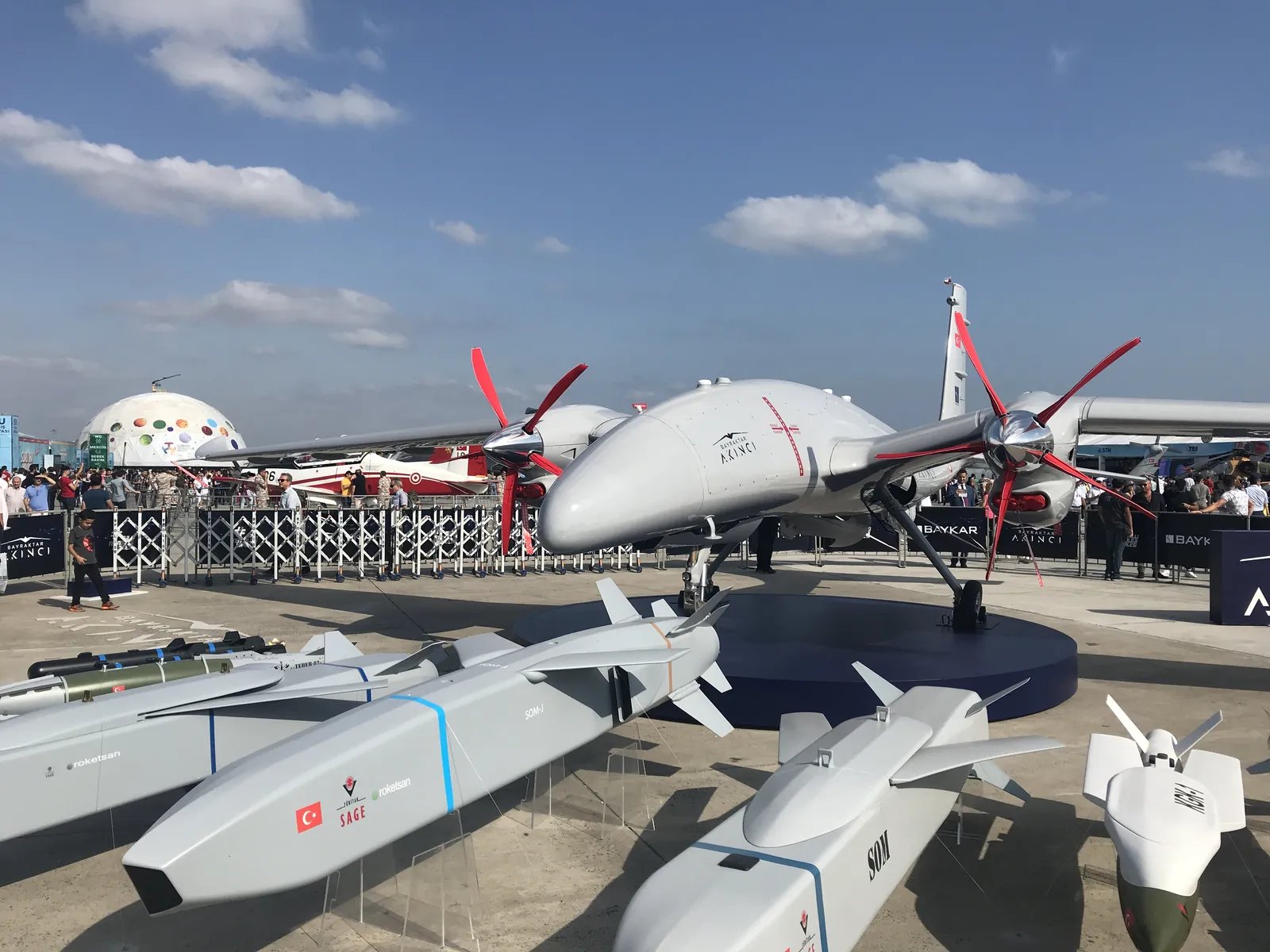
Baykar’s Bayraktar AKINCI combat drone released two ASELSAN-made TOLUN-P bunker-penetrating munitions in salvo while flying through an active jamming environment, according to statements from both companies on November 12. The trial is the latest in a run of tests Türkiye’s two largest defence electronics and drone makers have used to show that their precision weapons keep working when an adversary tries to jam their satellite guidance.
Baykar chairman Selçuk Bayraktar announced the test on the Turkish social platform NSosyal, and ASELSAN chief executive Ahmet Akyol followed with his own post crediting the “AKINCI-ASELSAN cooperation” and describing TOLUN-P’s bunker-penetrating design. Neither executive disclosed the test range, the date the sortie flew, or the configuration of the jamming equipment used. Some Turkish trade outlets described the setup as involving seven separate jammers, but that figure appears nowhere in the companies’ own statements, so it should be treated as unconfirmed.
What TOLUN-P Is Built to Do
TOLUN-P is the penetrator variant of ASELSAN’s TOLUN glide-bomb family, a GPS/INS-guided weapon designed to be carried by both crewed jets and unmanned platforms. ASELSAN specifies a warhead built to punch through up to one metre of reinforced concrete before a programmable, time-delayed electronic fuze sets it off — intended to defeat hardened bunkers, command posts and armoured structures rather than destroy them on impact. The munition can be carried on ASELSAN’s SADAK-4T multiple ejector rack, which lets a single sortie release several TOLUN-series weapons rather than one at a time, and that rack is what allowed AKINCI to fire the pair in this test as a salvo rather than a single drop. The family sits alongside ASELSAN’s broader push into guidance kits that turn unguided bombs into precision weapons, and its KGK-84 glide bomb, which cleared its own F-16 qualification firing last month.
The defining feature of this particular trial was not the munition’s penetration claim, which ASELSAN has published before, but the jamming backdrop. GPS-guided weapons are vulnerable to electronic attack that denies or spoofs satellite positioning data, a vulnerability that has shaped weapons design on both sides of the war in Ukraine, where jamming has degraded the accuracy of satellite-guided artillery shells, glide bombs and loitering munitions from multiple suppliers. A Turkish weapon’s ability to still find its target under jamming is now a selling point companies actively market to export customers rather than a theoretical footnote.
AKINCI as the Delivery Platform
AKINCI is Baykar’s twin-engine, high-altitude long-endurance combat drone, built for strike missions that TB2 and TB3 are too small to fly. Baykar lists a payload capacity of 1,500 kg across six hardpoints, a 20-metre wingspan, a service ceiling of roughly 40,000 feet, autonomous takeoff and landing, and satellite-communications links for missions flown beyond the operator’s line of sight. Those figures make it the heaviest-hitting drone in Baykar’s catalogue and the natural test bed for Türkiye’s growing family of guided glide munitions, including the TOLUN series and ASELSAN’s MGK-series kits that AKINCI fired for the first time last month.
This was not the first time ASELSAN and Baykar have paired a new munition with AKINCI to generate test publicity. The companies ran a similar demonstration with the IHA-300 supersonic missile and, separately, with the MGK guidance kit, both inside the past two months. The pattern reflects a deliberate marketing rhythm ahead of export discussions: Baykar and ASELSAN increasingly release weapons-integration test footage in close succession, each one adding a capability claim — longer range, heavier warhead, jam resistance — to the sales pitch for AKINCI as a strike platform rather than purely a surveillance one.
Why It Matters Beyond Türkiye
Electronic warfare resilience has become one of the sharpest differentiators in the export market for precision-guided munitions. Buyers evaluating Turkish systems against Chinese, Russian or Western alternatives increasingly ask how a weapon performs once an opponent starts jamming, rather than relying on manufacturer-quoted circular error probable figures measured in benign conditions. AKINCI already has export customers and users across the Gulf and beyond, and ASELSAN has been expanding its guided-munitions production lines through 2026 to meet both domestic Turkish Armed Forces orders and growing export interest.
Neither company has said whether this jamming test was conducted for a specific customer evaluation or as part of routine qualification ahead of wider fielding. What is confirmed is narrower than the headlines suggest: two munitions were released from AKINCI under jamming conditions, and both companies describe the firing as successful. Impact footage, precise accuracy data and the identity of any jamming equipment used have not been made public.
Sources
- Anadolu Agency (AA), “Türkiye’s Akinci drone tests bunker-penetrating munitions under electronic jamming,” November 12, 2026
- Statements by Baykar Chairman Selçuk Bayraktar and ASELSAN CEO Ahmet Akyol on NSosyal, November 12, 2026