KIZILELMA Explained: Türkiye’s Unmanned Fighter Programme

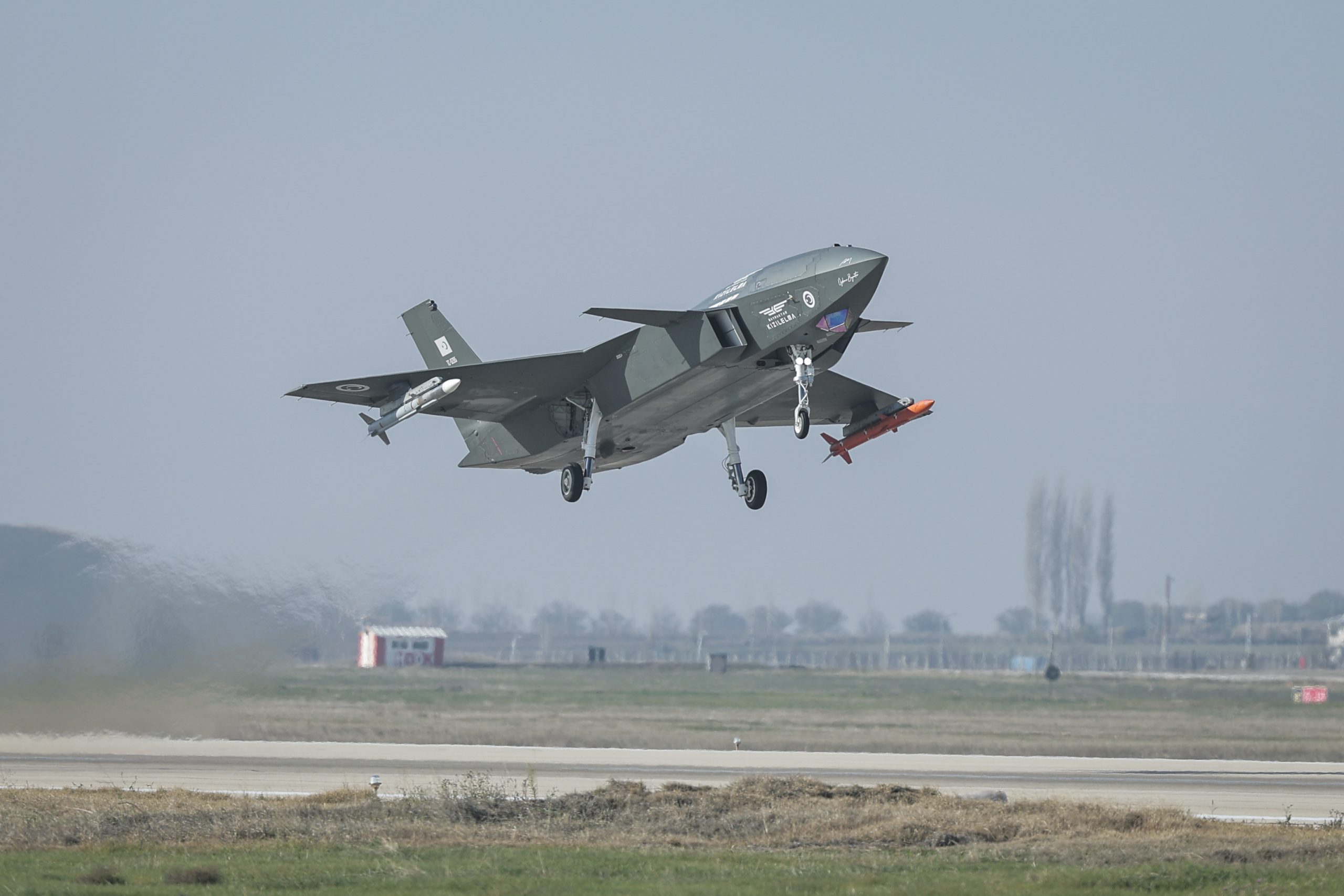
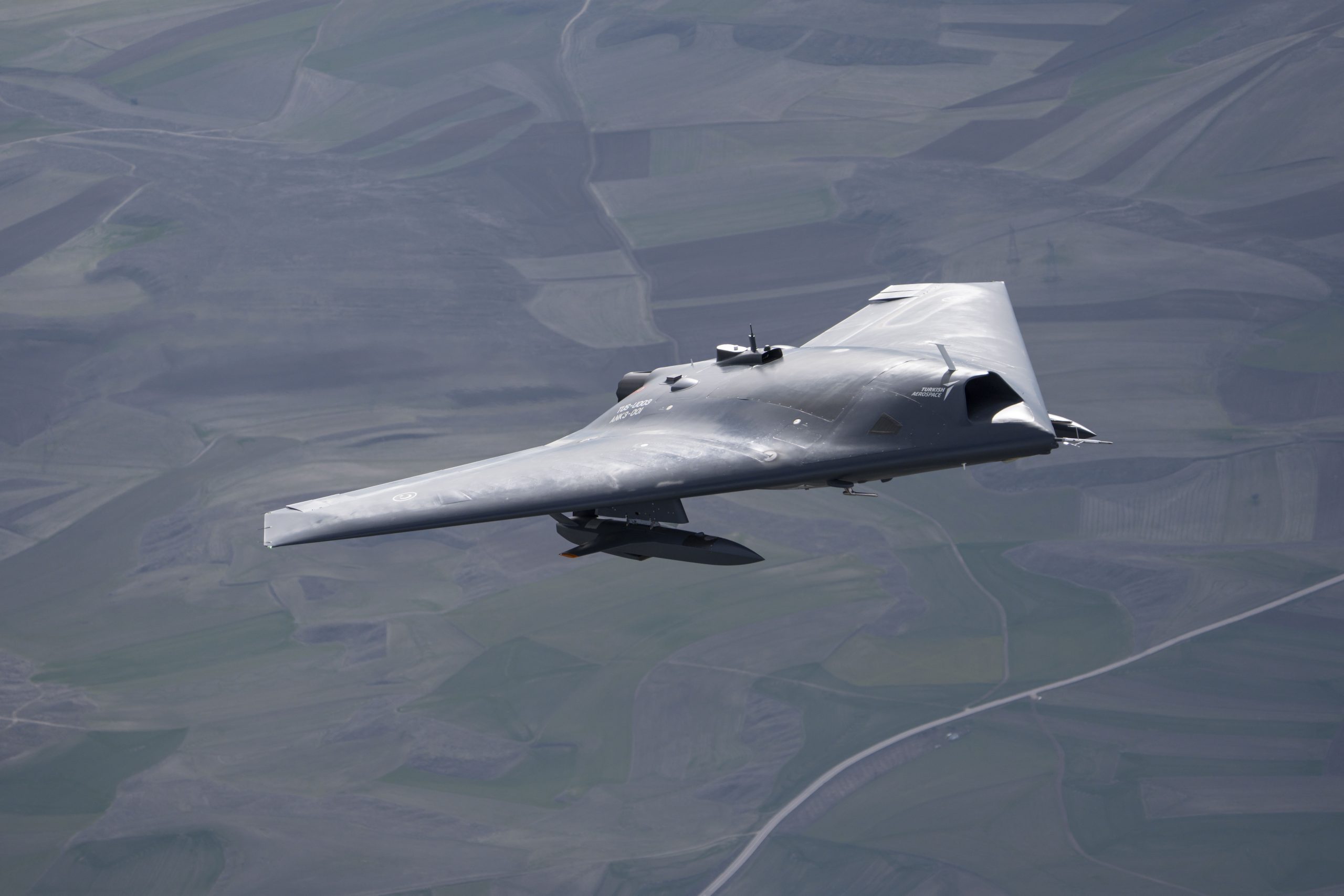
Bayraktar KIZILELMA is Baykar’s jet-powered unmanned combat aircraft, and as of 11 November 2026 it has flown, fired from an internal weapons bay, shot down a jet-powered target with a beyond-visual-range missile and signed its first export agreement — but it has not yet been delivered to the Turkish Armed Forces. That gap between capability demonstrated and capability fielded is the whole story of the programme. KIZILELMA flew nearly three years before the American collaborative combat aircraft it is usually compared with, yet those aircraft entered production first. For a foreign buyer, the question is not whether the aircraft works. It is whether Baykar can deliver it, and on whose engine.
DefenceTürkiye Data Box
Manufacturer: Baykar Technology (privately owned, Istanbul)
System: Bayraktar KIZILELMA
Category: Jet-powered unmanned combat aircraft (UCAV) / collaborative combat aircraft class
Programme status: Flight test and early serial production. Serial-standard airframe S2 flying and firing.
First flight: 14 December 2022 (rollout 14 November 2022)
First delivery: Not announced as of 11 November 2026. Baykar’s stated aim was first serial deliveries during 2026.
Known customers: Turkish Armed Forces (domestic, undelivered); Indonesia (export agreement, deliveries from 2028)
Export status: One signed agreement — 12 aircraft, with a provision to rise to 48
Current milestone: First internal weapons bay firings, 25 and 28 July 2026, Çorlu
Is KIZILELMA actually a fighter jet?
Baykar calls it “Türkiye’s first unmanned fighter aircraft,” and the shorthand has stuck in English coverage. It needs qualifying, because the word “fighter” sets expectations the airframe is not built to meet.
KIZILELMA is subsonic. Baykar’s own published figures give a 0.6 Mach cruise and a 0.9 Mach maximum, with a 40,000 ft service ceiling and a 25,000 ft operational altitude. Maximum take-off weight is 8,500 kg with a 1,500 kg payload — roughly a third the weight of a loaded F-16. Endurance is given as three hours or more, and combat radius as 500 nautical miles. Those are the numbers of a medium, single-engine strike aircraft with air-to-air capability bolted on, not of an air-superiority fighter.
What makes the “fighter” label more than marketing is the sensor and weapons fit. The aircraft carries a multi-mode AESA radar, an electro-optical targeting system and an infrared search and track set, and it has fired an active-radar-guided air-to-air missile at a manoeuvring aerial target. Very few uncrewed aircraft anywhere have done that. The honest description is that KIZILELMA sits in the collaborative combat aircraft class — an expendable-ish, sensor-carrying partner to crewed fighters — and is among the most capable aircraft in that class on current evidence, rather than a replacement for Türkiye’s KAAN fifth-generation fighter programme, which is a different aircraft for a different job.
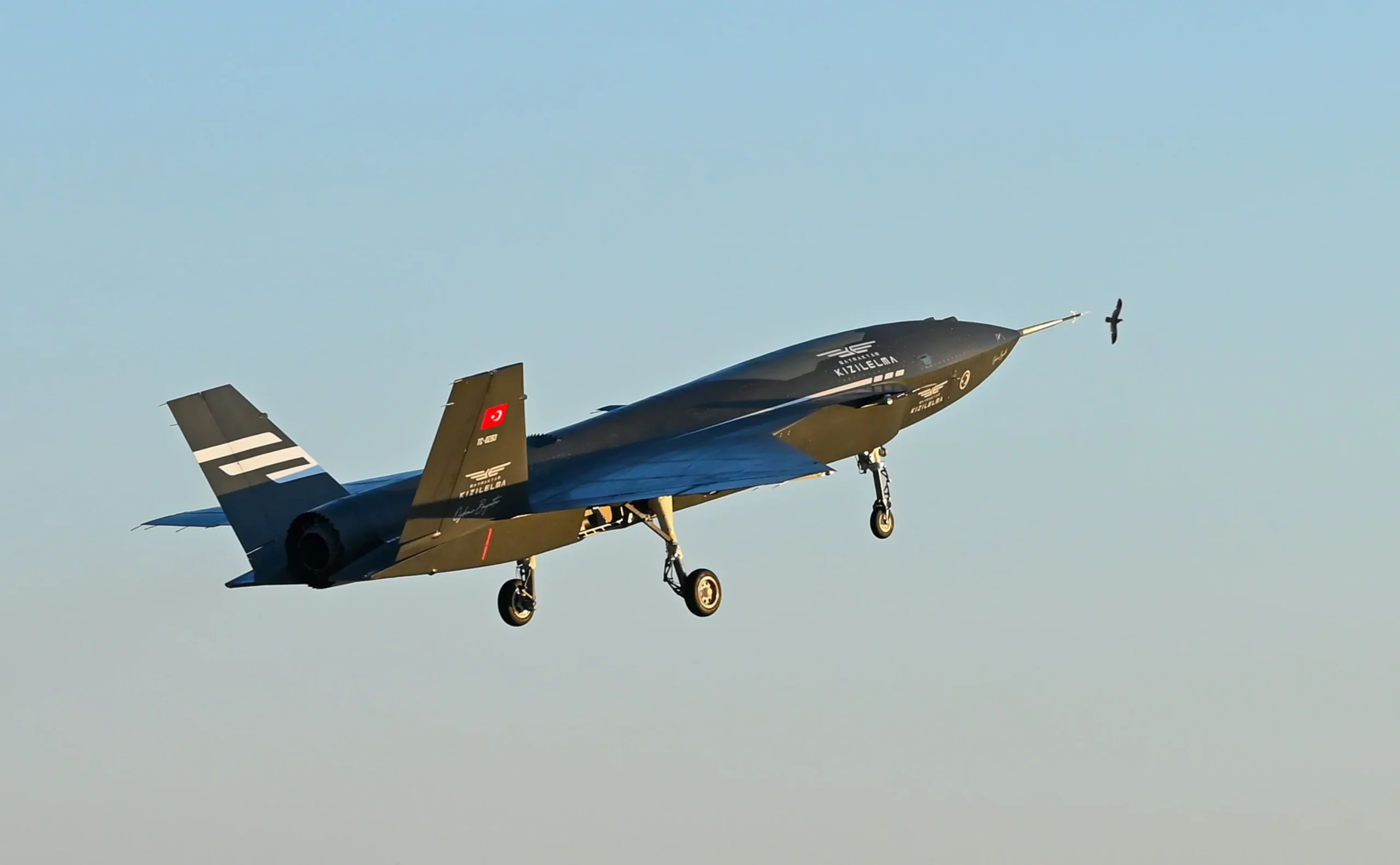
One design choice does separate it from most of the class: the aircraft was shaped from the start for short-runway and carrier operation. Baykar lists take-off and landing from short-runway aircraft carriers as a feature, while also stating that work to enable carrier operation is still ongoing. That is the capability that would let Türkiye put fast jets on a deck it already owns, and it is not yet demonstrated.
The programme timeline, milestone by milestone
KIZILELMA was launched in 2021 and funded, Baykar says, entirely from the company’s own equity. That matters commercially: there was no Turkish government development contract to satisfy, which is why Baykar has been able to sign an export agreement before its home air force has taken delivery. The table below is built from Baykar’s own press releases and from trade reporting where the company has not published a date.
| Date | Milestone | Evidence |
|---|---|---|
| 2021 | Programme launched on Baykar’s own equity | Baykar |
| 14 Nov 2022 | Rollout of first aircraft, tail number TC-ÖZB | Baykar |
| 14 Dec 2022 | Maiden flight | Baykar |
| 8 Oct 2025 | First live firings. Prototype PT-3 drops TOLUN and TEBER-82 at Çorlu. Afterburning engine option integrated. | Baykar |
| 21 Oct 2025 | First flight carrying an AESA radar (ASELSAN MURAD) | FlightGlobal |
| 29 Nov 2025 | Destroys a jet-powered target with a GÖKDOĞAN beyond-visual-range missile off Sinop, cued by its own radar | Baykar |
| Jan 2026 | Baykar states five prototypes flown and two serial-standard aircraft completed; Q1 2026 delivery target given | Company statement, via Turkish media |
| 6–9 May 2026 | First export agreement signed with Indonesia’s Republikorp at SAHA 2026 | Janes |
| 22 Jun 2026 | Autonomous formation flights with Leonardo M-346 aircraft under the K-SWARM programme | Baykar / Leonardo |
| 15 Jul 2026 | Serial aircraft S2 fires a JET-230 supersonic missile from a wing station at Merzifon | Baykar |
| 25 & 28 Jul 2026 | First firings from the internal weapons bay — TEBER-82 then TOLUN, both direct hits | Baykar |
| 11 Nov 2026 | No delivery to the Turkish Armed Forces announced | Absence of any Baykar, SSB or MoD release |
Two entries in that table do heavy lifting. The July 2026 internal-bay firings confirm that the weapons bay is real and functional, which is what separates a low-observable design from a conventional aircraft with faceted lines — Baykar’s own wording is that the aircraft struck its targets “while maintaining a low radar signature,” and it notably does not use the word stealth. The November 2025 air-to-air shot is the one that changed how the programme is read internationally.
The nine days in late 2025 that defined the class
On 29 November 2025, over the Sinop range on the Black Sea, KIZILELMA fired a GÖKDOĞAN beyond-visual-range air-to-air missile, developed by TÜBİTAK SAGE, from a wing station and destroyed a jet-powered target aircraft. The target was detected and tracked by the aircraft’s own ASELSAN MURAD AESA radar. Five F-16s from the 5th Main Jet Base Command at Merzifon flew in formation alongside it and an AKINCI filmed the engagement. Baykar described the result as the first time an unmanned fighter had destroyed a jet-engine-powered aerial target with a BVR missile, and the first time an indigenous air-to-air missile had been fired from an indigenous aircraft at an airborne target under the guidance of an indigenous radar.
Nine days later, on 8 December 2025, a Boeing MQ-28A Ghost Bat fired an AIM-120 AMRAAM over the Woomera range in South Australia during Trial Kareela 25-4 and destroyed a jet-powered Phoenix target drone. The Australian Defence Force confirmed that shot in its own words.
Setting the two events side by side is more useful than arguing about who was first, and it is where the Turkish programme’s real distinction shows up. Baykar’s claim survives on the calendar by nine days. It survives on substance for a different reason: the MQ-28 carried its AMRAAM on an external pylon and was cued as a teamed asset, flying with an E-7A Wedgetail and supported by an F/A-18F Super Hornet, with the ADF not releasing how the target was found. KIZILELMA found and tracked its own target with its own radar and fired its own nationally developed missile. Baykar has also not disclosed how much of the engagement was autonomous and how much was operator-directed, a gap FlightGlobal flagged at the time and which still has not been filled.
For a buyer, the distinction is not patriotic, it is practical. An aircraft that closes its own kill chain needs less of a supporting fleet around it. An aircraft firing a nationally produced missile is not subject to a third country’s release approvals — a point that matters to anyone who has watched export controls bite on a programme mid-contract.
Where KIZILELMA sits in the global unmanned combat aircraft market
The honest comparison is not with the F-35 or with any crewed fighter. It is with the small group of jet-powered uncrewed combat aircraft that different air forces are fielding as partners to crewed fighters. Those programmes overlap in mission but differ sharply in maturity, funding model and export availability.
| Programme | Country | First flight | Live air-to-air shot | Status | Export |
|---|---|---|---|---|---|
| Bayraktar KIZILELMA | Türkiye | Dec 2022 | Yes — Nov 2025, own radar, own missile | Flight test, early serial build; no delivery announced | Agreement signed (Indonesia) |
| MQ-28A Ghost Bat | Australia / Boeing | 2021 | Yes — Dec 2025, AMRAAM, external pylon | Block 2 in production; service entry targeted 2028 | Marketed abroad; no signed export |
| YFQ-42A / FQ-42A Dark Merlin | United States | Aug 2025 | Not publicly reported | Production ordered Jun 2026; test flying at Creech AFB; no fielding date published | None |
| YFQ-44A / FQ-44A Fury | United States | Oct 2025 | Not publicly reported | Production ordered Jun 2026; test flying at Creech AFB; no fielding date published | None |
| YFQ-48A Talon Blue | United States | Oct 2026 | Not publicly reported | Early flight test | None |
| ANKA-3 | Türkiye | Dec 2023 | Not publicly reported | Flight test; one prototype lost Jun 2025; production configuration pending | None announced |
Read down the columns and the pattern is clear. KIZILELMA flew first, by nearly three years over the American aircraft, and it is the only one of the six with a signed export agreement. It is also the only one not yet in the hands of its home air force. The two American programmes went from first flight to a production order in roughly ten months, and their test aircraft have flown at Creech Air Force Base. But the US Air Force has not published a fielding date either, saying only that it hopes to have them in operational service toward the end of the decade. KIZILELMA, meanwhile, has been flying for four years and is still, publicly, undelivered.
That is not a contradiction. It reflects two different models. The US CCA effort is a funded air force requirement with a procurement machine behind it. KIZILELMA is a self-financed company product that has to earn its production run — which is exactly why Baykar has pushed so hard on visible capability milestones, and why it signed an export deal early. The same self-funded model drove the Bayraktar TB2 into a long list of export air forces before most Western competitors had a comparable product to sell.
The engine: the one dependency Baykar admits
Speaking at SAHA 2026 in May, Baykar chief executive Haluk Bayraktar said that every system on the aircraft was developed domestically except the engine. That is an unusually direct admission from a Turkish manufacturer and it is worth taking at face value, because the engine is the single largest constraint on the programme.
KIZILELMA flies on Ukrainian power. The non-afterburning variant uses an Ivchenko-Progress AI-25TLT; the afterburning option, whose integration Baykar announced as complete in October 2025, is the AI-322F. Baykar said at the time that the aircraft “will approach the speed of sound” with the afterburning engine — a forward-looking statement about expected performance, not a reported test result.
Sourcing a combat aircraft’s engine from a country fighting a full-scale war is a risk no buyer can be asked to ignore. Ukraine’s ability to guarantee long-term supply, spares and overhaul for a foreign customer is not something Baykar controls. The mitigation is public and under way rather than hypothetical: TUSAŞ Engine Industries (TEI) is developing the TF6000, a roughly 6,000 lbf dry-thrust turbofan intended for both KIZILELMA and ANKA-3, with an afterburning TF10000 derived from the same core. The TF6000 completed its first ignition test in March 2024 and was publicly run again in September 2025.
What has not happened is the part that counts. On the public record the TF6000 has not flown on KIZILELMA. Until it does, every KIZILELMA delivered — to Türkiye or to Indonesia — is an aircraft whose propulsion sits outside Turkish control, and a buyer’s through-life support case rests on an engine line in a war zone. This is the same problem, with the same proposed answer, that runs through Türkiye’s wider aero-engine effort, and it is the most important single thing to watch on this programme.
Export status: what the Indonesian agreement actually says
KIZILELMA’s first export was announced at SAHA 2026 in Istanbul in May 2026, and the way it has been reported in English deserves correcting.
What was signed, according to Janes, is an updated collaboration agreement between Baykar Defence and Indonesia’s Republikorp Group, under which 12 Bayraktar KIZILELMA will be delivered to Indonesia starting in 2028. A Baykar spokesperson told Janes the agreement contains a provision to increase the delivery size to 48 aircraft in future. Janes consistently describes it as an agreement and a framework agreement — not a contract. Janes further understands that the framework proposes establishing maintenance, repair and overhaul facilities in Indonesia; it does not say the aircraft itself will be built there.
Several outlets, including Envanter Medya’s English edition, have rendered this as a deal for “up to 60 unmanned fighters” by adding the 48 to the 12 and describing the larger number as an option across four additional squadrons. That arithmetic is defensible, but it stacks a firm figure and a provision into one headline number and loses the distinction. On the published record the committed quantity is 12, from 2028, under an agreement rather than a signed supply contract, with a stated route to 48. Procurement readers should treat the three differently. Envanter’s Turkish-language coverage of the programme is a useful companion on the platform itself — its Turkish-language platform profile of KIZILELMA, covering specifications, radar and variants goes into airframe detail this analysis does not.
The Indonesian agreement did not appear from nowhere. It builds on a February 2025 joint venture accord for producing Bayraktar TB3 and AKINCI aircraft in Indonesia, and Haluk Bayraktar has said Indonesia pushed for the KIZILELMA deal for about a year before Baykar was willing to sign. Indonesia is already one of the most committed buyers of Turkish aerospace and is a partner in the KAAN programme, which puts this agreement inside a much larger relationship rather than standing alone. It is the clearest case on the board of a country buying into a Turkish programme early, and it fits the broader pattern visible in which countries buy the most Turkish weapons.
Buyer View
Delivery: No aircraft delivered to any operator as of 11 November 2026. The first export deliveries are set for 2028. A buyer signing now is buying a schedule, not a fielded system.
Cost: No unit price has been published by Baykar or by any customer. Any figure circulating is an estimate without an attributable source.
Industrial partnership: The Indonesian framework proposes MRO facilities locally. Local manufacture of the aircraft has not been announced.
Weapons integration: Demonstrated with TOLUN, TEBER-82, JET-230 and GÖKDOĞAN — all Turkish. Integration of a buyer’s existing non-Turkish inventory has not been publicly demonstrated.
Engine dependency: Ukrainian, with a Turkish replacement in development that has not yet flown on the aircraft. This is the central support risk.
Export limitations: Türkiye licenses exports case by case through the Ministry of National Defence. As a self-funded product with no foreign subsystem of record other than the engine, KIZILELMA carries fewer third-country veto points than most aircraft in its class — but the engine is a real one.
The limitations, stated plainly
It has not been delivered. Baykar announced a Q1 2026 delivery target in January 2026. By May that had become “within this year.” As of 11 November 2026 there is no delivery release on Baykar’s press page, and no SSB or Ministry of National Defence announcement of KIZILELMA entering Turkish Armed Forces service. The schedule has moved at least once and the current date is effectively unstated.
The engine is foreign and the replacement has not flown. Covered above, and it remains the programme’s largest single risk.
Autonomy is undemonstrated in public. Baykar has not disclosed how much of the November 2025 engagement was autonomous. For an aircraft whose entire value proposition rests on operating as a crewed fighter’s partner, that is a material gap in the public record.
Carrier operation is a design intent, not a capability. Baykar’s own page states that work to enable carrier operation is ongoing. KIZILELMA has not been publicly shown taking off from or landing on a ship.
No combat record. Unlike the TB2 and AKINCI, KIZILELMA has not been used operationally. Its performance is known from test events conducted by its manufacturer, which is a different evidence class from the Turkish systems that do have a combat record.
Several key figures are not published. Baykar gives no engine thrust, no radar detection range and no unit cost. Numbers circulating for radar range in particular — including figures above 200 km — are not traceable to ASELSAN or to Baykar and should not be relied on.
What comes next
Three things would change the picture, and all three are observable from open sources.
The first is a delivery announcement. Baykar publishes its milestones aggressively, so a first handover to the Turkish Air Force will not be quiet. Until that happens, the gap between the November 2025 air-to-air shot and an in-service aircraft stays the programme’s defining weakness.
The second is a TF6000 flight on KIZILELMA. That single event would convert the aircraft from a platform with a wartime supply dependency into a genuinely national product, and it would materially change the through-life support case for every prospective buyer.
The third is movement on the Indonesian agreement — conversion of the framework into a signed supply contract, or activation of the provision taking the quantity from 12 to 48. Either would be the first hard evidence that the unmanned combat aircraft class has a real export market, which no other programme in the table above has yet proved.
Beyond those, Baykar lists five variants — KIZILELMA-A, -B, -CA, -CB and -D — of which only the early configurations have been seen flying. The company’s work with Leonardo under K-SWARM, which in June 2026 put KIZILELMA into autonomous formation with M-346 aircraft, points at a European route for the manned-unmanned teaming software rather than for the airframe. Türkiye’s other entrant, the ANKA-3 flying wing, is pursuing the same engine and a similar mission from a state-contracted direction, and the two programmes will eventually compete for the same production capacity.
Why It Matters
KIZILELMA is the test case for whether a privately funded company can field a combat aircraft class that major air forces are still prototyping. It flew three years before the American collaborative combat aircraft and shot down a jet-powered target before any of them, which is why it gets attention disproportionate to its size.
For buyers outside the US alliance structure, it is also the only aircraft of its kind currently available for export. That scarcity, not the specification sheet, is what gives Türkiye leverage here — and it will last only as long as it takes Washington, Canberra or Beijing to offer the same thing.
FAQ
Is KIZILELMA in service?
No. As of 11 November 2026 no delivery to the Turkish Armed Forces has been announced. Baykar stated in January 2026 that two serial-standard aircraft were complete and targeted first deliveries for the first quarter of 2026, then said in May 2026 that it aimed to deliver within the year.
Has KIZILELMA shot down an aircraft?
It destroyed an uncrewed jet-powered target aircraft on 29 November 2025 off Sinop, using a GÖKDOĞAN beyond-visual-range missile guided by its own MURAD AESA radar. It has not engaged a crewed aircraft and has no combat record.
Who is buying KIZILELMA?
Indonesia is the only announced export customer. Baykar and Indonesia’s Republikorp signed an agreement at SAHA 2026 in May 2026 covering 12 aircraft from 2028, with a provision to raise the number to 48.
What engine does KIZILELMA use?
Ukrainian Ivchenko-Progress engines — the AI-25TLT in the non-afterburning configuration and the AI-322F in the afterburning one. Türkiye’s TEI is developing the TF6000 and TF10000 as replacements. Neither has flown on KIZILELMA on the public record.
Is KIZILELMA a stealth aircraft?
Baykar does not use the word. It describes the aircraft as maintaining a low radar signature and has demonstrated firings from an internal weapons bay, which is consistent with a low-observable design. No radar cross-section figure has been published by anyone with access to the data.
Can KIZILELMA operate from an aircraft carrier?
It was designed for short-runway and carrier operation and Baykar lists that as a feature, but the company also states that work to enable carrier operation is ongoing. No shipboard take-off or landing has been publicly demonstrated.
How does KIZILELMA compare with the American collaborative combat aircraft?
KIZILELMA flew first, in December 2022, and is the only aircraft of its class with a signed export agreement. The American YFQ-42A and YFQ-44A flew in 2025 and reached a production order in June 2026, which is a far faster run to production than KIZILELMA has managed. Neither side has a published in-service date: the US Air Force says only that it hopes for operational service toward the end of the decade. KIZILELMA is ahead on demonstrated air-to-air capability and is the only one of the group with a signed export agreement.
How much does KIZILELMA cost?
No unit price has been published by Baykar or by any customer, and no contract value has been disclosed for the Indonesian agreement.
Sources
- Baykar Technology, Bayraktar KIZILELMA product page — specifications, variants, carrier statement
- Baykar Technology, “Direct Hit on First Strike from Bayraktar KIZILELMA”, 8 October 2025
- Baykar Technology, “A New Chapter in Aviation History”, 30 November 2025 — the GÖKDOĞAN engagement
- Baykar Technology, “KIZILELMA Successfully Completes First Firing Tests From Its Internal Weapons Bay”, 30 July 2026
- Craig Hoyle, “Baykar’s Kizilelma soars through AESA integration and weapons testing”, FlightGlobal, 21 October 2025
- Akhil Kadidal and Manasvi Shanker Sharma, “SAHA 2026: Baykar signs agreement to export Kizilelma to Indonesia”, Janes, 8 May 2026
- “Baykar aims to begin first serial deliveries of unmanned combat aircraft this year: CEO”, Hürriyet Daily News, 10 May 2026 — the 2026 and 2028 statements
- The War Zone, “MQ-28 Ghost Bat Has Fired An AIM-120 AMRAAM Missile”, 9 December 2025
- The War Zone, “USAF Orders Both General Atomics’ FQ-42 And Anduril’s FQ-44 Into Production”, 17 June 2026
- Envanter Medya, Turkish-language comparison of jet-powered unmanned aircraft, 30 October 2026