
ASELSAN’s KGK-84 Glide Bomb Clears First F-16 Qualification Firing

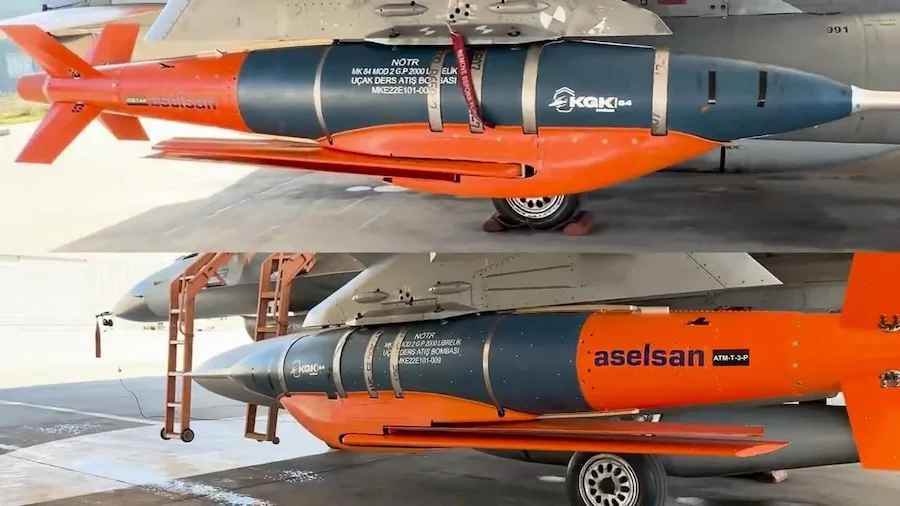
ASELSAN’s KGK-84 winged guidance kit has cleared its first qualification firing from a Turkish Air Force F-16, releasing a 2,000-pound-class bomb that glided to a direct hit on a designated target at the Sinop Firing Range on October 26. ASELSAN confirmed the test and released video and photographs of the munition under the fighter’s wing.
It is the first time the KGK-84 has been fired from an F-16 in a qualification trial, a step the company says is part of preparing the kit for service entry rather than a final type-certification milestone.
What the Kit Does
KGK-84 — “Kanatlı Güdüm Kiti 84,” or Winged Guidance Kit 84 — is a strap-on glide kit that converts unguided MK-84-class bombs, including the MK-84, MK-84-T, NEB and NEB-T variants used by the Turkish Air Force, into precision stand-off munitions. The kit replaces the bomb’s tail section with deployable wings, an inertial navigation system fused with GPS, and a controller-actuator unit that steers the weapon toward its programmed aim point after release.
Because the bomb glides rather than falling ballistically, an F-16 can release it well outside the effective range of many short- and medium-range air defense systems, rather than overflying the target. Earlier ASELSAN figures for the upgraded KGK-84 put its range at up to 100 km when released at high altitude, though the company has not published a release envelope specific to the October 26 test.
Built to Operate Under Jamming
ASELSAN has built the KGK-84 around a CRPA (controlled reception pattern antenna) GPS receiver intended to resist jamming and spoofing of satellite navigation signals — a design choice that reflects how seriously Turkish programs now treat electronic warfare threats to GPS-guided weapons. The company describes the kit as fire-and-forget, able to engage targets of opportunity, with a selectable terminal impact angle and day/night, all-weather operation. It is built to the MIL-STD-1760 standard for aircraft-to-weapon electrical interfaces, the same standard used across NATO precision munitions, which keeps integration work on other aircraft types relatively straightforward.
The anti-jam GPS approach is not unique to the KGK-84 — it runs through most of the current generation of Turkish-made glide bombs and guidance kits, a response to the growing use of GPS jamming and spoofing in conflicts from Ukraine to the Middle East that Turkish designers have had to account for from the outset.
Part of a Crowded Family
KGK-84 is one entry in a wider Turkish effort to indigenize precision-guided munitions that once had to be imported. ASELSAN’s own TOLUN covers the smaller end of the glide-bomb category, while its MGK kit was fired for the first time from a Bayraktar AKINCI drone earlier this month. TÜBİTAK SAGE’s KUZGUN family and Roketsan’s TEBER laser-guidance kits round out a domestic munitions ecosystem that now spans laser, GPS/INS and combined guidance across multiple bomb weights and launch platforms — a buildout covered in more detail here. The common thread across all of them, including KGK-84, is GNSS receivers designed to keep working under jamming.
For the Turkish Air Force, qualifying the heaviest of these kits on the F-16 — still the backbone of the fighter fleet while KAAN and further HÜRJET deliveries are years away — extends the standoff reach of an aircraft that otherwise relies largely on older or imported munitions for this weight class. For ASELSAN, a successful run through qualification firing, operational testing and eventual serial production would add another indigenous munition to a catalog it has increasingly offered to export customers alongside TOLUN and its other guided weapons.
What Hasn’t Been Disclosed
ASELSAN has not published a timeline for completing qualification testing, nor has it disclosed a unit cost, planned production quantity, or an in-service date for the Turkish Air Force. No export customer or interest has been announced for KGK-84 specifically. The October 26 firing should be read as a qualification milestone on the path to service entry, not confirmation that the kit has entered production or operational use.
Sources: ASELSAN; Defence Industry Europe; Türkiye Today.


