Baykar’s AKINCI Strikes 250 km Away With Roketsan’s New İHA-300 Missile

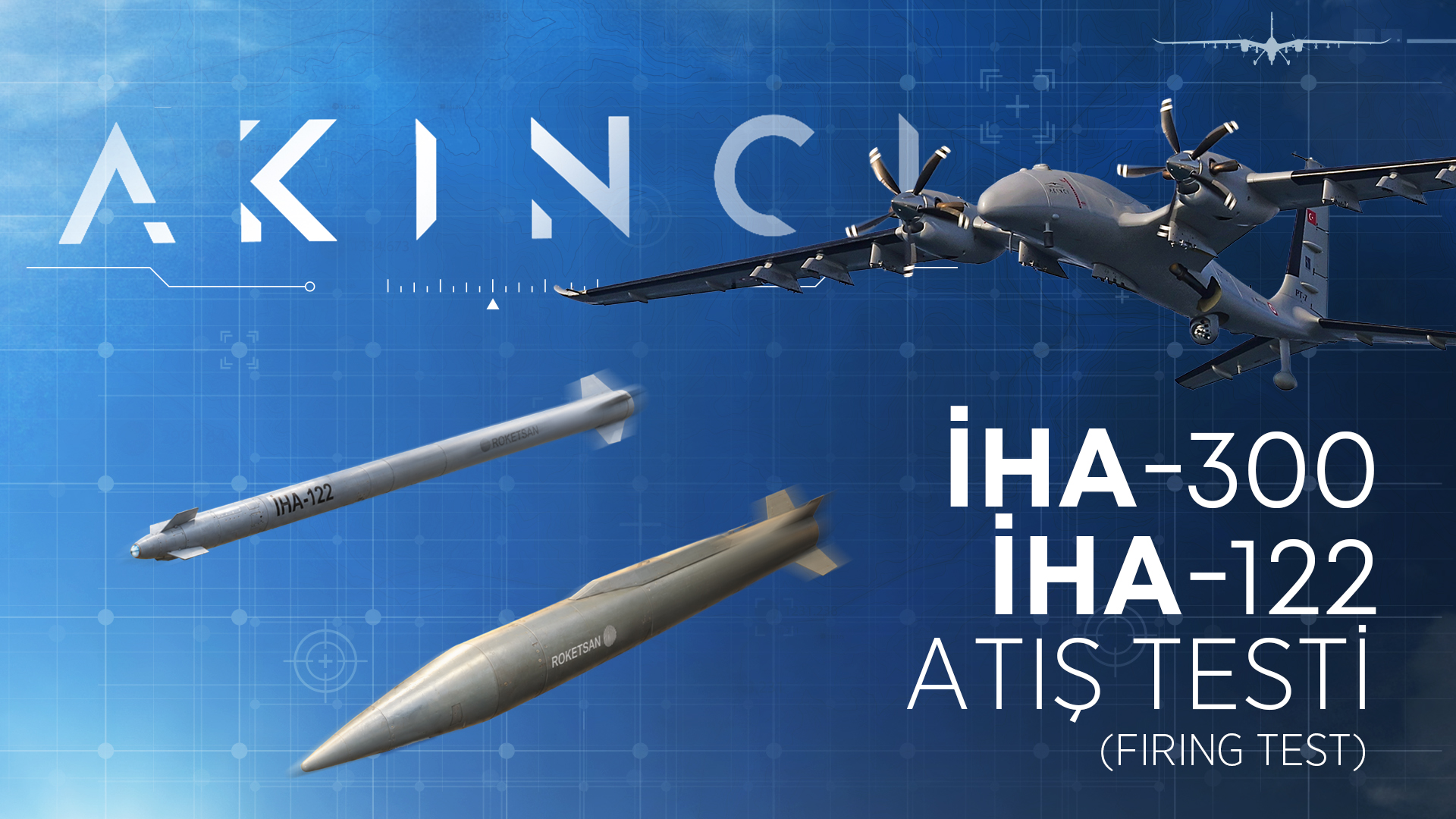
Baykar’s AKINCI combat drone hit a maritime target more than 250 kilometres away on September 11 using a new supersonic missile from Roketsan, the İHA-300, in a test that pushes the stand-off strike range of Türkiye’s heaviest armed drone well past anything it has carried before.
Baykar said the AKINCI departed from the Çorlu Flight Training and Test Centre in Tekirdağ, transited to a firing area over the Black Sea off Sinop, and released the İHA-300 against a maritime target, scoring a direct hit before returning to base along its planned route. The company’s official statement described the missile as supersonic and confirmed the engagement range exceeded 250 km, without disclosing the aircraft’s release altitude or additional test parameters.
What the İHA-300 Adds to AKINCI’s Arsenal
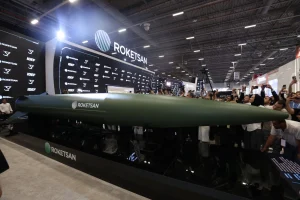
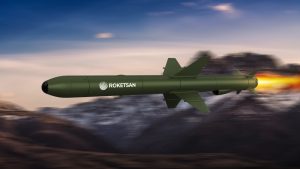
The İHA-300 — also referred to in Turkish reporting as the UAV-300 or 300 ER — is an air-launched ballistic missile roughly five metres long and weighing about 900 kg, with a 370 mm-diameter body and a warhead exceeding 150 kg, according to Turkish trade publications tracking the programme. It uses GPS and inertial navigation for guidance. Industry reporting has put its maximum range at up to 500 km depending on the launch platform’s altitude and speed, though Baykar’s own statement confirms only the demonstrated 250-km-plus hit; Roketsan has not published a certified maximum range.
Baykar confirmed the İHA-300 joins two munitions already integrated on AKINCI: the shorter-ranged İHA-122 and İHA-230 air-launched ballistic missiles, both also built by Roketsan. Combined with the MAM precision-guided bomb family, the TOLUN and TEBER series, and various loitering munitions and cruise missiles, Baykar says AKINCI can now carry more than 26 munition types, giving the platform strike options from close range out to several hundred kilometres against both ground and maritime targets.
Closing the Gap With Manned Strike Aircraft
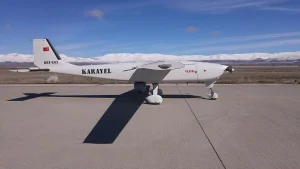
AKINCI is Baykar’s twin-engine, high-altitude long-endurance UCAV, built to carry heavier payloads and fly higher and longer than the company’s original Bayraktar TB2. Since entering Turkish Armed Forces service, it has been steadily upgraded from an armed reconnaissance platform into something closer to an unmanned strike aircraft, with radar, electronic warfare and satellite-communication variants alongside the baseline strike configuration.
An air-launched ballistic missile with a demonstrated range past 250 km is a different category of weapon than the guided bombs and shorter cruise munitions that have defined armed-drone warfare over the past decade. It lets AKINCI engage targets — warships, air defence batteries, command posts — from well outside the effective range of most short- and medium-range air defence systems, a capability historically associated with manned fighters or ballistic-missile batteries rather than uncrewed aircraft. For an export customer, that changes what a single AKINCI airframe can threaten without needing manned strike aircraft or a separate missile battery.
Why It Matters Beyond Türkiye
Baykar was the world’s largest UAV exporter in 2025, with $2.2 billion in export revenue and agreements covering 39 countries, according to the company. Long-range strike munitions are increasingly the differentiator in that market: China’s CH-series and Wing Loong drones, and various loitering munitions from Israeli and other suppliers, compete heavily on price and availability, but few unmanned platforms anywhere pair a heavy UCAV with a supersonic, long-range air-launched ballistic missile built entirely in-country. If the İHA-300 completes qualification and enters Turkish Air Force and export configurations, it would give Baykar’s existing and prospective AKINCI customers a stand-off strike option that most competitor UAV ecosystems cannot currently match — one more entry in the wider case for why armed forces keep choosing Turkish drones.
The test also reflects Roketsan’s broader push into longer-range, higher-speed air-launched weapons — a segment where Türkiye has moved from importing components to fielding domestically designed missiles across its combat aircraft and drone fleets. Roketsan has separately been marketing its precision-strike portfolio, including the İHA-300’s shorter-ranged predecessor, to customers at recent European trade shows.
What Isn’t Yet Confirmed
Neither Baykar nor Roketsan has stated when the İHA-300 will complete formal qualification, enter serial production, or become available for export, and no unit cost or production quantity has been disclosed. The September 11 test also does not confirm the missile’s stated maximum range of up to 500 km, which so far rests on trade-press reporting rather than an official figure from either company.
Background
AKINCI’s weapons integration has accelerated through 2026 alongside Baykar’s other major programme, the jet-powered Kızılelma unmanned fighter, which completed its own internal weapons-bay firing tests with Roketsan’s TEBER-82 and ASELSAN’s TOLUN munitions in July. Baykar and Roketsan have said the two unmanned platforms are being developed with an eye toward complementary mission integration, with AKINCI handling longer-endurance strike and surveillance roles while Kızılelma is built around contested airspace.
Sources
This report draws on Baykar’s official press release confirming the September 11 test, cross-referenced with Turkish defence trade reporting (SavunmaSanayiST, Ulusavunma, SSBülten) on the İHA-300’s specifications and range estimates.