ARCA Defense: Türkiye’s $3 Billion Ammunition Exporter

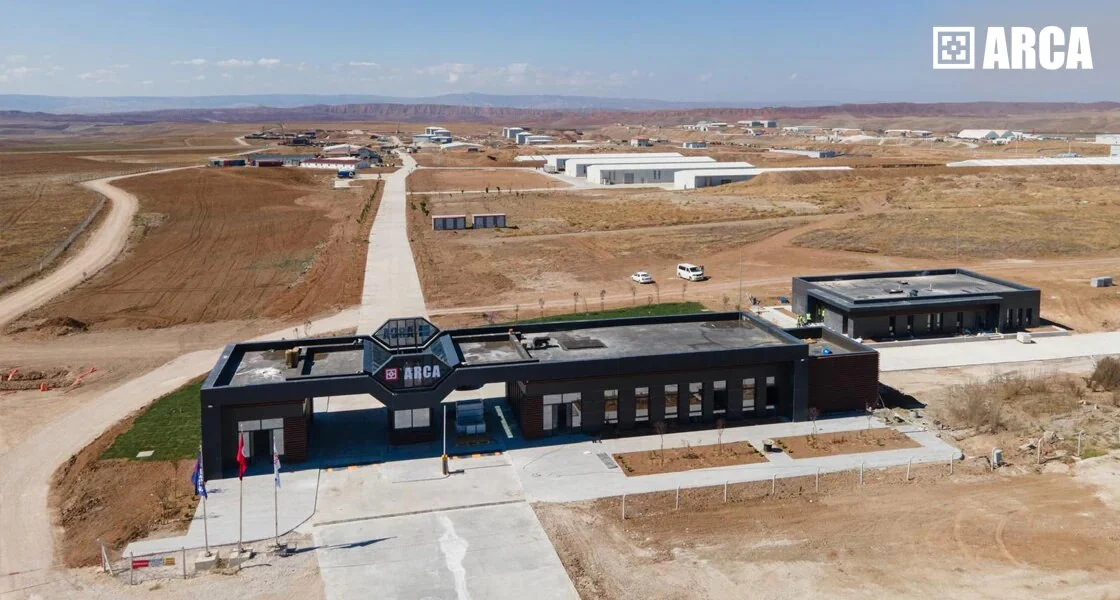
ARCA Defense (ARCA Savunma Sanayi ve Ticaret A.Ş.) is a privately held Turkish ammunition manufacturer, founded in Ankara in 2020, that reported $3 billion of defence revenue for 2025 and entered the Defense News Top 100 at 53rd place — third among Turkish companies, ahead of ROKETSAN. Its revenue multiplied 4.6 times in a single year, from $653.2 million. It makes artillery shells, mortar bombs, rockets, tank ammunition, propellant and C4 at an integrated campus at Sungurlu in Çorum province, and the company says all of its revenue comes from export. Four years after it was founded, almost nothing has been written about it in English.
That combination — very large numbers, very little scrutiny — is the reason this page exists. What follows separates what ARCA says about itself from what can be checked against a government document, a court record or a published contract award, because for a procurement office those are not the same category of fact.
DEFENCETÜRKIYE DATA BOX
Company: ARCA Savunma Sanayi ve Ticaret A.Ş., trading in English as ARCA Defense
Founded: Ankara, 2020. Production at Sungurlu, Çorum from 2022
Ownership: Private, described by the company as 100 per cent domestic capital. Not state-owned, and not connected to MKE
Chairman of the board: İsmail Terlemez
Sector: Artillery, mortar, rocket and tank ammunition; propellant, primers and plastic explosive
Sites: Çorum Sungurlu OIZ, about 960,000 m²; Ankara Başkent OIZ steel centre, 10,000 m²; a plant planned at Põhja-Kiviõli, Estonia; an acquired business unit at Casalbordino, Italy
2025 defence revenue: $3bn (Defense News Top 100, 2026 edition), against $653.2m in 2024
Global rank: 53rd worldwide; third among Turkish firms behind ASELSAN and Turkish Aerospace
Workforce: About 5,000 across nine factories, as reported by Estonian public broadcaster ERR; the company does not publish a headcount
Named export customers: None confirmed by a customer government in public as of 9 October 2026
What ARCA builds, and why the calibre list matters
ARCA’s published product catalogue is the single most informative document the company releases, and it is worth reading closely. It lists 155 mm M107 high-explosive projectiles and a 155 mm ERFB-BB AR204 in the 40-kilometre class; 152 mm D-20, 122 mm D-30 and 105 mm M1 artillery ammunition; 60, 81 and 120 mm mortar bombs; three 122 mm high-explosive rockets at 20 and 40 kilometres, one of them designated AR-1071 Malazgirt; 125 mm tank ammunition; propellant charges; and C4 plastic explosive.
Read as a list of products that is unremarkable. Read as a list of standards it is not, because it spans two mutually incompatible families of ordnance. The 155 mm, 105 mm and mortar natures are NATO-pattern. The 152 mm, 122 mm gun, 122 mm rocket and 125 mm tank natures are Soviet-pattern. Very few manufacturers anywhere build both at volume, because the Western industrial base largely stopped making Warsaw Pact calibres after 1991 and had no commercial reason to restart.
| Nature | Pattern | Guns it feeds | Why it matters commercially |
|---|---|---|---|
| 155 mm M107 HE | NATO | All NATO 155 mm towed and self-propelled guns | The baseline Western round; European stockpiles are short of it |
| 155 mm ERFB-BB AR204, 40 km class | NATO | 52-calibre guns firing at extended range | Higher unit value, and the subject of ARCA’s largest announced agreement |
| 105 mm M1 | NATO | Light towed howitzers | A long tail of legacy users in Africa, Asia and Latin America |
| 60, 81 and 120 mm mortar | NATO | Infantry and vehicle-mounted mortars | High volume, low unit value, steady and unglamorous demand |
| 152 mm D-20 | Soviet | D-20 and 2S3-pattern guns | Western producers closed these lines after 1991 |
| 122 mm D-30 | Soviet | The D-30 howitzer, widely fielded outside NATO | Enormous installed base, very few qualified suppliers |
| 122 mm rockets, 20 and 40 km | Soviet | BM-21 Grad and its derivatives | Consumed faster than any other artillery nature in current wars |
| 125 mm tank ammunition | Soviet | T-72, T-80 and T-90 family guns | Almost no NATO-aligned source exists |
| Propellant, primers and C4 | Both | Feedstock for everything above | Energetics, not steel, are Europe’s real constraint |
Table compiled by DefenceTürkiye from ARCA Defense’s published product catalogue. Pattern and commercial columns are DefenceTürkiye analysis.
WHY IT MATTERS
A supplier that can qualify both NATO and Soviet-pattern ammunition on the same site is rare, and it is exactly what the last four years of demand have called for. Western armies needed more 155 mm than their own plants could make, while the armies they were arming fired 122 mm and 152 mm. ARCA’s catalogue sits across that divide. That is the most defensible explanation on the public record for a 4.6-fold jump in one year — and it is a hypothesis a buyer should test with questions about line capacity, not accept because the growth figure is large.
Where the revenue came from
The clearest public measure of ARCA’s size arrived on 31 August 2026, when Defense News published the 2026 edition of its Top 100 ranking. ARCA entered at 53rd on $3 billion of 2025 defence revenue, against $653.2 million the year before. Set against the other Turkish entries — ASELSAN 40th on $4.46 billion, Turkish Aerospace 48th on $3.65 billion, ROKETSAN 64th on $2.37 billion and MKE 81st on $1.42 billion — ARCA is now the third-largest Turkish defence company by this measure, having been outside the list entirely twelve months earlier. Our summary of the five Turkish firms in the Defense News Top 100 sets out the full table.

Two caveats belong next to that number and should travel with it. ARCA is privately held and publishes no audited accounts; Defense News works from revenue figures supplied by companies, and ARCA’s own communications describe the sum as export volume rather than as audited revenue. Second, one year of 4.6-fold growth is a data point, not a trend. The company was also named Türkiye’s defence and aerospace export champion for 2025 by the Turkish Exporters Assembly, and first in the weapons systems and ammunition category — an award based on declared export values, which is a different test from an audit. ARCA, unlike ASELSAN, is not listed on Borsa İstanbul and files nothing with the Public Disclosure Platform, so none of its contract values reach the open market through the disclosure route that makes Turkish listed-company numbers checkable.
The contracts ARCA has announced, and what can be checked
ARCA announced three large items within a single week at SAHA EXPO 2026, held at the İstanbul Expo Center from 5 to 9 May 2026. The table below separates them by the strength of the evidence behind each, which is the distinction that matters to anyone considering the company as a source of supply.
| What was announced | Counterparty | Value | Evidence |
|---|---|---|---|
| Oct 2025 — purchase of a business unit of Esplodenti Sabino, Casalbordino, Italy | Arca Defence Italy S.p.A. | Undisclosed | Yes — court-approved sale at Vasto, in the Italian legal press |
| 21 Apr 2026 — ammunition plant at Põhja-Kiviõli, Estonia | Estonian Centre for Defence Investments | €300m | Yes — Estonian state agency; 141 ha plot, up to €10m of state works |
| May 2026, SAHA EXPO — 155 mm 40 km long-range artillery project | GMP (Global Military Products, US) | $1.2bn | No — company statement; no public US award names ARCA |
| May 2026, SAHA EXPO — artillery ammunition export contract | VTIC International (Bulgaria) | $2.2bn | No — company statement only |
| May 2026, SAHA EXPO — logistics cooperation protocol | OMSAN Lojistik (OYAK group) | Not stated | No — company statement only |
| 6 Aug 2026 — named among private firms facilitating a transfer of Turkish-held US kit to Ukraine | US State Department notification to Congress | ~$280m equipment value | Yes — in the congressional record; company roles not described |
| 31 Aug 2026 — 53rd in the Defense News Top 100 on 2025 defence revenue | — | $3bn | Partly — published ranking, company-supplied figure |
Table compiled by DefenceTürkiye from ARCA Defense statements, the Estonian Centre for Defence Investments, Italian legal filings, the congressional record as reported by the Kyiv Independent and Novinite, and Defense News as reported by Anadolu Agency. Evidence assessment is DefenceTürkiye’s.
The American route, and what a “$1.2 billion US contract” actually describes
ARCA’s announcement of a $1.2 billion agreement with GMP has been read in places as a Turkish company selling shells to the Pentagon. The public record describes something narrower and more interesting.
GMP is Global Military Products, a wholly owned subsidiary of Global Ordnance Holdings. In September 2025 the US Army’s Contracting Command at Rock Island awarded GMP a firm-fixed-price contract worth $639.8 million for 155 mm high-explosive complete rounds, with production from 2026 and an estimated completion date of 10 July 2027. The award sits under the Special Ammunitions and Weapons Systems programme, which exists to buy munitions that are not intended for US weapon systems and are not available through standard Army supply channels. GMP said at the time that it would work with Rheinmetall Expal Munitions to meet the schedule.
So the route, as documented, runs through an American intermediary rather than a direct award: no published US contract names ARCA. Two further things follow. First, the arithmetic does not sit comfortably — ARCA’s stated $1.2 billion is close to double GMP’s publicly known Army award, which means the figure either covers a longer period, a framework ceiling, or end customers other than the US Army. Second, the programme GMP is contracting under is explicitly a channel for non-standard ammunition, which fits the Soviet-calibre half of ARCA’s catalogue at least as well as the 155 mm half. None of that diminishes the commercial achievement. It does change what the contract proves about qualification and end use, and those are the questions a procurement office asks.
There is a second American thread. On 6 August 2026 a US State Department notification was entered in the congressional record covering the re-export to Ukraine of US-origin equipment held by Türkiye — 70 M39 ATACMS missiles, 12 M270 launchers, more than 2,000 cluster munitions and 47,000 howitzer rounds, with an original acquisition value of roughly $280 million. The Kyiv Independent reported that the transfer was “facilitated through a number of private companies, including Turkey’s MKE, ASFAT, and ARCA Savunma, Bulgaria’s VTIC International, and the U.S. firms Pansophico and Patriot Defense Group.” Novinite, citing the same documents, put the M270 package at about $255.9 million and described the shells as 203 mm M509A1 natures.
VTIC International therefore appears twice in ARCA’s public record: as the counterparty to the largest contract the company has announced, and as a named participant in a US-approved transfer of Turkish stocks to Ukraine. The published documents do not connect the two, and this article does not assert that they are connected. A buyer running diligence would nonetheless want to understand the relationship, because intermediated sales and direct sales carry different end-use, warranty and continuity risks.
The European route: Estonia and Italy
On 21 April 2026 the Estonian Centre for Defence Investments announced that ARCA Baltics Operations would build a €300 million ammunition plant in the Põhja-Kiviõli defence industry park in Ida-Viru County, with the Estonian state providing a 141-hectare plot and up to €10 million towards access roads, fencing and utility connections. The plant is to make 155 mm ammunition including extended-range natures, mortar bombs in several calibres and 122 mm rockets, with production from 2028 and up to 1,000 jobs promised. The ceremonial signing took place at SAHA EXPO in May, with Estonian Defence Minister Hanno Pevkur and İsmail Terlemez signing for the two sides. Output will go mainly to export; Estonia holds an option to buy.
This is a different category of transaction from a sale, and it is the one that matters most for European access. EU defence funding instruments are structured in ways that make a shell manufactured in Türkiye hard to buy with EU money, while a shell manufactured by a Turkish-owned company registered inside the Union is a question nobody has yet tested. We set out the mechanics — the SAFE exclusion and the EDIP content cap — in our analysis of whether Türkiye can supply Europe’s ammunition, and the Estonian plant is the clearest live test of route one. It also belongs alongside the vehicle and aircraft contracts catalogued in which NATO members operate Turkish defence systems, with the difference that this is Turkish capital building inside a member state rather than a member state buying Turkish.
Italy is the quieter half of the European story. In October 2025 Arca Defence Italy S.p.A. completed the purchase of a business unit of Esplodenti Sabino S.p.A., a company founded in 1972 at Casalbordino and specialised in the demilitarisation of conventional ammunition. The sale was approved by the Court of Vasto as part of a settlement of the company’s crisis, with around 65 employees expected to return progressively to work. Terms were not disclosed. Demilitarisation is the reverse of ARCA’s main business — taking ammunition apart rather than filling it — but it brings an EU-registered industrial site, an established workforce and European regulatory standing, and those are the scarce items.
Ownership, leadership and what is not public
ARCA describes itself as a wholly domestically owned private company with headquarters in Çankaya, Ankara, and integrated production running from raw material intake to finished round. Its board chairman is İsmail Terlemez, who also signed for ARCA Baltic Operations in Estonia. The company states that it has started serial production of 155, 152 and 122 mm artillery bodies and completed qualification firings; that it built Türkiye’s first C4 plant at Sungurlu; and that it is building a second primer plant there with an intended output of 1.2 billion primers a year. It has acquired Mite Savunma, an ammunition production and production-technology firm, and it is the title sponsor of the local football club, now Arca Çorum FK. ERR, citing the Estonian process, reported a workforce of about 5,000 across nine factories and activity in energy and construction as well as defence.
What is not public is the part a buyer needs. There is no published figure for rounds per month, by calibre or in total. There is no customer list: no foreign government has confirmed a contract with ARCA by name. There are no audited accounts, no order book, and no breakdown of how much of the $3 billion is finished ammunition as against components, energetics or brokered equipment. ARCA’s position is the opposite of ASELSAN’s, where a Borsa İstanbul listing forces exact contract values into the open.
BUYER VIEW
Ask for the qualification file, not the revenue figure. The useful questions are which natures have completed lot acceptance against which standard, in which year, and for which customer. ARCA states that qualification firings for 155, 152 and 122 mm bodies are complete; a buyer should ask to see the test authority and the acceptance criteria. Our explainer on who certifies Turkish weapons and whether it counts abroad sets out what Turkish qualification does and does not transfer.
Establish whether you are buying from ARCA or through someone. The two largest announced contracts are with intermediaries in the United States and Bulgaria. Intermediated supply can be faster to arrange and harder to enforce.
Separate capacity from ambition. The Estonian plant does not produce until 2028. Announced contract values across one trade-fair week exceed the company’s entire stated annual revenue, which usually indicates multi-year frameworks rather than deliveries.
Expect export-licence exposure. Artillery ammunition is licensed on a case-by-case basis in Türkiye, and output from the Estonian plant will additionally sit under Estonian export control. This is open-source editorial analysis, not procurement advice.
The limitations, stated plainly
ARCA is four years old. It has no public record of sustained delivery performance against a large foreign order, because no such order is public. Its growth figure comes from the company and has not been audited in the open. Several of its announced contracts have no counterpart confirmation from the buyer. Its Estonian plant is a building site. The 155 mm M107 it would start with there is a short-range nature; the shell most European armies now want is the 40-kilometre class, and ARCA’s extended-range product has no publicly confirmed Western customer.
There is also a diligence question on the record. ERR reported during the Estonian process that earlier corruption suspicions concerning the company’s owner had been raised, without giving details, and that the Estonian government reviewed the bidders’ declarations and the company’s Turkish activities before proceeding. Defence Minister Pevkur described ARCA as “a company with very high expertise and a very large-scale ammunition manufacturer”. No finding against the company has been reported. For a procurement office the relevant point is not the allegation but the fact that a NATO member state ran the check and published the answer — which is more than exists for most private ammunition suppliers.
Finally, scale should be kept in proportion. Türkiye’s own stockpile rebuild has first call on domestic output, and the country’s total ammunition capacity, examined in our assessment of how much Türkiye can actually build, is not large enough to resolve Europe’s shortfall. What ARCA changes is the number of qualified sources, not the size of the global pool.
What comes next
Three things are worth watching, and all three are checkable. The first is whether any customer government names ARCA in its own procurement documents — a single confirmed national contract would do more for the company’s standing than another trade-fair announcement. The second is construction progress at Põhja-Kiviõli against the 2028 date, which the Estonian Centre for Defence Investments reports publicly. The third is the 2027 edition of the Defense News Top 100: if the $3 billion holds or grows, the 2025 figure was a business; if it falls back towards $653 million, it was a year.
Türkiye’s ammunition sector now has three distinct shapes in it — the state producer, the private producer and the machine builder. MKE, examined in our profile of the state ordnance corporation, makes rounds and propellant and also builds the guns that fire them. Repkon sells the production machinery that lets other countries make their own. ARCA is the third model: privately financed, export-financed, and growing by buying its way into other people’s jurisdictions. Readers who want the Turkish-language technical and corporate detail will find Envanter Medya’s Turkish-language company file on ARCA Savunma useful, and its technical file on MKE’s indigenous 155 mm artillery ammunition covers the state-owned comparison in detail.
FAQ
What is ARCA Defense and who owns it?
ARCA Defense (ARCA Savunma Sanayi ve Ticaret A.Ş.) is a private Turkish ammunition manufacturer founded in Ankara in 2020, with its main production site at the Sungurlu organised industrial zone in Çorum province. The company describes itself as 100 per cent domestically owned. Its board chairman is İsmail Terlemez. It is not state-owned and has no connection to MKE.
How big is ARCA Defense?
In the Defense News Top 100 published on 31 August 2026, ARCA placed 53rd with $3 billion of 2025 defence revenue, up from $653.2 million in 2024. That makes it the third-largest Turkish defence company on the list, behind ASELSAN and Turkish Aerospace and ahead of ROKETSAN. The figure is company-supplied and not publicly audited.
What does ARCA Defense manufacture?
155 mm M107 and 155 mm ERFB-BB AR204 artillery ammunition in the 40 km class, 152 mm D-20, 122 mm D-30 and 105 mm M1 artillery natures, 60, 81 and 120 mm mortar bombs, 122 mm rockets at 20 and 40 km, 125 mm tank ammunition, propellant charges and C4 plastic explosive. The catalogue covers both NATO and Soviet-pattern calibres.
Does ARCA Defense sell ammunition to the United States?
Not directly, on the public record. ARCA announced a $1.2 billion agreement with GMP — Global Military Products, a subsidiary of Global Ordnance Holdings — at SAHA EXPO in May 2026. GMP itself holds a $639.8 million US Army contract awarded in September 2025 for 155 mm rounds under the Special Ammunitions and Weapons Systems programme. No published US government contract names ARCA as the awardee.
Is ARCA Defense building a factory in the European Union?
Yes. ARCA Baltics Operations is to build a €300 million plant at Põhja-Kiviõli in Ida-Viru County, Estonia, announced by the Estonian Centre for Defence Investments on 21 April 2026. The Estonian state is providing a 141-hectare site and up to €10 million of associated works. Production is planned from 2028, primarily for export, with an Estonian option to purchase.
Which countries buy ARCA Defense ammunition?
No customer government has publicly confirmed a contract with ARCA by name as of 9 October 2026. The company states that all of its revenue is earned from export. ARCA was named among the private firms facilitating a US-approved transfer of Turkish-held American equipment to Ukraine in a State Department notification entered in the congressional record on 6 August 2026, alongside MKE, ASFAT and Bulgaria’s VTIC International; the documents do not describe each firm’s role.
Why did ARCA Defense’s revenue grow so fast?
The company has not explained it in detail. The most defensible reading of the public evidence is the breadth of its calibre range: it qualifies both NATO and Soviet-pattern ammunition at a time when Western stockpiles are short of 155 mm and the armies being supplied by the West fire 122 mm and 152 mm. That remains an analytical inference drawn from the product catalogue and the structure of the contracts, not a company statement.
Sources
- ARCA Defense, corporate profile and product catalogue — arcadefense.com.tr/hakkimizda and arcadefense.com.tr/urunler.php
- ARCA Defense, press release on the $1.2bn agreement with GMP, SAHA EXPO 2026 — arcadefense.com.tr
- ARCA Defense, press release on the $2.2bn agreement with VTIC, SAHA EXPO 2026 — arcadefense.com.tr
- Estonian Centre for Defence Investments, “ARCA Baltics Operations to Build €300 Million Ammunition Factory in North Kiviõli”, 21 April 2026 — kaitseinvesteeringud.ee
- ERR (Estonian Public Broadcasting), “Major ammunition plant in Estonia to be built by Turkish company” — news.err.ee
- Defense News, Top 100 ranking, 2026 edition published 31 August 2026 — defensenews.com/top-100. The Turkish entries and the ARCA figures were reported by Anadolu Agency and carried by Daily Sabah on 1 September 2026.
- Global Military Products, “Global Military Products Awarded Contract Exceeding $635 Million for 155mm Artillery Munitions”, 26 September 2025 — prnewswire.com
- Stars and Stripes, “Army signs $639M contract for US production of 155mm shells in high demand in Europe”, 25 September 2025 — stripes.com
- Kyiv Independent, “Ukraine buys 70 ATACMS missiles, other US weapons from Turkey in major defense package”, 8 August 2026 — kyivindependent.com
- Novinite (Sofia News Agency), reporting on the congressional notification of 3–6 August 2026 — novinite.com
- Legal500, “Arca Defence Italy SpA completes acquisition of Esplodenti Sabino SpA business unit”, October 2025 — legal500.com
- SAHA EXPO, exhibition information confirming the 5–9 May 2026 dates and venue — sahaexpo.com