Türkiye’s Drone Swarms Have Left the Lab and Started Shooting

For years, a drone swarm was something Turkish companies showed on slides and in carefully edited video. In 2026 the pitch changed. STM detonated warheads from twenty drones flying as one group, HAVELSAN put a quadcopter swarm through simulated link losses in front of officials, and Baykar let a two-seat jet crew command an unmanned combat aircraft in formation. None of this is fielded doctrine yet. It is, however, the point where the claims started to come with live evidence.
What Did STM Actually Demonstrate With KARGU?
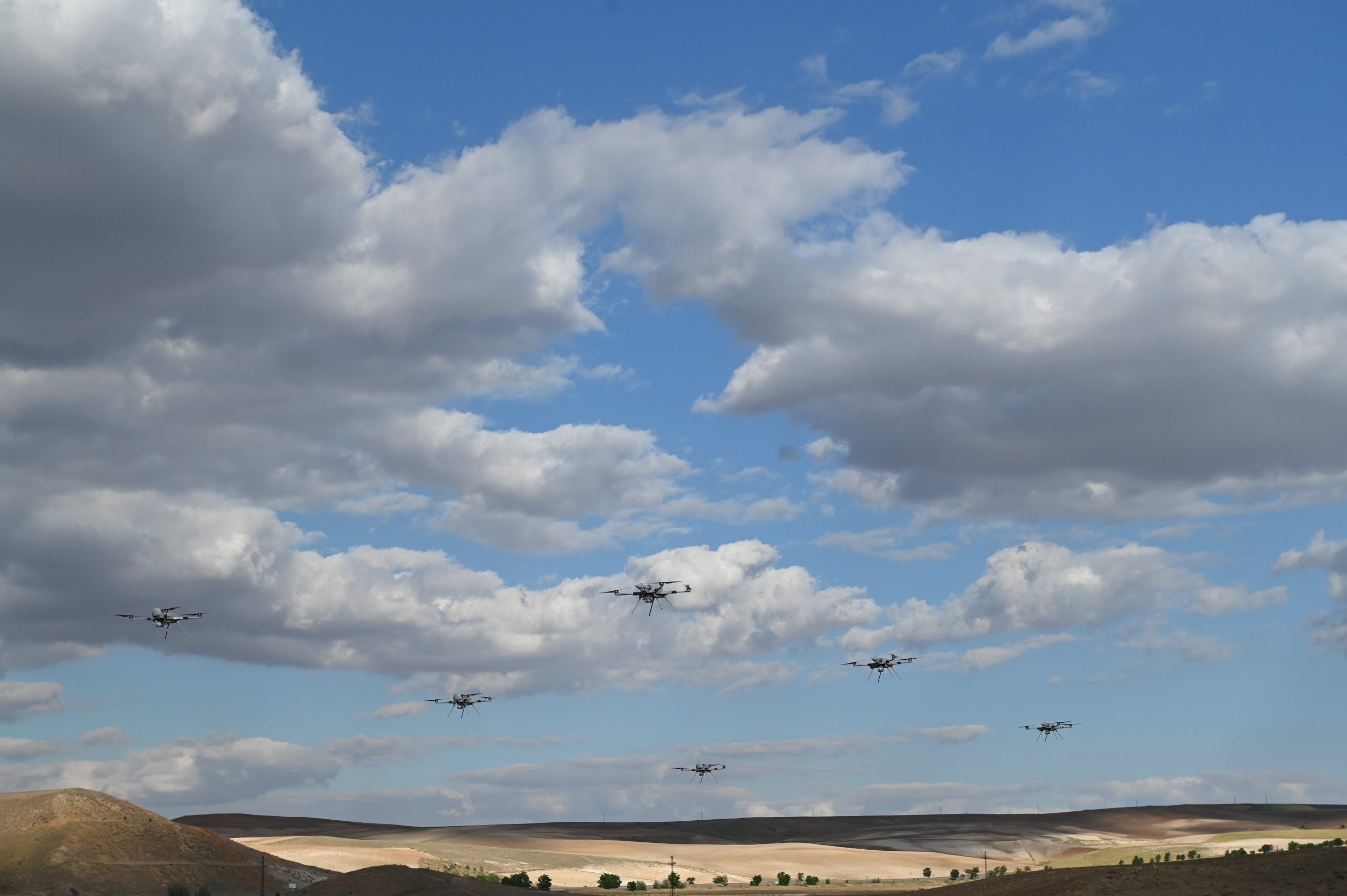
The clearest marker is STM’s live-fire trial announced on 27 January 2026. According to the company, 20 KARGU rotary-wing loitering munitions took off together, navigated to the mission area on their own and split into three sub-groups, each assigned to a separate target. On a single operator command, the sub-groups attacked at the same time. The drones carried anti-personnel warheads, and STM reported direct hits.
The test was held at the General Nahit Şenoğul firing and training area in Polatlı, Ankara. STM said the head of the Presidency of Defence Industries (SSB), Haluk Görgün, and senior Land Forces officers watched it, and that the capability was rated highly by the command authorities. That is the company’s account, reported by defence outlets, and no independent data on hit accuracy has been published.
The earlier step was quieter. In July 2025, during IDEF, STM released footage of six KARGU drones flying a coordinated attack. Three carried anti-personnel warheads and went for a group of mock personnel. Three carried armor-piercing warheads and went for a mock vehicle. The jump from six to twenty, and from mock targets to live detonations, took about six months.
The airframe is not new. KARGU is STM’s rotary-wing loitering munition, already sold abroad, and our profile of how KARGU reached export markets covers that record. What changed is the software layer on top of it.
| Item | STM KARGU swarm (company claims) |
|---|---|
| Developer | STM |
| Platform | KARGU rotary-wing loitering munition |
| Live-fire test | 27 January 2026 announcement, 20 drones, Polatlı, Ankara |
| Control concept | Distributed, no central control unit; one operator for the group |
| Payloads in tests | Anti-personnel (20-drone test); mixed anti-personnel and armor-piercing (2025 six-drone demo) |
| Stated navigation aids | CRPA-enhanced navigation, GNSS-denied navigation with KERKES integration |
How Does a Swarm Without a Leader Work?
STM’s description of the architecture is specific. Each drone shares target data with the others, takes part in task allocation and can decide for itself. There is no central command node to jam or destroy. If one drone fails or is shot down, the rest redistribute the work. Drones can be added to or removed from the group in flight, and the group can split into sub-swarms and later rejoin.
The listed functions include autonomous formation control, collision avoidance, real-time target detection and classification, target prioritization, and matching payload type to target type. That last point matters operationally: a mixed swarm can send armor-piercing munitions at a vehicle and fragmentation warheads at troops without a human assigning each one.
STM calls the intended effect a saturation attack. The logic is arithmetic. A short-range air defence gun, a jammer or a squad with rifles can only deal with so many incoming objects at once. Twenty cheap drones arriving from several directions stretch that capacity far more than one drone ever could.
The cost side is just as blunt. A defender who spends an interceptor missile or a burst of expensive gun ammunition on each small drone loses the economic exchange even while winning the engagement, which is why swarm tactics keep drawing attention from air defence planners.
Is HAVELSAN Building the Same Thing?
Not quite. HAVELSAN’s pitch is software that can sit on any platform. The company has worked on its “Digital Troops” concept since 2019, and an early test had UAVs operating around its BARKAN unmanned ground vehicle under swarm software, returning without remote control. The stated next step was adding unmanned naval platforms.
More recently HAVELSAN demonstrated a swarm of POYRAZ quadcopters in a live field activity in front of senior civilian and military officials, according to Army Recognition’s reporting. The scenario included kamikaze-style attack profiles, simultaneous engagement of several targets and deliberately simulated communication interruptions. Malfunctioning drones reportedly left the swarm without operator intervention while the others continued. A BULUT vertical take-off UAV with an electro-optical payload supplied imagery, which is the sensor-plus-expendable-effector pairing that defines many current swarm concepts.
One detail is worth noting. HAVELSAN says munition activation stays bound by predefined mission rules and safety conditions. That is a hint that the firms know the regulatory and ethical questions are coming. For background on the company, see our HAVELSAN company profile.
Are Swarms Only for Small Quadcopters?
No, and this is where the picture widens. Three other efforts show the same idea at different scales.
- At sea. In 2023 ASELSAN’s kamikaze ALBATROS-S unmanned surface vessels, in a group of eight, attacked a target ship detected by a Bayraktar TB2 near Mersin. One vessel carrying Roketsan-produced munitions hit and sank it, according to Turkish and defence press reports. It was billed as a joint USV-UAV swarm attack.
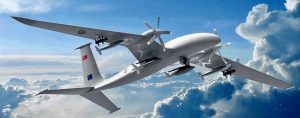
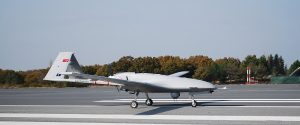
- In the air, with a crew. In May 2026 Baykar and Italy’s Leonardo completed the first live trials of K-SWARM, a crewed-uncrewed teaming concept. A Bayraktar KIZILELMA took off autonomously, joined an M-346 jet and then flew under the direct control of the M-346’s two-person crew, executing formations, separations and rejoins. Baykar’s Smart Fleet Autonomy algorithms handled the flying, and Leonardo’s GCC Tactical Platform protected the data exchange. Human pilots kept full decision-making authority, per Quwa’s report. Our KIZILELMA programme guide has the platform itself.
- Across domains. CTech has introduced a hybrid satcom link aimed at Turkish USV swarms, a reminder that communications, not airframes, are often the limiting factor. We covered it in CTech Unveils Hybrid Satcom Link for Turkish USV Swarms.
What Stands Between a Demo and Doctrine?
Several things, and the companies themselves would agree with most of them.
Repeatability. One successful trial under observation is not a service-wide capability. Armies need the same result in rain, at night and against an opponent that is jamming. STM cites CRPA antennas and GNSS-denied navigation; HAVELSAN cites simulated link losses. Neither is a substitute for field trials against live electronic warfare.
Endurance and payload. Quadcopter effectors have short range, limited loiter time and sensitivity to wind. They suit tactical, short-range problems. Longer-range swarms need different airframes, which is partly why the KIZILELMA teaming work matters.
Rules for autonomy. STM describes a single operator issuing the attack command, while HAVELSAN says engagement runs without operator intervention inside predefined mission rules. In both cases the drones handle routing and allocation. Where exactly that line sits, and how it is audited, will shape whether buyers and allied governments accept these systems.
The defender’s answer. Turkish industry is selling the counter as well. KORKUT, ASELSAN’s electronic warfare systems and interceptor drones are all aimed at this threat, and our piece on how Türkiye turned the drone threat into an export product line explains the other side of the ledger. Swarm and anti-swarm are being developed in the same ecosystem.
Who Else Could Join the Swarm Race?
STM and HAVELSAN are not the only Turkish firms with autonomy work. Baykar runs its own autonomy lab, ASELSAN has its naval swarm, and smaller companies are pushing kamikaze designs of their own. For the wider field beyond the best-known names, see who else builds Türkiye’s drones besides Baykar.
The practical test over the next year is procurement. If the Land Forces order swarm-capable KARGU batches or HAVELSAN’s software goes into a funded programme, the subject moves from demonstration to doctrine. Until a contract or an exercise report says so, the honest description is a fast-maturing capability with strong company claims and thin independent verification.