Erdoğan Pitches Deeper US Defence Ties at UN Gala

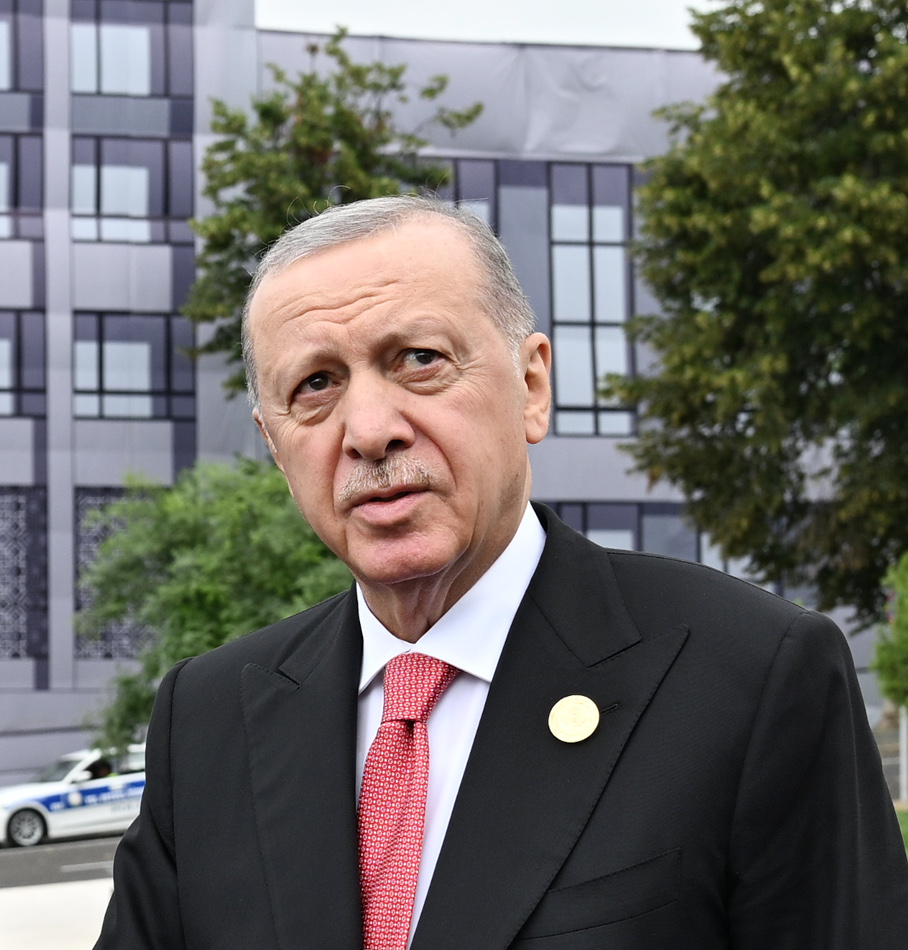
President Recep Tayyip Erdoğan used a gala marking a century of Turkish-American diplomatic ties to make the case for deeper defence industrial cooperation with Washington, telling business leaders in New York that Turkish firms have “reached a level that enables them to invest in the United States” and predicting Türkiye will soon rank among the world’s top ten defence exporters.
Erdoğan spoke on 21 September at the “100 Years of Friendship: Türkiye-United States” gala, held on the sidelines of the 81st session of the UN General Assembly. The event was organised by the US Chamber of Commerce and the US-Türkiye Business Council and hosted by council chairman Hamdi Ulukaya. Foreign Minister Hakan Fidan, Treasury and Finance Minister Mehmet Şimşek, Trade Minister Ömer Bolat, Energy Minister Alparslan Bayraktar and Industry and Technology Minister Mehmet Fatih Kacır were among the Turkish officials in attendance.
“Barriers That Should Never Have Existed”
The Turkish president’s language was pointed. “We want to gain new momentum by leaving behind the barriers that should never have existed between the two allies in the first place,” he told the gathering, according to Turkish state broadcaster coverage of the event. He added that he hoped the alliance would “grow even stronger in the second century of our diplomatic relations.”
On defence specifically, Erdoğan called it “traditionally one of the strongest areas of our Türkiye-US partnership” and said cooperation needed to advance “both bilaterally and within NATO.” He went further than the usual diplomatic language on trade, telling the room that “deepening our cooperation with the United States in a multidimensional manner, including opportunities for joint production, will be in our mutual interest.” He also set out a target of $100 billion in bilateral trade, alongside cooperation in nuclear energy, LNG, civil aviation and high technology.
Erdoğan framed Türkiye’s defence-export growth as a credibility marker in that pitch: exports that stood at roughly $248 million two decades ago have grown to more than $10 billion annually today, he said, a trajectory he used to argue Turkish companies are now capable partners rather than junior suppliers. That growth has been driven overwhelmingly by a domestic supply chain built to route around ITAR and other foreign licensing controls — the same independence that now gives Ankara room to negotiate joint production with Washington from a position of relative strength rather than dependency.
Why the Timing Matters
The remarks land at a genuinely more favourable moment for US-Türkiye defence ties than at almost any point since 2019, when Ankara’s purchase of Russian S-400 air-defence systems triggered CAATSA sanctions and Türkiye’s removal from the F-35 programme. In July, Turkish Aerospace chief executive Mehmet Demiroğlu confirmed that Washington had cleared export licences for the General Electric F110 engines needed to move the KAAN fighter programme into serial production — 80 engines, on top of ten already delivered for prototypes, with first deliveries expected in 2027. Congress let the mandatory review window close on 9 July without blocking the sale, a decision tied in part to signals from the Trump administration that it was open to revisiting aspects of the post-S-400 restrictions.
The KAAN fleet is meant to fly on the imported F110 until Türkiye’s indigenous TF35000 engine, still in development, becomes available around 2032 — which is itself a reason Ankara has an interest in normalising the relationship rather than pursuing engine independence at any cost.
Other threads point the same way. Turkish pilots began flight training on Eurofighter Typhoon jets in the United Kingdom this month as part of an £8 billion procurement unrelated to Washington, but which underscores how far Türkiye’s air force modernisation has continued regardless of the F-35 freeze. Meanwhile the reopening of Saudi Arabia’s own F-35 file over the summer has revived debate in Ankara over whether a similar opening could eventually apply to Türkiye — a question this publication has examined in detail — though nothing announced at the New York gala moves that specific question forward.
An Aspiration, Not Yet a Ranking
Erdoğan’s “top ten” ambition should be read as a target rather than a current standing. Türkiye’s own Defence Industry Agency (SSB) put the country at 11th place among global defence exporters as of a separate briefing days earlier in Denizli, with trailing twelve-month exports of roughly $11 billion — a figure broadly consistent with the president’s “more than $10 billion” but measured over a different period and by a different institution. Neither figure was accompanied by a breakdown of which markets or platforms are driving the growth, and no new contract, licence or company-specific deal was announced at the gala itself. What the event delivered was a political signal: an explicit Turkish offer to shift the defence relationship from case-by-case licence approvals toward structured joint production, at a moment when Washington has just shown some willingness to loosen a five-year-old bottleneck.
For companies such as Turkish Aerospace, TEI and ASELSAN, “joint production” with US partners would mark a step change from the current pattern of licensed components and case-by-case export approvals. Whether that materialises will depend less on gala rhetoric than on how Congress and the Pentagon treat the next set of licence requests — starting with whatever follows the F110 approval, and on whether Washington eventually revisits the stalled T-70 Black Hawk co-production line, the last major US-Turkish joint manufacturing effort still waiting on clearer footing.
Sources
- Anadolu Agency, “Türkiye and US must leave behind barriers, ‘gain new momentum’ in relations: President Erdogan,” 21 September 2026
- Daily Sabah, “Erdoğan calls for new momentum in ties with US,” 21 September 2026
- Middle East Monitor, “Erdogan: Turkey emerges as global defence player,” 22 September 2026
- Breaking Defense, “Turkish Aerospace CEO: US cleared KAAN fighter engines for export,” 22 July 2026