How ASELSAN’s İHTAR Finds, Identifies and Jams Small Drones

Small drones are cheap, quiet and easy to hide behind clutter, which makes them a poor match for a missile battery. ASELSAN’s İHTAR anti-drone system is built for the opposite end of the problem. It does not try to shoot a quadcopter out of the sky with a million-dollar interceptor. It finds the drone, identifies it, and cuts the link that keeps it flying.
The idea is layering. A radar spots the target, cameras confirm what it is, and a jammer or other effector deals with it. This article walks through how the pieces fit, what ASELSAN has said publicly about them, and where İHTAR sits in the company’s wider counter-UAS family.
| Item | Detail |
|---|---|
| System | İHTAR (written iHTAR in some English sources) counter-UAS system |
| Manufacturer | ASELSAN, Türkiye |
| Role | Detection, classification and soft-kill of mini and micro UAVs |
| First shown | IDEF 2019, Istanbul, according to Janes |
| Developed with | Presidency of Defence Industries (SSB) and the Turkish armed forces, per Janes |
| Sensors | Radar, electro-optical (TV and thermal) cameras, optional acoustic detection |
| Effectors | RF jamming; hard-kill and directed-energy options can be linked in |
| Configurations | Fixed site, vehicle-mounted or platform-integrated |
What does İHTAR actually do?
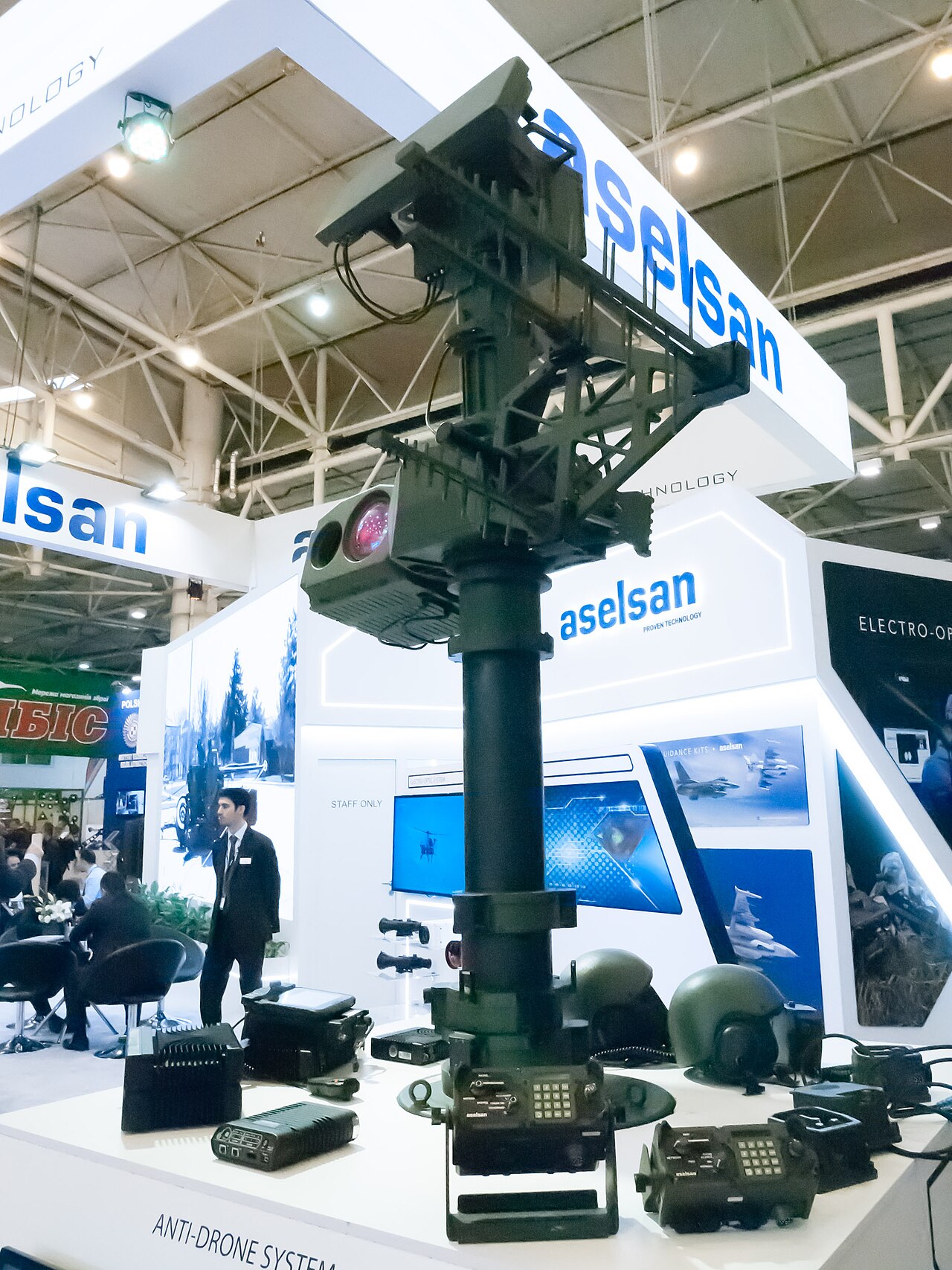
ASELSAN describes İHTAR as a modular architecture for neutralising mini and micro UAV threats in urban and rural settings. On its product pages the company lists AESA radar, AI-assisted decision algorithms, TV and thermal cameras for recognising threats at distance, and programmable jamming as the core of the package.
Janes, writing from IDEF 2019 where the system broke cover, described a mast-mounted sensor head carrying a primary radar called ACAR, a secondary radar, an electro-optical sensor and a directional jammer, with an optional acoustic direction finder for rural use. The same report said the system can be networked across several units to cover a wider area.
The design brief, according to Janes, came from drone threats faced by Turkish forces in operations in the southeast and from the need to protect civilian sites such as airports.
How do the sensors find a drone that barely shows up on radar?
A hobby quadcopter has a tiny radar cross-section and flies slowly, so a conventional air-defence radar tends to filter it out as clutter. Counter-UAS radars use pulsed Doppler processing and track-while-scan modes tuned for that kind of target.
A sponsored ASELSAN feature published by Australian Defence Magazine describes İHTAR’s radar as the Ku-band AURA 100-G, with 360-degree surveillance, multi-target tracking and a publicly stated detection range of up to 5 km against defined targets. Turkish press coverage of the DRONEDEF demonstrations, by contrast, has described the ACAR surveillance radar with a 40 km range as part of the set. The two figures refer to different radars and different target definitions, so treat any single range number with care.
Radar alone cannot say whether a track is a drone, a bird or a friendly aircraft. That is the job of the electro-optical head. Day and thermal cameras, with automatic video tracking, let the operator confirm the target before anything is jammed. For quiet rural terrain, ASELSAN’s SEDA 100-cUAV acoustic detector, introduced in November 2024 and described as part of İHTAR, adds microphones that pick up the sound of rotors.
How does the jammer stop a drone?
Most small drones depend on a radio link to their pilot and on satellite navigation to know where they are. Break either and the aircraft typically lands, returns home or drifts.
ASELSAN says İHTAR’s jammer uses programmable digital frequency synthesis against the command links and navigation signals of remote controls, radios, GNSS receivers, Wi-Fi, ISM bands and GSM, 3G and 4G/LTE networks. Turkish reports name the radio-frequency countermeasure unit as GERGEDAN. It can run in directional or omnidirectional mode, which matters because a directional beam reduces collateral interference near an airport or a city.
The same family includes narrower tools. ASELSAN’s November 2024 announcement listed BUKALEMUN, a GNSS spoofing system that feeds false positions to a drone’s navigation instead of simply blocking it, and KANGAL-FPV, a jammer aimed at first-person-view drones across the electronic warfare spectrum.
Where does İHTAR fit in a layered counter-drone defence?
Jamming is the cheapest layer, but it has limits. It does little against a drone flying a pre-programmed route with no radio link, or one guided over a fibre-optic cable. ASELSAN’s answer is to plug İHTAR into harder-hitting effectors.
The company’s product page says the system can be integrated with KORKUT 25, ŞAHİN Lite/Dual 40 mm and MİĞFER weapon systems on the hard-kill side, and with the EJDERHA high-power electromagnetic system and the GÖKBERK laser on the directed-energy side. The Turkish press has grouped these under the DRONEDEF label.
That chain was on show on 6 June 2026 in Ankara, according to Armada International, in a live demonstration for delegations from 20 countries. İHTAR reportedly handled wirelessly controlled drones approaching from different directions, with a stated detection range of 10 km. GÖKBERK was reported to have destroyed a fibre-optic-controlled drone, and EJDERHA to have neutralised two fibre-optic drones flying in swarm formation. The AURA 200-G radar and a unified command-and-control centre tied the layers together. These are ASELSAN’s demonstration results as reported, not independent test data.
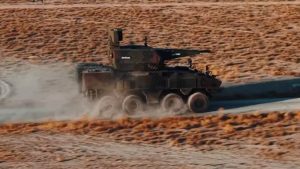
The same logic applies at sea and on armoured vehicles. ASELSAN’s sponsored feature positions İHTAR as the soft-kill layer beside kinetic systems such as KORKUT and GÖKDENİZ. Readers who want the gun side of that picture can see our look at ASELSAN’s KORKUT 35 taking on drones.
Who has bought or fielded it?
Anadolu Agency reported in April 2023 that ASELSAN had begun exporting İHTAR, with contracts for Angola, Kyrgyzstan, Niger and the Turkish Republic of Northern Cyprus. The same report said earlier contracts covered protection of the Presidential Complex in Ankara, and that three more, for the TÜPRAŞ and TPAO oil refineries and the Akkuyu Nuclear Power Plant, were due for delivery in 2023. Those are company-sourced statements; contract values were not published.
Protecting fixed infrastructure is where a sensor-plus-jammer package earns its keep. A refinery or airport needs a permanent umbrella that can tell a hostile drone from a stray one and respond without firing a weapon near fuel tanks. ASELSAN’s own list of intended uses includes nuclear plants, refineries, border security and large public events.
ASELSAN has kept pushing the wider counter-drone range at export shows. Our coverage of the MSPO 2026 counter-drone and EW display shows how İHTAR-type systems are now sold alongside electronic warfare suites, and the broader Turkish counter-drone export story covers the other domestic players.
How does it compare with other Turkish counter-drone tools?
İHTAR is not Türkiye’s only answer. Roketsan’s ALKA pairs a jammer with a laser in a single weapon, which is a different packaging of the same soft-plus-hard idea. ASELSAN’s approach is to keep sensing and jamming in one core system and let customers bolt on guns, lasers or microwaves as budgets allow.
That modularity is the selling point, and also the thing to check in any contract. A bare İHTAR gives detection and electronic defeat. What happens against a fibre-optic or autonomous drone depends on which additional effectors the buyer adds.
The electronic warfare know-how behind the jammer sits within the company’s broader electronics business, described in the ASELSAN company profile.
What is still unclear?
Several details remain unpublished or inconsistent. ASELSAN has quoted different detection ranges across materials, depending on radar variant and target size. Effective jamming radius, number of simultaneous engagements and false-alarm rates are not given in the sources reviewed. The number of fielded systems and total export value are also not public.
What can be said with confidence is the architecture: radar to find, optics to confirm, jamming or spoofing to defeat, and open interfaces to heavier weapons. As small drones and fibre-optic variants spread, that sequence is likely to matter more than any single sensor figure.