
ASELSAN’s GÜRZ Air Defence System Passes First Live-Fire Test


ASELSAN’s GÜRZ hybrid air defence system carried out its first live-fire field activity on September 5 at the Sinop Test Center on Türkiye’s Black Sea coast, successfully detecting, tracking and engaging an aerial target with a GÖKSUR interceptor missile. The company announced the results two days later, and General Manager Ahmet Akyol said the programme has now moved from development into “a real product,” with entry into Turkish Armed Forces inventory planned for 2027.
GÜRZ is the newest element of Çelik Kubbe (“Steel Dome”), Türkiye’s layered national air defence architecture, and it is designed to close a specific gap: a single vehicle capable of countering everything from small drones to low-flying aircraft at short range, without handing off between separate gun and missile systems.
What Was Tested
According to ASELSAN and Turkish reporting on the September 5 trial, the field activity validated the system’s four-faced AESA search radar, a separate fire-control radar, electro-optical sensors and the data-link guiding GÖKSUR missiles fired from the platform. The GÖKSUR round performed evasive-target-style manoeuvres during its flight profile and tracked its intended course successfully, according to Turkish defence outlets covering the test. ASELSAN has not released engagement range, intercept altitude or the specific target type used, and DefenceTürkiye has not been able to independently verify those figures — they should be treated as undisclosed until ASELSAN publishes technical data.
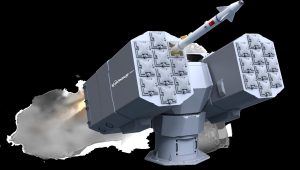
GÜRZ mounts its sensors and weapons on a single 6×6 or 8×8 truck chassis. The configuration combines a 35mm air-defence gun firing ATOM airburst, high-explosive-incendiary and target-practice ammunition families with two batteries of short-range missiles — four very-low-altitude interceptors and four low-altitude interceptors — alongside the radar and electro-optical suite. That gun-plus-missile combination on one vehicle is the system’s core design idea: it lets a single crew respond to a fast-moving drone swarm with the cannon and a faster or higher-flying threat with a missile, without waiting for a second vehicle to arrive on station.
Where GÜRZ Fits
Steel Dome is built in layers, and ASELSAN has been fielding pieces of it in public view over the past year. SUNGUR covers the shortest-range, man-portable-missile layer. KORAL II handles electronic warfare and radar jamming rather than kinetic intercepts. GÜRZ slots in as a mobile, vehicle-mounted layer meant to protect manoeuvring army formations and fixed points against the mixed threat of loitering munitions, small drones and low-flying aircraft that Turkish and other forces have faced in recent conflicts — the same threat picture that has pushed European armies toward similar gun-missile hybrid systems, such as Germany’s Skyranger and France’s Serval-based short-range air defence programmes.
The September 5 test was not GÜRZ’s first public appearance — ASELSAN had already shown a serial-production-configuration example of the system at SAHA Expo 2026 — but it is the first time the system has fired a live missile against an aerial target, which is the milestone that actually matters for a programme moving toward service entry. A field test validates radar detection and missile guidance under real flight conditions in a way a static exhibition display cannot.
Why It Matters Beyond Türkiye
GÜRZ is, for now, a domestic Turkish Armed Forces programme with no announced export customer. But its individual components carry export relevance on their own: ASELSAN has already sold pieces of the broader Steel Dome family, including counter-drone and electronic warfare systems shown at MSPO 2026 in Poland this week, and GÖKSUR itself completed its first live-fire naval intercept test against a sea-skimming target in October 2025. A vehicle-mounted short-range air defence system with a validated missile-and-gun combination is exactly the kind of product NATO armies rebuilding ground-based air defence after years of underinvestment are currently shopping for — a market that has also drawn German, French and South Korean systems in the past two years.
ASELSAN’s Akyol tied the September 5 result directly to that inventory timeline, describing GÜRZ as having moved past prototype status. Until the system completes qualification and enters Turkish service in 2027, its performance figures — range, kill probability, reaction time — remain unpublished, and any claims about how it compares to Western equivalents should wait for that data.
Background: Çelik Kubbe
Türkiye launched the Çelik Kubbe programme to knit together its existing and in-development air defence systems — from SUNGUR at short range up through HİSAR and SİPER at progressively longer ranges — into a single integrated, layered shield, drawing lessons from drone and missile threats observed in the region. GÜRZ’s role is to plug the mobile, close-in gap in that architecture that fixed-site systems cannot cover, protecting armoured formations and forward bases on the move rather than static installations.
ASELSAN has not disclosed a production quantity or contract value for GÜRZ’s initial Turkish order. DefenceTürkiye will update this story as further test data or procurement details become public.

[…] ASELSAN’s GÜRZ Air Defence System Passes First Live-Fire Test […]