Otokar’s TULPAR Has Export Interest and a Gun, but No Army Contract

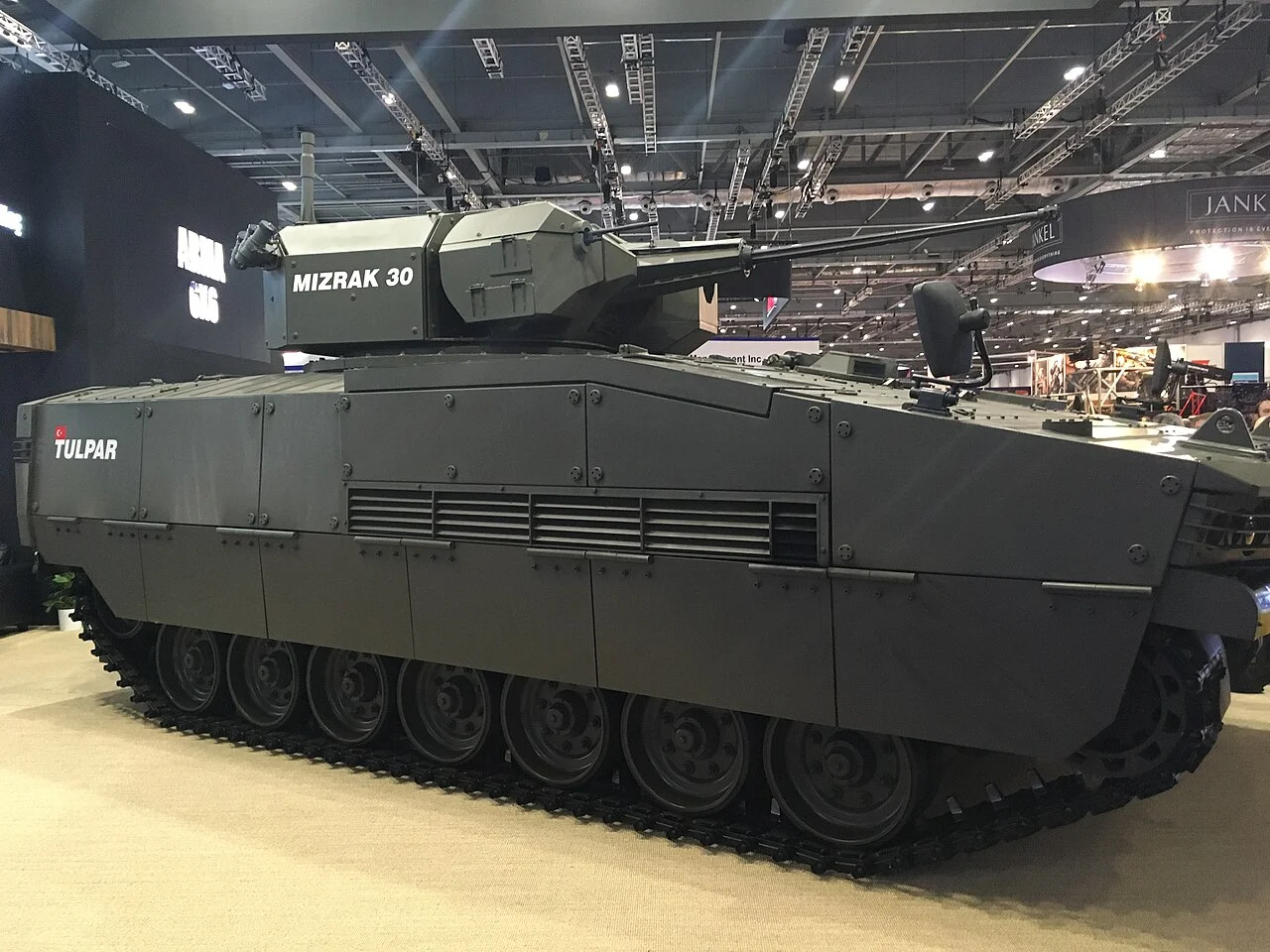
Otokar’s TULPAR has now fired a 120mm gun, drawn interest from Brazil and Kazakhstan, and sat through more than a decade of Turkish procurement talk. What it has not received is a large Turkish Land Forces contract. That gap between technical progress and a signed order is the real story of the programme in late 2026.
Most coverage of the latest trials focuses on the gun. This piece looks at the other side: what the Turkish requirement actually is, who else is competing for it, and why export customers may end up shaping the vehicle before the army does.
| Item | Detail |
|---|---|
| Manufacturer | Otokar (Koç Group) |
| Type | Tracked infantry fighting vehicle chassis, also offered as a light or medium tank |
| First public showing | IDEF 2013, as an infantry fighting vehicle |
| Weight | Roughly 28 to 45 tonnes depending on armour and equipment, as reported |
| Turret options shown | CMI Defence 3105 with 105mm gun (2018); Leonardo HITFACT MkII with 120/45mm gun (2026 trials); Otokar MIZRAK for the IFV role (reported for Brazil) |
| Turkish service status | No large-scale Land Forces procurement announced |
What is the TULPAR, exactly?
TULPAR began as an answer to a Turkish infantry fighting vehicle requirement. Otokar developed it in parallel with the ALTAY main battle tank, with the same design team involved, and showed it at IDEF in 2013. It carries its name from the winged horse of Turkic mythology.
The base vehicle has been described with a three-person crew plus a squad of troops, a Scania diesel in the 800 hp class and a 30mm cannon in the original IFV form. Published figures vary by source and by configuration, which is normal for a platform that has been shown in several guises. Weight is the clearest example: figures run from the low 30s of tonnes up to around 45 tonnes with heavier armour kits.
The chassis idea is modular. The same hull can take an IFV turret, a 105mm light-tank turret or, as now demonstrated, a 120mm turret. Otokar pitches that flexibility to buyers who want one tracked family rather than separate tank and IFV fleets.
How did the light tank version come about?
Otokar put the TULPAR light tank in front of the public at Eurosatory 2018 in Paris. That version used a CMI Defence 3105 turret with a 105mm gun, an autoloader and a two-person turret crew, with Falarick anti-tank missiles listed as an option. Otokar’s general manager argued at the time that light tanks matter where heavy main battle tanks cannot go, such as bridges with weight limits or dense urban terrain.
The reasoning was straightforward. The Turkish army needed tracked fighting vehicles. Export buyers wanted something between a wheeled gun system and a 60-tonne tank. The same hull served both audiences.
The company’s wider export record, covered in our look at how Otokar built its armoured vehicle export business, shows why it chased this logic: its wheeled and tactical vehicles already serve customers across several continents, and a tracked product extends the catalogue upward.
What did the September 2026 trials show?
Otokar and Leonardo reported that they completed integration work and live-fire trials of the TULPAR with the HITFACT MkII turret and its 120/45mm smoothbore gun. The firing took place at the UTTAT Nettuno range near Rome, in static and moving conditions, according to published accounts of the companies’ announcement. The work covered mechanical, electrical, electronic and software interfaces between hull and turret.
The companies said all planned objectives were met. One defence outlet noted that no independent accuracy data, recoil measurements, ammunition details or round counts were published. That is a fair caution. A successful integration firing shows that a turret and a hull work together. It is not a full qualification against an army’s requirements, and it says little about endurance, reliability or crew workload.
We covered the test itself in more detail in our report on the live-fire result. The question here is what it changes for the Turkish order, and the honest answer is: very little directly.
Where does the Turkish Land Forces requirement stand?
The tracked requirement sits in a programme usually described as New Generation Light Armoured Vehicles. According to Shephard Media’s programme tracker, the tracked element covers about 1,800 vehicles, with an award year of 2027 and first deliveries projected for 2029. Those are analyst estimates, not an official SSB timetable. The tracker lists FNSS, with its Kaplan 20 NG-AFV, and Otokar, with the TULPAR, as the expected bidders.
The same source reports that at SAHA 2026 both companies declined to comment on the programme, which it read as a sign of little visible progress since the requirement was announced. An earlier Request for Proposal date in 2019 and a long list of slipped milestones fit that reading. Earlier trade reporting also spoke of Turkish IFV numbers in the hundreds, such as 400 or 700 vehicles, so the quantity itself has moved over the years. No figure should be treated as settled.
Two things stand out. First, Turkish officials have not announced a TULPAR order. Second, the competitor is a domestic one: FNSS has its own tracked family and its own export pipeline, described in our profile of FNSS and its exports. A single large contract may well be split or structured to keep both firms in the game, but that is speculation until SSB says otherwise.
Why might the army be in no hurry?
Several reasons can be named without guessing at internal decisions. Budgets are stretched across air defence, drones, naval programmes and the ALTAY tank, whose own delivery and engine questions are tracked in our ALTAY programme overview. A 1,800-vehicle tracked fleet would be a very large commitment. And the army’s operational priorities in recent years have leaned toward wheeled and mine-protected vehicles, drones and long-range fires.
These are context points, not stated reasons. Neither Otokar nor the procurement agency has explained the timing publicly.
Who else wants the TULPAR?
Export interest is where the platform is moving. Kazakhstan reportedly included a TULPAR-based light tank with the Leonardo 120mm turret in a 2026 localisation roadmap for the Besqaru facility, alongside plans for wheeled vehicles derived from Otokar designs. Reports from Kazakh and regional outlets describe production as planned, not as delivered. Treat dates as intentions.
Brazil is the second case. Otokar has offered tracked TULPAR variants to Brazil’s armoured forces modernisation effort, with a light-tank version carrying the HITFACT MkII turret and an IFV version possibly carrying Otokar’s MIZRAK turret. The reported Brazilian powertrain would use a Caterpillar C13-series diesel and an Allison automatic transmission, chosen partly to avoid US ITAR restrictions on the engine and gearbox. Brazil reportedly weighs the TULPAR against the Rheinmetall Lynx, BAE Systems CV90 and GDELS ASCOD, with deliveries discussed for the late 2030s. Our report on the Türkiye and Brazil defence agreement covers the diplomatic framework around that kind of deal.
Bangladesh has also been named in reference works as an interested party. Those mentions are older and thinner than the Kazakh and Brazilian reporting, so we leave them at that.
Does export success need a home order first?
Often it does. Buyers ask who already uses a vehicle, and a lack of a launch customer at home complicates sales talks. Turkish firms have partly answered this through speed and price, a pattern we examined in why countries buy Turkish armoured vehicles. They also offer local production, which is exactly what Kazakhstan’s plan and the Brazilian offer involve.
Otokar’s bet looks like this: prove the hull accepts a real 120mm turret, sign a foreign production partner, and let the Turkish army follow once the platform has a track record. It may work. The risk is that tracked vehicle programmes live and die on a home-country order, and the tracked contract is still unannounced.
What should readers watch next?
- Any SSB announcement of a competition or selection for the tracked light armoured vehicle requirement.
- Independent test data on the 120mm configuration, including accuracy, recoil and endurance results.
- A signed contract or industrial agreement from Kazakhstan, as opposed to a roadmap.
- Brazil’s shortlist decision among the four reported competitors.
Until one of those lands, TULPAR remains a capable demonstrator with credible export talks and no confirmed Turkish production line.