Why Turkish Missiles Rely on Imaging Infrared Seekers

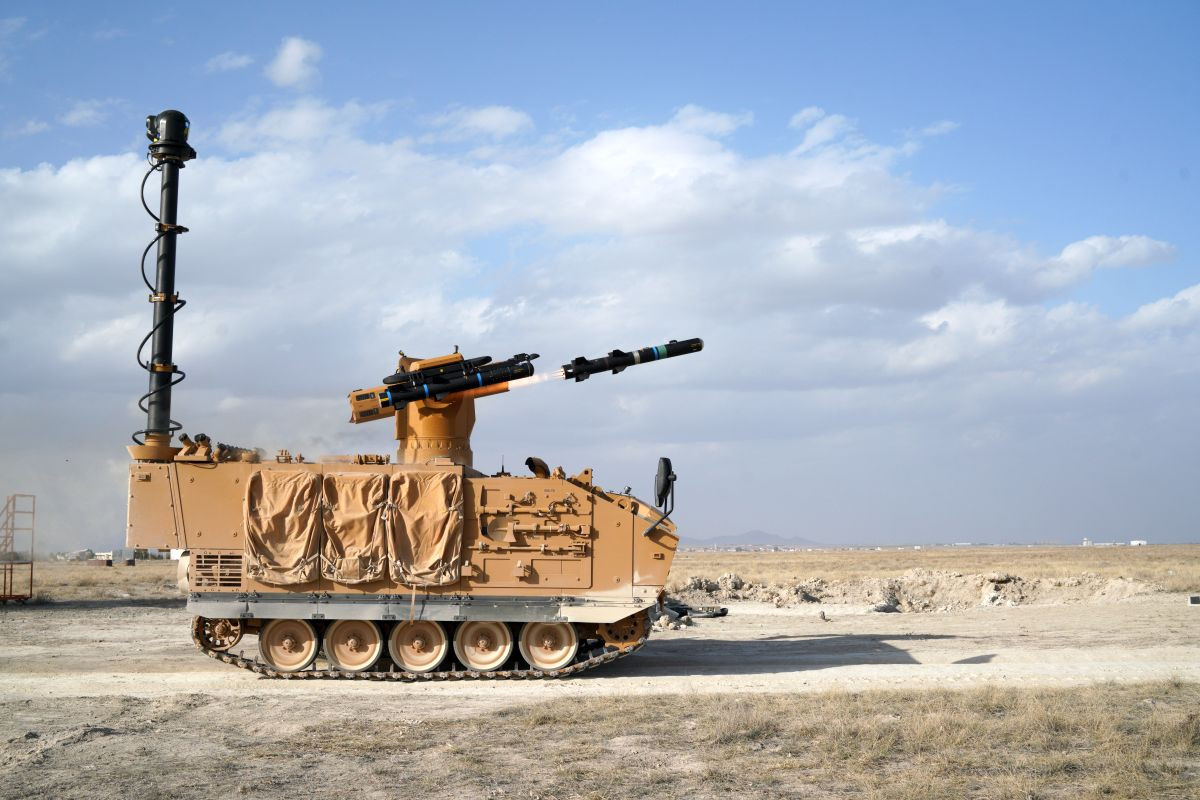
A missile can be fast, long-ranged and carry a heavy warhead, and still miss if the last few seconds go wrong. That final stretch belongs to the seeker, the sensor in the nose that finds the target and steers the weapon into it. In Turkish programmes, one seeker type keeps appearing in the specification sheets: the imaging infrared seeker, usually shortened to IIR.
It shows up in the HİSAR air defence missiles, in the UMTAS and OMTAS anti-tank missiles, in the SUNGUR shoulder-fired missile and in the short-range Bozdoğan air-to-air missile. This article explains what the technology does, why Ankara has invested in it, and where the public record is thin.
What Is an Imaging Infrared Seeker?
Older infrared seekers worked like a single bright-spot detector. They sensed a hot point, typically a jet exhaust, and chased it. That is simple and cheap, but it is easy to fool. A flare burns hotter than an engine, and a basic seeker will often follow the flare.
An imaging seeker uses a detector array, a grid of tiny heat-sensitive elements, much like the sensor in a thermal camera. The missile does not see a point. It sees a shape: wings, a fuselage, a turret, a hull. Onboard processing compares that image against what it has locked onto and keeps tracking the object even when other heat sources appear nearby.
The practical gains are well known across the industry. The seeker can pick a target out of clutter, aim at a particular part of it, reject decoys more reliably, and work at night. It also works without any emitter on the missile, so there is nothing for the enemy to detect or jam in the way a radar seeker can be. The weaknesses are equally standard: thick cloud, rain and dense smoke degrade infrared sensing, which is one reason some missiles pair it with a radio-frequency alternative.
Where Do Turkish Missiles Use IIR Seekers?
| Missile | Role | Seeker as publicly described |
|---|---|---|
| HİSAR-A and HİSAR-O | Low and medium altitude air defence | Inertial navigation and data-link mid-course update, imaging infrared terminal seeker |
| UMTAS | Long-range anti-tank | Imaging infrared with RF data link (Roketsan product page); an earlier version used a laser seeker |
| OMTAS | Medium-range anti-tank | ASELSAN uncooled imaging infrared seeker |
| SUNGUR | Man-portable air defence | Imaging infrared, lock-on before launch (reported) |
| Bozdoğan | Short-range air-to-air | Imaging infrared (reported to be dual-colour) |
The pattern matters more than any single row. A seeker developed for one missile can often be adapted to the next, and the Turkish industry has leaned on that. The detail below sticks to what manufacturers and credible trade press have published.
How Does the HİSAR Family Use One?
HİSAR was developed by ASELSAN and Roketsan under a Turkish procurement contract awarded in 2011. ASELSAN served as the main contractor and handled the launcher, command and control, fire control, search radar and electro-optical elements, while Roketsan was responsible for the missile itself.
The guidance logic is a classic two-step. Early in the flight, an inertial navigation system flies the missile, and corrections reach it by data link from the ground radar. As it closes in, the missile switches on its imaging infrared seeker and homes on the target itself. Public descriptions of HİSAR-A and HİSAR-O both describe this combination, and reporting indicates the ASELSAN-made IIR seeker carried over from the original HİSAR-A to the improved HİSAR-A+.
The reason for the two-step design is physical. An infrared seeker has a limited detection range, so it cannot find a target tens of kilometres away on its own. The data link brings the missile to the right patch of sky, and the seeker handles the last, most precise portion. Reference sources quote a range of roughly 15 km for HİSAR-A+ and 25 km or more for HİSAR-O, with a longer-range RF-seeker variant, HİSAR-RF, reported to have engaged a target at 40 km in 2024.
That last variant is a useful clue about the technology’s limits. An active radar seeker is less affected by weather and can reach further from the nose. The existence of an RF version does not replace IIR so much as complement it, and the family’s layered approach is covered in the site’s overview of the HİSAR missile family.
Why Do Anti-Tank Missiles Need Them?
Tanks and armoured vehicles are warm, but they are also surrounded by hot ground, burning wreckage and decoy smoke. An imaging seeker lets the operator or the missile select the vehicle in the picture and keep it there.
Roketsan describes UMTAS as a 160 mm missile with a range of 0.5 to 8 km, a tandem high-explosive anti-tank warhead, and both direct-attack and top-attack modes. Its seeker is listed as imaging infrared with an RF data link, supporting fire-and-forget and fire-and-update operation. Fire-and-update means the crew can still send a command to the missile in flight, for instance to switch to another target. The product page lists helicopters, light attack aircraft, land vehicles and naval platforms as launchers.
The seeker history is worth noting. UMTAS began with a laser seeker, where a designator illuminates the target and the missile follows the reflection. That ties up the launching platform until impact. The IIR version removes that requirement, which is the whole point of fire-and-forget.
For OMTAS, the smaller medium-range sibling, the public record is more precise. In January 2019, Roketsan signed a contract with ASELSAN for serial production of an imaging infrared seeker for OMTAS, worth about USD 47 million according to Janes, with deliveries running from 2019 to 2024. Janes described the seeker as an uncooled imaging infrared design. The difference between uncooled and cooled detectors is mainly cost, size and warm-up time: uncooled sensors are cheaper and lighter and need no cryogenic cooling. The site has a longer comparison in how UMTAS and OMTAS divide Turkish anti-tank work by range.
What About Shoulder-Fired and Air-to-Air Missiles?
The smaller the missile, the harder it is to fit a sophisticated seeker. SUNGUR is Roketsan’s man-portable air defence missile. Reference material describes an imaging infrared seeker with lock-on before launch and a range of 500 m to 8 km, and puts it in service from 2022. A fuller account is in the site’s SUNGUR guide.
On the air-to-air side, TÜBİTAK SAGE’s Bozdoğan is a short-range missile that is reported to carry a high-resolution dual-colour imaging infrared seeker. Dual-colour sensing, which reads two parts of the infrared spectrum, is generally intended to help the seeker tell an aircraft from a flare. Public detail on Bozdoğan’s seeker supplier and performance is limited, so treat the capabilities as manufacturer-described. The state of the programme is covered in Türkiye’s indigenous air-to-air missiles.
Why Is Seeker Production a Bottleneck?
Seekers are among the hardest components of a guided weapon to scale. They need clean-room assembly, careful calibration and long test cycles. ASELSAN has opened a guided-weapons production centre built around seekers, inertial navigation packages and control electronics, a USD 56 million investment the company framed as a response to order volume. That plant is described on this site in ASELSAN Opens $56M Guided-Weapons Production Plant.
Seeker supply also shapes export behaviour and sovereignty. A country that makes its own missile bodies but imports the seeker still depends on someone else’s export licence. For ASELSAN, the corporate background is in the ASELSAN company profile.
What Is Still Unclear?
Several things are not public. Detector resolution, field of view, lock-on range against different target types and counter-countermeasure performance are normally classified or withheld by the manufacturers. The same is true of the exact share of seekers supplied domestically for each missile, and the numbers produced per year. Anything quoted on those points should be treated as unverified until ASELSAN, Roketsan or the Presidency of Defence Industries confirm it.
What can be said with confidence is the direction. Turkish programmes have moved from importing sensors toward fielding indigenous imaging seekers across anti-tank, air defence and air-to-air roles, and the production capacity is now being built to match.