Where Turkish Sea Drones Fit in the Global USV Market

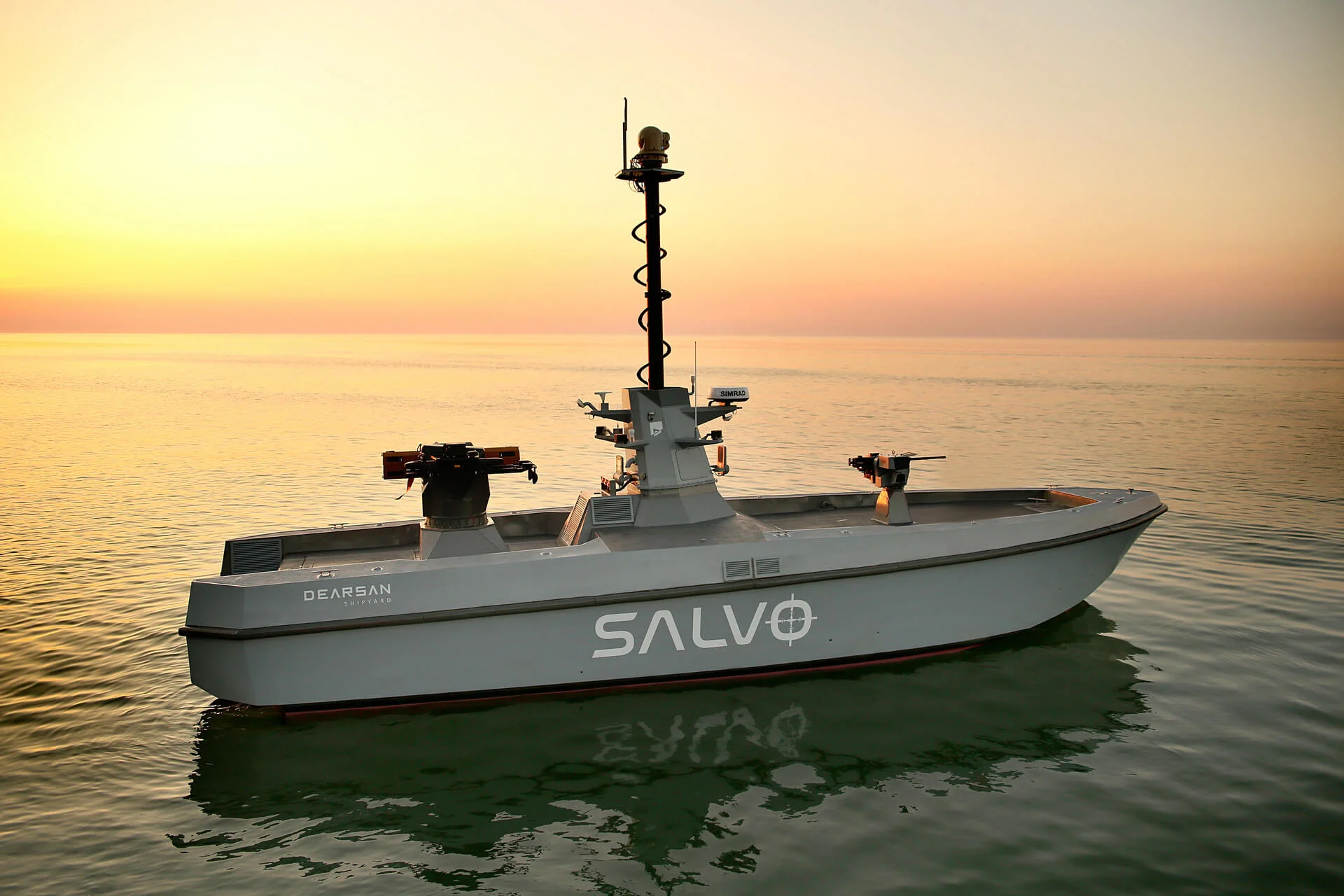
Türkiye has five armed or armed-capable unmanned surface vessel types commissioned into its navy, one confirmed armed-USV export — a single ULAQ 11 for Qatar’s Coast Guard, reported at about $5.85 million — and a domestic decision to buy roughly 100 one-way attack boats. That puts it at the small, cheap end of a market that has split in two. The United States is buying 55-metre medium USVs at about $40 million each. France is still choosing between prototypes. Türkiye sells 8-to-15-metre boats that already exist, already carry weapons and have already been handed to a foreign customer. That is the position. It also has real limits.
DEFENCETÜRKIYE DATA BOX
Segment: Armed and armed-capable unmanned surface vessels (USVs / AUSVs; Turkish: SİDA)
Main Turkish builders: ARES Shipyard + Meteksan Savunma (ULAQ); ASELSAN + Sefine (MARLIN); Dearsan (SALVO); ASELSAN (ALBATROS-S); HAVELSAN + Yonca-Onuk (SANCAR); STM + Yonca (YAKTU)
Types in Turkish Navy service: five distinct USV types, per Naval News — MARLIN, ULAQ, SALVO, ALBATROS-S and SANCAR
First armed-USV export: one ULAQ 11 ISR/PSV to Qatar’s Ministry of Interior; contract signed at Milipol Qatar, October 2024; delivery reported December 2025
Reported contract value: QAR 21.3 million (about $5.85 million) for one vessel, as reported by Janes
Largest domestic order: roughly 100 expendable one-way attack USVs, decided at the February 2026 Defence Industry Executive Committee; value and delivery schedule undisclosed
Known subsystem exports: ASELSAN reported $171 million of Asia-Pacific contracts for USV communications systems and payloads (January 2026)
The market has split by price, not by capability
Three years ago there was no armed USV market to speak of — a handful of navies had experimental hulls and nobody was buying in quantity. Ukraine changed that, and the procurement response has not been uniform. It has forked into price classes that barely compete with each other.
At the top, the US Navy announced on 29 September 2026 that it would buy 30 Medium Unmanned Surface Vessels, with production other-transaction agreements going to Galliano Marine Services, HII and Saronic Technologies at 10 vessels each. The service’s acting portfolio manager for robotic and autonomous systems put the figure at roughly $40 million a hull — more than $1 billion for the batch, as reported by DefenseScoop from the Navy’s release. Saronic’s Marauder, one of the three, is a 180-foot ship. First deliveries are slated before the end of fiscal 2027.
At the bottom sits the expendable tier: boats built to be destroyed on their first mission. Saronic’s 24-foot Corsair is the American entrant here, and while the company holds a $392 million production contract, no official unit price has been published; the figure in circulation, roughly $1 million a boat, is an unofficial estimate and should be treated as one.
Turkish boats sit in the middle — and in the bottom tier too, as of this year.
| Class | Indicative cost per hull | Fielded by |
|---|---|---|
| Medium USV 40–60 m, ship-sized |
~$40 million US Navy figure, Sept 2026 |
United States 30 ordered, none delivered |
| Armed small USV 8–15 m, reusable, weapon station |
~$5.9 million Qatar’s ULAQ 11, per Janes |
Türkiye, Israel, Qatar in service and exported |
| Expendable attack USV 5–8 m, one-way |
~$1 million unofficial Corsair estimate |
Ukraine, United States, Türkiye Turkish order placed 2026 |
| Prototype stage armed USV, in competition |
not yet priced | France, United Kingdom DANAE decision due end-2027 |
Read across that table and the Turkish position becomes legible. Türkiye is not competing with the $40 million medium USV; nobody outside the United States is buying that class yet. It is competing for the navy or coast guard that wants an armed robot boat this year, for low single-digit millions, from a supplier that has already built one for somebody else.
What Türkiye actually has in the water
The claim that matters internationally is not that Turkish industry has designed USVs. Most industrial countries have. It is that the Turkish Navy has commissioned five distinct types and employs them in exercises — which converts marketing into a reference customer.
| Type / builder | Role | Status |
|---|---|---|
| MARLIN ASELSAN + Sefine |
ISR, EW, mine-laying | In service Jan 2024 mine trial Aug 2026 |
| ULAQ ARES Shipyard + Meteksan |
Armed patrol, ISR | In service only exported type |
| SALVO Dearsan |
Armed patrol, ~14.8 m | In service late 2025 |
| ALBATROS-S ASELSAN |
Kamikaze, swarm-capable | In service TB3 strike Dec 2025 |
| SANCAR HAVELSAN + Yonca-Onuk |
Anti-surface, mine warfare | In service Feb 2026 |
One event in that table does more export work than the rest combined. On 4 December 2025, off Antalya, a Bayraktar TB3 launched from TCG Anadolu took remote control of an ASELSAN ALBATROS-S kamikaze USV through its data link and directed it onto a sea target. Naval News reported that military delegations from Italy, the United Kingdom, Spain, Japan and Brazil watched it happen. A carrier-launched drone commanding a robot boat is a capability several larger navies are still writing requirements for, and Türkiye demonstrated it in front of five of them.
For readers who want the platform-level technical detail rather than the market picture, Envanter Medya maintains a Turkish-language technical profile of the Dearsan SALVO and its weapons fit, and a separate piece explaining how unmanned surface vessels differ from unmanned underwater vehicles — a distinction that gets blurred in a lot of English-language coverage of this sector.
The one export, and what it really tells you
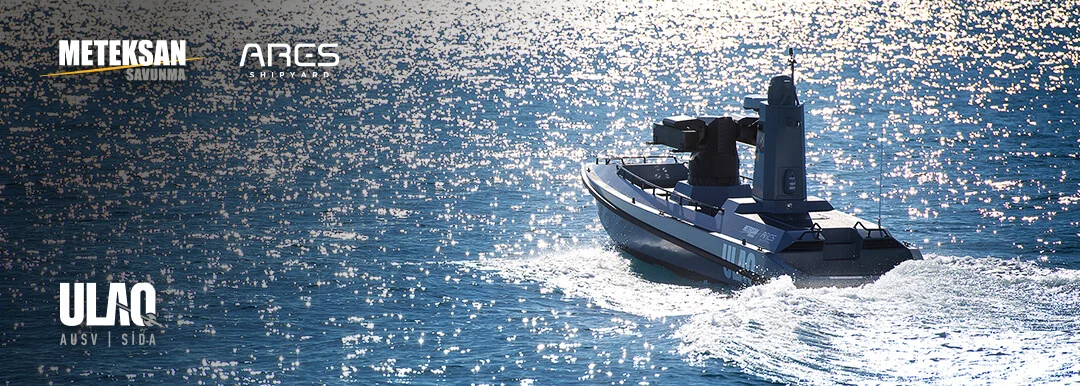
Türkiye’s armed-USV export record is one vessel. That is not a criticism; it is the correct scale for a product category this young, and the detail of the deal is more informative than the headline.
Qatar’s Ministry of Interior signed for a single ULAQ 11 at Milipol Qatar in late October 2024 — a customer ARES Shipyard had already been building crewed patrol craft for. Janes reported the value at QAR 21.3 million, about $5.85 million. The vessel delivered to the Qatar Coast Guard is an ISR and port-security variant fitted with an ASELSAN SARP-DUAL 12.7 mm remote weapon station, naval radar, electro-optical and infrared sensors and encrypted communications — not the missile-armed anti-surface configuration that appears in ULAQ family brochures, and the two should not be conflated. Naval News places delivery in December 2025, though the same report also carries a conflicting December 2024 arrival date.
The quote worth keeping is from Qatar’s side. Major General Saud Rashid al-Shafi, speaking to Janes, framed the buy as a trial: “If we find it effective, then we will consider acquiring more vessels.” That is how this market actually works at the small end — a single hull, an evaluation period, then a fleet order or nothing. Turkish industry has the first half. The second half is unproven.
Alongside the platform business, ASELSAN reported in January 2026 that it had signed $171 million of export contracts with Asia-Pacific customers for USV communications systems and payloads, and Onur Yüksek Teknoloji a $1.4 million order for an integrated voice and data system destined for an export vessel. Those are subsystem sales into somebody else’s boats, and they may end up being the larger business — Meteksan and ASELSAN both sell autonomy, sensors and data links independently of any hull. It is a pattern Turkish industry already runs in other segments.
WHY IT MATTERS
Armed USVs are one of the few categories where a middle-income producer can reach a foreign navy before the established primes do, because the barrier is integration and tempo rather than capital. Türkiye got a weaponised, state-operated robot boat into a foreign service in 2025, while France was still shortlisting prototypes and the US Navy was still testing. For a navy that needs port protection or littoral strike inside a two-year horizon, the supplier list is genuinely short — and Turkish yards are on it.
Where the Turkish position is weaker than the brochures suggest
Four limitations are worth stating plainly, because a procurement officer will find all of them anyway.
One export is one export. A single $5.85 million vessel does not establish a production line, a support network or a price curve. ARES and ULAQ Global have said they expect further contracts and that talks with Gulf and Far East customers are running, but as of this writing no second armed-USV export customer has been publicly confirmed. Reported interest is not an order.
The big money is in a class Türkiye does not build. The only genuinely large USV procurement announced anywhere is the US MUSV programme, and it is closed to foreign suppliers in practice. Turkish yards build 8-to-15-metre boats; the American order is for 55-metre ships. These are not substitutes, and a Turkish share of the dollar value of the global USV market will look small for as long as that is where the budget sits, however fast Türkiye’s overall defence export line grows.
The cheap tier is about to get crowded. Expendable attack USVs have a low barrier to entry — Ukraine proved that a workshop can build one — and Türkiye’s own 100-boat domestic order, split between ASELSAN/ARES (TUFAN), STM/Yonca (YAKTU) and HAVELSAN/Sefine, is a buy rather than a sale. Being an early fielder of a product class that anyone can copy is a shorter-lived advantage than being the only supplier of a hard subsystem.
Combat record is thin. Turkish USVs have an exercise record, a live-fire record and a demonstration record. What they do not yet have is the thing that sold Turkish drones — a war in which they visibly changed an outcome. Ukraine’s sea drones have that record, and they are not Turkish.
BUYER VIEW
Delivery: Qatar signed in October 2024 and took delivery in December 2025 — roughly 14 months for a first-of-type single vessel. Treat that as the realistic floor, not the catalogue figure.
Cost visibility: unusually good for this sector. One published contract value exists for a Turkish armed USV. Neither the US MUSV vendors nor the French DANAE teams have published a comparable unit price.
Weapons integration: the delivered Qatari configuration carries a 12.7 mm remote weapon station. Missile-armed variants exist in the Turkish Navy, but an export buyer should assume a separate licence conversation for anything above a machine gun.
Industrial participation: not demonstrated in the USV segment. Turkish yards have done local assembly and technology transfer in other categories; no USV offset or local-build arrangement has been publicly announced.
Support: untested abroad. One vessel in one country is not a sustainment track record, and a buyer should price spares, training and software updates explicitly rather than assume them.
Who else is actually in this market
Naming the competition precisely matters, because the usual shorthand — “Türkiye versus the West” — does not describe this segment.
Israel is the incumbent exporter. Rafael’s Protector has been in the armed USV business far longer than anything Turkish, and third-party references list Israel, Mexico and Singapore as operators, though that count is unconfirmed and Israel’s own naval USV patrol programme has had difficulties. Rafael is the supplier a Gulf or Asian buyer would most plausibly compare a ULAQ against on capability — where it cannot always be compared is on politics.
France is the clearest picture of how far behind Europe is on fielding. The Defence Innovation Agency and the Marine Nationale selected three teams for the DANAE armed surface drone programme in October 2026 — SeaOwl; the Orcas group of SEAir, Ægir, MBDA and Diades Marine; and a Sirehna, Couach and Naval Group team. Each builds a larger prototype over about a year, with a single winner expected by the end of 2027 and first deliveries after that. France has also been explicit that firing authority stays with human operators, which is a requirement Turkish exporters should expect European customers to carry over.
The United States is building two things at once: the $40 million medium class, and Saronic’s small boats at the opposite end. The American cheap tier is the development Turkish industry should watch most closely, because it attacks exactly the price point where Turkish yards are currently competitive, backed by capital Turkish yards do not have.
Ukraine is not an exporter in any conventional sense, but it sets the reference the whole market is measured against. Its boats have sunk and damaged Russian warships. Every sales pitch in this sector is implicitly compared to that.
What comes next
Three things would change the assessment above, and all three are testable rather than speculative.
The first is a second export customer. ARES and ULAQ Global have said publicly that Gulf and Far East negotiations are live and that they expect announcements; until one lands, the Turkish armed-USV export business is a single data point.
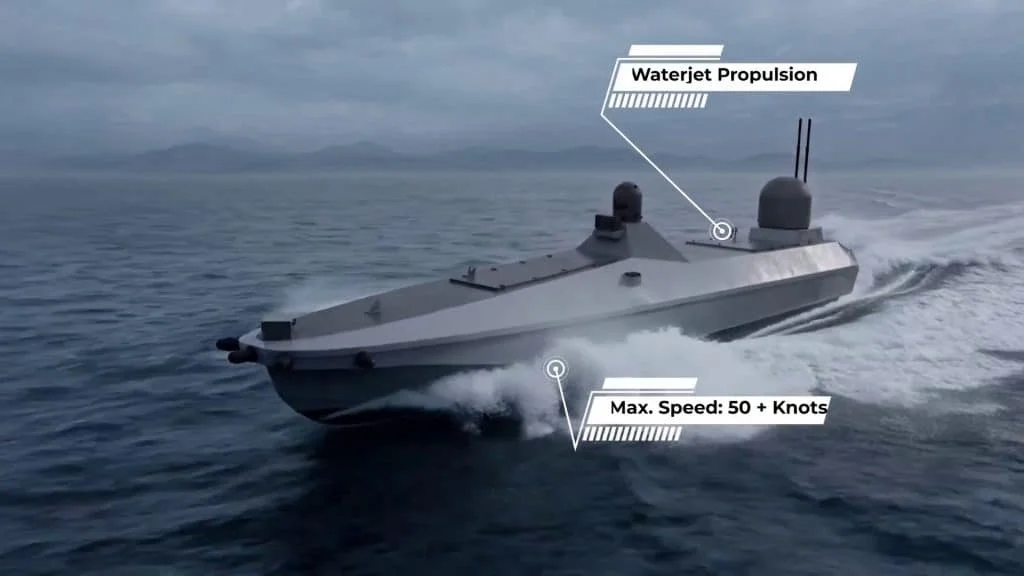
The second is the 100-boat domestic programme actually being contracted and delivered. The February 2026 committee decision authorised roughly 100 expendable attack USVs — Defense News reported a split of 40 ASELSAN/ARES TUFAN, 32 STM/Yonca YAKTU and 32 HAVELSAN/Sefine, which totals 104 and will be adjusted to fit a four-boat swarm doctrine. No contract value or delivery schedule has been published. If those boats are built at scale, Türkiye acquires something no other NATO member has: a serial production line for one-way attack USVs, which is the cheapest credible export product in the segment.
The third is weapons. The Qatari vessel carries a machine gun. The Turkish Navy’s own boats carry Cirit rockets and, in the ALBATROS-S case, a warhead. Whether Türkiye exports the missile-armed configurations, and to whom, determines whether this stays a patrol-boat business or becomes a strike business.
FAQ
Has Türkiye exported an armed unmanned surface vessel?
Yes, once. Qatar’s Ministry of Interior contracted one ULAQ 11 ISR/port-security vessel at Milipol Qatar in October 2024, reported by Janes at QAR 21.3 million (about $5.85 million), and it was delivered to the Qatar Coast Guard, reported in December 2025. No second armed-USV export customer has been publicly confirmed.
How many unmanned surface vessels does the Turkish Navy operate?
Five distinct types have been commissioned or are in service, according to Naval News: MARLIN, ULAQ, SALVO, ALBATROS-S and SANCAR. Hull counts per type are not consistently published, so the number of types is more reliable than the number of boats.
Are Turkish USVs cheaper than American ones?
They are in a different class. The one published Turkish figure is about $5.9 million for an armed 11-metre boat; the US Navy’s medium USV programme is costed at roughly $40 million a hull for 55-metre ships. The American small-boat tier, such as Saronic’s Corsair, is closer to Turkish pricing, but no official unit price has been released for it.
Which countries build armed USVs?
Israel (Rafael’s Protector), Türkiye (ULAQ, SALVO, SANCAR, ALBATROS-S, MARLIN), the United States (Saronic, HII and others under the MUSV programme) and Ukraine, whose designs are built for national use rather than export. France and the United Kingdom have programmes at prototype stage.
Is Türkiye buying one-way attack sea drones of its own?
Yes. The Defence Industry Executive Committee decided in February 2026 to procure roughly 100 expendable attack USVs. Defense News reported the allocation as 40 ASELSAN/ARES TUFAN, 32 STM/Yonca YAKTU and 32 HAVELSAN/Sefine boats, with the authorised total to be adjusted. Contract value and delivery dates have not been disclosed.
Have Turkish USVs been used in combat?
Not in a publicly documented engagement. Their record consists of live-fire trials, exercises such as TURNAs and the December 2025 TCG Anadolu demonstration in which a Bayraktar TB3 controlled an ALBATROS-S against a sea target. That is a capability record, not a combat record, and the distinction matters to buyers.
Sources
US Navy MUSV procurement and per-hull cost, DefenseScoop, 30 September 2026. Qatar ULAQ delivery, variant and weapon fit, Naval News, January 2026. SANCAR commissioning and the five-type count, Naval News, 25 February 2026. TB3-controlled ALBATROS-S strike from TCG Anadolu, Naval News, 4 December 2025. The 100-boat expendable USV decision and platform details, Defense News, 21 May 2026. DANAE shortlist and schedule, Naval News, October 2026. Turkish USV subsystem export contracts, Daily Sabah citing Anadolu Agency, 26 January 2026. Turkish procurement structure and programme authority, Presidency of Defence Industries (SSB). The QAR 21.3 million contract value and Major General al-Shafi’s remarks were first reported by Janes.