Türkiye’s Unmanned Boat Fleet Splits Into Three Camps

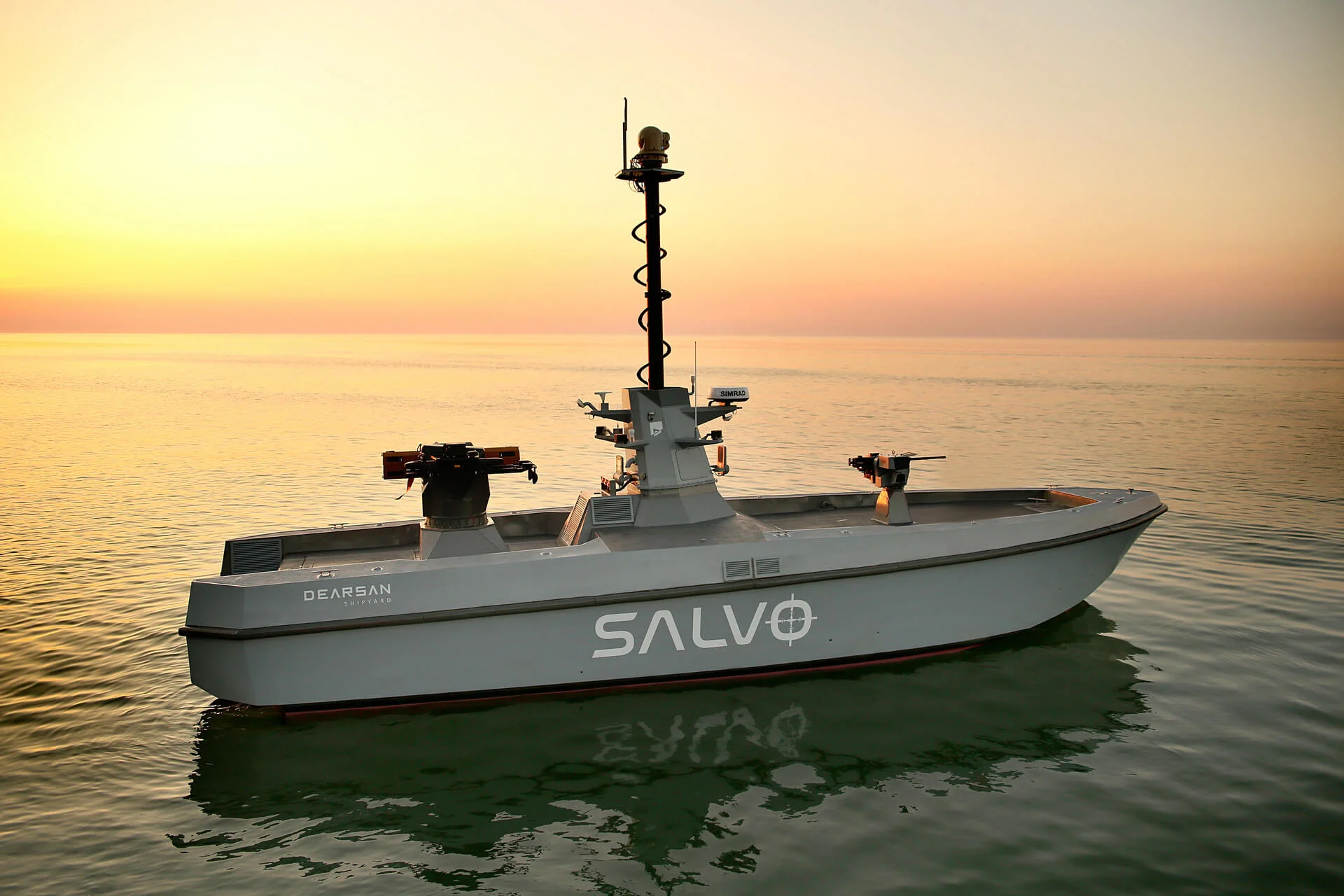
Turkish unmanned surface vessels are no longer a single project. Since the Defence Industry Agency (SSB) started funding prototype armed sea drones, three distinct design philosophies have emerged, each tied to a different shipyard and a different idea of what a robot boat is for. ULAQ from Ares Shipyard and Meteksan is the weapons carrier. MARLIN from Sefine Shipyard and Aselsan is the electronic warfare and sensor picket. SALVO from Dearsan is the fast, light striker that has already found a foreign user.
Putting them side by side is useful because the names are often used as if they were interchangeable. They are not. The hulls, the sensors and the intended jobs differ, and so do the customers.
Why Did Türkiye Build Several Sea Drones at Once?
The SSB did not pick one winner. According to Naval News reporting from 2022, the agency ran parallel efforts with separate shipyard and electronics partnerships. Ares and Meteksan worked on ULAQ, Dearsan on its USV 15 family that became SALVO, Yonca-Onuk and HAVELSAN on SANCAR, and Sefine and Aselsan on what became MARLIN.
The logic is familiar from other Turkish programmes. Competing prototypes keep several shipyards in the game, and the navy gets to compare real hulls before deciding what to order in numbers. For the shipyards, it is also a way to build an export catalogue while the domestic requirement is still taking shape. The wider yard picture is covered in our guide to who builds Türkiye’s warships.
What Makes ULAQ the Weapons Carrier?
ULAQ was the first of the group to appear. Ares Shipyard built the hull and Meteksan developed the mobile coastal control station, including mission electronics and software. Naval News reports that it was unveiled in October 2020, with sea trials completed in the first quarter of 2021. The base boat is about 11 metres long, reaches around 35 knots and has a reported range of 400 kilometres, with a payload capacity of up to 2 tonnes.
The anti-surface configuration was described with Cirit and UMTAS laser-guided missiles, while a harbour protection version carries a 12.7 mm remote weapon station and an anti-submarine version carries lightweight torpedoes. On 27 December 2022 the SSB signed a procurement contract with Ares and Meteksan covering ASuW and ASW variants, according to Naval News. The quantity was not stated in that report. Our earlier story on the armed ULAQ entering service covers the navy side of that step.
The family has grown since. Janes reported that the first phase of sea acceptance tests for an ASW variant, about 12 metres long with a shallow-water sonar derived from Ada-class corvette technology, had been completed. In March 2025 The Defense Post reported two further versions heading for naval delivery: the 12-metre ULAQ 12 for anti-surface work, and ULAQ KAMA, a 6.5-metre kamikaze boat said to carry a 200 kg charge. Both were described as still in testing at that point.
| Feature | ULAQ | MARLIN | SALVO |
|---|---|---|---|
| Builder | Ares Shipyard, Meteksan | Sefine Shipyard, Aselsan | Dearsan Shipyard |
| Length (reported) | about 11 m (base), 12 m (ULAQ 12, ASW) | about 15 m | about 14.8 m (USV 15), 11 m versions |
| Speed (reported) | about 35 knots | more than 35 knots | up to 60 knots |
| Main role | Armed strike, ASW, harbour security | Electronic warfare, ISR, ASW | Armed escort, strike, reconnaissance |
| Status | SSB contract Dec 2022, variants in test | Navy service since January 2024 | Unveiled Dec 2021, seen with Azerbaijan Aug 2025 |
Why Is MARLIN Treated as a Sensor and Jamming Platform?
MARLIN is the biggest of the three. Naval News describes a vessel of roughly 15 metres, with a top speed above 36 knots and the ability to operate in Sea State 4. Wikipedia cites a displacement of 21 tonnes and a 4-tonne payload, though those are secondary-source figures and the builders have kept endurance undisclosed.
What sets it apart is the mission suite. Naval News quotes the programme as carrying an electronic warfare package with both electronic support and electronic attack functions, which allows off-board jamming to protect warships. Payload options listed include radar, electro-optical sensors, sonobuoys, ESM, AIS and ADS-B receivers. This is where Aselsan, which supplies the mission systems, matters most. For the company’s wider electronics portfolio see our ASELSAN company profile.
The boat appeared at NATO’s Dynamic Messenger exercise in Portugal in September 2022, where it showed its electronic warfare role. The Turkish Navy received the first unit, hull number TCB-1101, in January 2024. Janes later noted it deployed alongside surface warships for the first time during a national exercise, and the platform has been reported to have test-fired a Kuzgun-KY missile in January 2023.
What Is SALVO, and Who Else Operates It?
Dearsan unveiled its USV 15 family on 23 December 2021, with the prototype called ATAK USV 15. Live-firing trials followed on 25 May 2022, according to Naval News. The 14.79-metre hull is built for speed, with 45 to 60 knots reported, and arms include a stabilised 12.7 mm machine gun and laser-guided Cirit missiles.
SALVO is the only one of the three with a clearly documented foreign sighting. The Defense Post reported that the Azerbaijani Navy showed a Salvo during a Caspian Sea exercise in August 2025 focused on protecting offshore energy infrastructure. That report said the exact acquisition date was unclear. For the co-production angle, our own coverage of Azerbaijan’s SALVO and KAYRA work with Dearsan goes into the industrial arrangement, and the yard’s earlier foreign record is in our piece on Dearsan’s Turkmenistan exports.
Can These Boats Operate as a Swarm?
That depends on communications more than hulls. A robot fleet that loses its link is a collection of expensive targets, so the control layer is arguably as important as the weapon on the deck. CTech, for instance, has shown a hybrid satellite link aimed at Turkish USV swarms, covered in our report on the CTech satcom system. The ULAQ KAMA description, with target selection that continues during communication outages, points the same way, although it is a manufacturer claim and not an independently verified capability.
How Do the Three Compare in Practice?
Think of it as a division of labour that has formed more by accident than by plan.
- ULAQ is the most weapon-centric, with the widest list of announced variants, from missiles to torpedoes to a one-way attack boat.
- MARLIN is larger and the most clearly integrated with a navy fleet, because its main value is electronic and sensor support for manned ships.
- SALVO trades size for speed and appears the easiest to export, given the Azerbaijani appearance.
Public data on actual numbers in service is thin. The SSB has not published fleet sizes, and several figures above come from manufacturer releases and trade press, so they should be read as reported. What is clear is that the navy now has working examples to learn from, and that the next decisions will be about quantities and integration, not whether Türkiye can build such boats.