TUFAN: Inside ASELSAN’s One-Way-Attack Swarm USV

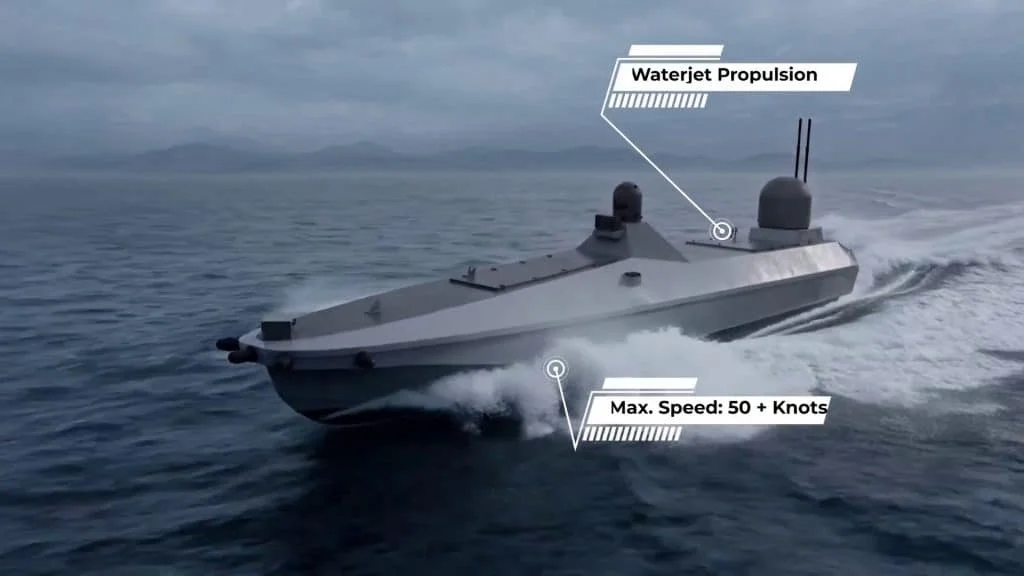
Naval trade publication Baird Maritime published a detailed vessel review this week of TUFAN, a Turkish one-way-attack unmanned surface vessel developed by ASELSAN and built by Ares Shipyard — one of the clearest technical profiles yet published of a drone boat Türkiye is building specifically to be expended against a target, not recovered.
TUFAN was first shown publicly at the SAHA EXPO defense fair in Istanbul in May 2026, alongside ASELSAN’s KILIÇ autonomous underwater strike system, and was demonstrated again at TEKNOFEST Mavi Vatan in August. Neither ASELSAN nor Ares Shipyard has announced a Turkish Armed Forces contract, a production quantity, a delivery schedule or an export customer for TUFAN. It has not entered service. What exists today is a tested, publicly marketed design that Türkiye is offering into a naval drone market that barely existed five years ago and that the Black Sea war has turned into one of the most closely watched segments in naval procurement.
What TUFAN Is Built to Do
ASELSAN and Ares Shipyard describe TUFAN as a planing-hull craft about 8 meters long with a 1.8-meter beam, powered by a waterjet propulsion system that the manufacturer rates at over 50 knots with a range of roughly 200 nautical miles. It carries a high-explosive payload reported at around 250 kilograms — in the same class as a single Mk 82 general-purpose bomb — fitted with detonating gear in the bow. The hull and electronics are designed to reduce both radar cross-section and thermal signature, lowering the craft’s probability of detection on approach.
Unlike Türkiye’s earlier unmanned surface vessels — ULAQ, SALVO and similar designs built around a reusable weapons station that fires a missile or rocket and returns to base — TUFAN is explicitly a one-way weapon. The vessel itself is the munition. ASELSAN has built the system around swarm coordination from the outset: TUFAN is designed to operate as part of a group of multiple craft, sharing targeting data so several boats can be committed against one target simultaneously, raising the probability that at least one scores a hit against point-defense systems trying to intercept an incoming boat.
Where TUFAN Sits in Türkiye’s Unmanned Boat Fleet
Türkiye now has several naval drone programs running in parallel, and DefenseTürkiye has previously mapped how that fleet splits into distinct camps: armed, reusable strike boats like Meteksan’s ULAQ, which went from an Antalya prototype to a Qatari export order; larger multi-role platforms like Dearsan’s SALVO; and now a distinct category of cheap, expendable one-way-attack craft that includes both TUFAN and MKE’s PİRANA, a similarly sized kamikaze USV that has been demonstrated repeatedly in Turkish Navy exercises, most recently during the TURNAs-2026 unmanned systems drill in late October. The distinction matters operationally: a reusable armed USV is a warship substitute, while an expendable one-way-attack craft is closer to a naval loitering munition that happens to travel on the surface instead of through the air.
Turkish defense trade reporting has described a Turkish Navy requirement for around 100 expendable unmanned surface vessels split across three industrial teams — ASELSAN with Ares Shipyard, STM, and HAVELSAN — under a program aimed at building swarm-strike capability at scale. DefenseTürkiye has not independently confirmed contract terms, unit allocations or a signing date for that program from an SSB or Turkish Navy source, and readers should treat the reported 100-unit figure as an industry estimate rather than a confirmed procurement contract until SSB or the Navy states otherwise.
Why a Cheap Boat Bomb Matters
The case for expendable attack USVs has been made largely by Ukraine’s war against Russia’s Black Sea Fleet, where remotely piloted explosive boats — built on a fraction of a warship’s budget — damaged or destroyed Russian vessels that no Ukrainian surface combatant could have approached. Turkish naval planners have drawn an explicit lesson from that experience: a swarm of $200,000-class expendable boats can threaten a warship costing hundreds of millions of dollars, forcing any adversary operating in the Eastern Mediterranean, Aegean or Black Sea to spend scarce close-in defense capacity countering cheap drones rather than conventional missiles.
For export customers, the appeal is similar to what has driven demand for Turkish loitering munitions and armed UAVs over the past five years: a credible asymmetric strike capability at a price point Western yards rarely offer, built by a supplier with no political strings attached to the sale. ASELSAN has not announced export interest in TUFAN specifically, but the company’s naval unmanned systems line — including PİRANA-class designs marketed through MKE and ASELSAN’s own KILIÇ underwater system — has already drawn attention from Gulf and Latin American buyers at exhibitions including SOFEX and Expodefensa.
What to Watch Next
The open questions are the ones that typically separate a trade-show demonstrator from a fielded weapon: a confirmed Turkish Navy order with a unit count and timeline, a live-fire test against a moving target rather than a static demonstration, and — eventually — an export contract with a named or at least officially acknowledged buyer. Until SSB, the Turkish Navy or ASELSAN confirms any of those, TUFAN remains what Baird Maritime’s review describes: a capable, combat-relevant design that Türkiye has built and shown, but not yet ordered into service.