SDT Builds the Recorders and Trainers Behind Turkish Aircraft

Most coverage of Türkiye’s defence electronics goes to the big names: radars, electronic warfare suites, missile seekers. Underneath them sits a layer of smaller firms that build the boxes nobody photographs, such as the recorder that logs a flight, the software that turns a training range into a scored exercise, or the guidance electronics inside a bomb kit. SDT Space and Defence Technologies, an Ankara company founded in 2005, works almost entirely in that layer.
This profile looks at what SDT actually sells, which Turkish platforms carry its hardware, and why a mid-sized supplier in this niche matters to the prime contractors that depend on it.
| Item | Detail |
|---|---|
| Company | SDT Uzay ve Savunma Teknolojileri A.Ş. (SDT Space and Defence Technologies Inc.) |
| Founded | February 2005 |
| Headquarters | Ankara, Türkiye (early years at the METU technology park) |
| Listing | Borsa İstanbul, ticker SDTTR, trading since 4 January 2023 |
| Main activities | Mission systems and data recording, radar and electronic warfare, simulation and training systems, guidance electronics, production programmes |
| Named customers | Turkish Aerospace (TUSAŞ), ASELSAN, Roketsan, HAVELSAN, FNSS, plus Turkish armed forces and security agencies |
| Certifications (per company site) | AS9100D, CMMI DEV, CMMI SPM |
Who Is SDT and Where Did It Start?
SDT was established in February 2005 as a product-focused engineering house. Its stated approach was to pick a few vertical areas where Türkiye had little domestic capacity and build real depth there, rather than chase every tender. The company lists five of them: sensor signal processing for radar, sonar and RF or infrared electronic warfare; image and pattern recognition; sensor data fusion and decision support; simulation and modelling; and mission management with digital data recording.
Early work leaned on research funding and subcontracting. SDT developed synthetic aperture radar (SAR) signal processing algorithms and real-time software for the ANKA unmanned aircraft, according to Defence Turkey magazine, and worked with ASELSAN on SAR development for naval and air force applications. It also served as a subcontractor to ASELSAN on ground station software and hardware for the Göktürk-I observation satellite programme. Its customer list from those years reads like a roll call of the Turkish industry: TUSAŞ, ASELSAN, Roketsan, HAVELSAN and FNSS.
Another early line was 3D visual modelling. The company has said it produced hundreds of platform and airbase models for the HELSIM helicopter simulator programmes, a quiet example of the simulation expertise that later grew into its training product lines.
What Does a Digital Data Recorder Do on a Military Aircraft?
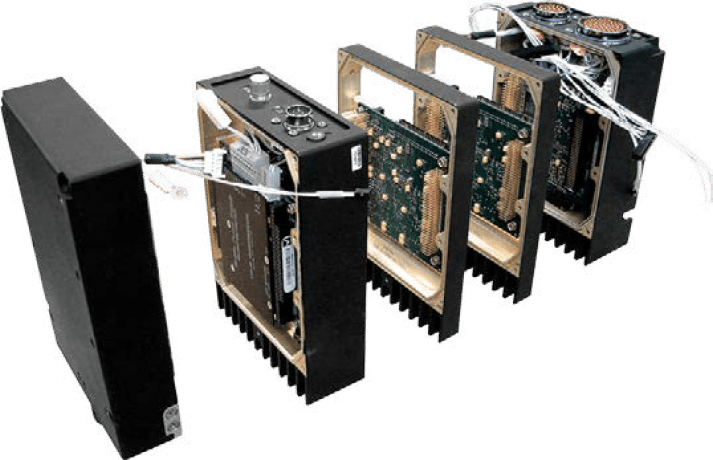
The recorder is SDT’s best-known product family, and the easiest way to understand the company. A military aircraft generates a constant stream of data on several buses at once, along with cockpit and sensor video and audio. Someone has to capture it, compress it, store it on removable media that survives rough handling, and then let engineers and instructors replay it on the ground.
According to SDT’s own product page, its Digital Data Recording System (DDR) accepts MIL-STD-1553B, ARINC 429, CAN and Ethernet data, along with video in formats such as PAL, NTSC, RS170, SDI, DVI and DisplayPort. The listed configuration includes a 512 GB removable SSD memory unit, four MIL-STD-1553 channels and several digital video inputs. Recordings are pulled out through USB, Ethernet or SATA to a ground support computer, and a debriefing station supports post-flight analysis. Event marking and secure data purging are listed as features, and the company says a railway adaptation exists for civilian use.
Defence Turkey reported that SDT recorders had been fielded across more than 200 platforms. Named programmes include the T-38 trainer modernisation, the ASELPOD targeting pod, the ANKA unmanned aircraft and the ATAK helicopter. That figure comes from the magazine’s account of the company, and SDT’s own pages do not repeat it in the same form, so treat it as reported rather than audited.
The same family branches into related boxes: an airborne computer that runs moving map and 3D video applications, a flight data recorder acting as the aircraft’s black box, a platform health management unit that tracks abnormal conditions and life-limited parts, and a missile data acquisition unit that stores telemetry and seeker imagery on a 32 GB ruggedised module. A symbology generator based on FPGA and DSP hardware puts critical flight data on a single display.
How Does SDT Handle Simulation and Combat Training?
The second pillar is what the company calls simulation systems and information technologies. Its website groups the products into air combat training, land combat training and naval combat training systems, with an ACMI pod and data link set among the radar and communication offerings.
The logic is straightforward. A training range needs to know where every participant is, what it fired and what it hit. Instrumentation on the platforms, a data link back to the ground, and software that reconstructs the engagement make that possible. The recorders described above feed the same chain from the other end, supplying the evidence instructors use in the debrief. That overlap is the commercial point: SDT can sell the on-board recording and the ground-side analysis as one coherent package instead of two unrelated contracts.
Public detail on individual training contracts is thin, and SDT does not publish most customer names for these programmes. Anyone looking for delivery numbers or contract values will not find them on the company’s pages, and this article does not guess at them.
What Else Is in the Product Range?
Over the years SDT has moved from pure engineering services into production. Its site now carries a separate production-programmes section whose entries include:
- Guidance kit electronics, covering the precision guidance kit (PGK) and wing-assisted guidance kit (WGK) electronics used in smart munition conversions.
- RF jammers, in manpack and vehicle-mounted versions.
- A tactical mobile anti-drone rifle system, a modular, battery-powered jammer with directional and omni-directional antenna options that targets GNSS signals, drone control links and data links. The company calls it field proven but names no customers.
- Aircraft arresting systems, a mechanical product far from the electronics core.
- Missile-side electronics, including fire control units, interface units and launcher remote control equipment.
The jammer line connects SDT to a wider trend. Türkiye’s counter-drone market has grown quickly, and our piece on how Türkiye turned the drone threat into an export product line shows how many firms, large and small, now compete in it. SDT’s advantage is that its electronics and signal processing background predates the rush.
How Does SDT Fit Beside the Large Primes?
The big integrators build the platform and own the programme. ASELSAN owns most of the radar and electronic warfare business, and the market map in Who Builds Türkiye’s Radars shows how concentrated it is. SDT’s role is different. It is a supplier and partner that fills specific capability gaps: a recorder that meets a military interface standard, a signal processing chain, a training data link.
For a prime, buying such a subsystem from a domestic specialist avoids two problems. Foreign recorders and mission computers can bring export licence and integration friction, and a prime’s own engineers are usually better spent on the core sensor or weapon. For the supplier, the risk is the reverse: dependence on a handful of large customers, and project-based revenue that can swing from quarter to quarter.
The same pattern shows up in other parts of the Ankara ecosystem. HAVELSAN’s simulator business sits at the large end of simulation, while SDT works on instrumentation and data-side components. The unmanned systems that carry SDT hardware, covered in our look at ANKA operators, also show where its products travel once platforms are exported, though export deliveries of SDT’s own equipment are not itemised publicly.
Why Did SDT Go Public, and What Has Followed?
SDT began trading on Borsa İstanbul under the code SDTTR on 4 January 2023. According to the exchange’s announcement, the offering raised 392 million lira, with individual applications covering the allocation roughly eleven times over and institutional demand reported at about 36 times. The exchange described it as the second defence-industry company to list.
Reports around the offering said management wanted to lift the export share of revenue from about 5 percent toward 30 percent by 2025 and to roughly double annual turnover. Those figures were company targets as reported in the Turkish financial press at the time, and this article cannot confirm whether they were met. Investors and readers wanting current results should check SDT’s filings in the investor relations section of its website, which carries financial reports, activity reports and investor presentations.
This is background information only, not investment guidance. A listing mainly changes how visible the company is and how it can finance production capacity; it does not by itself change what the products do.
What Should You Watch Next?
SDT’s recent news page shows the company exhibiting at a steady run of international shows, including IDEF 2025, ADEX 2025, LIMA 2025, Indo Defence 2025, FEINDEF 2025, DSA 2026 and SAHA 2026. Show attendance is not a contract, but it does indicate where the sales team is looking: Southeast Asia, Gulf and European markets as well as home.
Three questions will decide whether the company moves up a tier. First, whether its guidance kit electronics and jammers convert from demonstration to repeat orders. Second, whether training and instrumentation work lands a flagship customer that can be named publicly. Third, whether its recorders and mission computers appear on newer Turkish platforms as they enter service, rather than only on the programmes that made its reputation.
For now SDT is a good case study in how Türkiye’s defence supply chain is built. The headline systems get the attention, but a recorder in a trainer or a signal processing chain in a drone radar is what lets those programmes run on domestic engineering.